The text
Tap Recite along to follow verse by verse — use Next, or the arrow keys.
- Opening dohas
- Doha 1
बन्दउ माँ शाकम्भरी चरणगुरू का धरकर ध्यान, शाकम्भरी माँ चालीसा का करे प्रख्यान॥
bandau mā̃ śākambharī caraṇaguru kā dharakara dhyāna, śākambharī mā̃ cālīsā kā kare prakhyāna॥
I bow to Mother Shakambhari, holding meditation on the guru at her feet; may this Shakambhari Chalisa become renowned.
- Doha 2
आनंदमयी जगदम्बिका अनन्तरूप भण्डार, माँ शाकम्भरी की कृपा बनी रहे हर बार॥
ānaṃdamayī jagadambikā anantarūpa bhaṇḍāra, mā̃ śākambharī kī kṛpā banī rahe hara bāra॥
Blissful Jagadambika, treasury of infinite forms — may Mother Shakambhari's grace remain with me always.
- The 47 chaupais
- Chaupai 1
शाकम्भरी माँ अति सुखकारी।पूर्ण ब्रह्म सदा दुःखहारी॥
śākambharī mā̃ ati sukhakārī।pūrṇa brahma sadā duḥkhahārī॥
Mother Shakambhari, giver of great happiness; the complete Brahman, ever the remover of sorrow.
- Chaupai 2
कारण करण जगत की दाता।आनन्द चेतन विश्व विधाता॥
kāraṇa karaṇa jagata kī dātā।ānanda cetana viśva vidhātā॥
Giver and cause of the world's causes; blissful consciousness, creator of the universe.
- Chaupai 3
अमर जोत है मात तुम्हारी।तुम ही सदा भगतन हितकारी॥
amara jota hai māta tumhārī।tuma hī sadā bhagatana hitakārī॥
Your flame, Mother, is immortal; you alone are ever the well-wisher of your devotees.
- Chaupai 4
महिमा अमित अथाह अपर्णा।ब्रह्म हरि हर मात अपर्णा॥
mahimā amita athāha aparṇā।brahma hari hara māta aparṇā॥
Your glory is boundless and unfathomable, Aparna; Brahma, Hari, and Hara — you are their Mother, Aparna.
- Chaupai 5
ज्ञान राशि हो दीन दयाली।शरणागत घर भरती खुशहाली॥
jñāna rāśi ho dīna dayālī।śaraṇāgata ghara bharatī khuśahālī॥
You are a heap of wisdom, compassionate to the humble; you fill with prosperity the home of whoever takes refuge in you.
- Chaupai 6
नारायणी तुम ब्रह्म प्रकाशी।जल-थल-नभ हो अविनाशी॥
nārāyaṇī tuma brahma prakāśī।jala-thala-nabha ho avināśī॥
Narayani, you are the radiance of Brahman, imperishable in water, on land, and in the sky.
- Chaupai 7
कमल कान्तिमय शान्ति अनपा।जोतमन मर्यादा जोत स्वरूपा॥
kamala kāntimaya śānti anapā।jotamana maryādā jota svarūpā॥
Your peace is lotus-radiant and matchless; your very form is boundless light, its own measure and law.
- Chaupai 8
जब-जब भक्तों ने है ध्याई।जोत अपनी प्रकट हो आई॥
jaba-jaba bhaktoṃ ne hai dhyāī।jota apanī prakaṭa ho āī॥
Whenever devotees have meditated upon you, your own light has come forth and appeared.
- Chaupai 9
प्यारी बहन के संग विराजे।मात शताक्षि संग ही साजे॥
pyārī bahana ke saṅga virāje।māta śatākṣi saṅga hī sāje॥
You dwell together with your beloved sister; Mother, you are adorned in the company of Shatakshi.
- Chaupai 10
भीम भयंकर रूप कराली।तीसरी बहन की जोत निराली॥
bhīma bhayaṃkara rūpa karālī।tīsarī bahana kī jota nirālī॥
Terrible and fearsome is your form, O fierce one; unique is the light of your third sister.
- Chaupai 11
चौथी बहन भ्रामरी तेरी।अद्भुत चंचल चित्त चितेरी॥
cauthī bahana bhrāmarī terī।adbhuta caṃcala citta citerī॥
Your fourth sister is Bhramari — wondrous, restless, a painter of the heart.
- Chaupai 12
सम्मुख भैरव वीर खड़ा है।दानव दल से खूब लड़ा है॥
sammukha bhairava vīra khaḍā hai।dānava dala se khūba laḍā hai॥
Before you stands the hero Bhairava, who has fought fiercely against the demon hosts.
- Chaupai 13
शिव शंकर प्रभु भोले भण्डारी।सदा रहे सन्तन हितकारी॥
śiva śaṅkara prabhu bhole bhaṇḍārī।sadā rahe santana hitakārī॥
Lord Shiva Shankar, the guileless treasurer, ever remains the well-wisher of saints.
- Chaupai 14
हनुमत माता लौकड़ा तेरा।सदा शाकम्भरी माँ का चेरा॥
hanumata mātā laukaḍ़ā terā।sadā śākambharī mā̃ kā cerā॥
Mother, Hanuman himself is your Laukada — ever the servant of Mother Shakambhari.
- Chaupai 15
हाथ ध्वजा हनुमान विराजे।युद्ध भूमि में माँ संग साजे॥
hātha dhvajā hanumāna virāje।yuddha bhūmi meṃ mā̃ saṅga sāje॥
Hanuman stands with a banner in hand, adorning the battlefield at your side, Mother.
- Chaupai 16
कालरात्रि धारे कराली।बहिन मात की अति विकराली॥
kālarātri dhāre karālī।bahina māta kī ati vikarālī॥
You bear the form of Kalaratri, fierce and dreadful — the Mother's most terrifying sister.
- Chaupai 17
दश विद्या नव दुर्गा आदि।ध्याते तुम्हें परमार्थ वादि॥
daśa vidyā nava durgā ādi।dhyāte tumheṃ paramārtha vādi॥
The ten Mahavidyas, the nine Durgas, and others — speakers of ultimate truth — meditate upon you.
- Chaupai 18
अष्ट सिद्धि गणपति जी दाता।बाल रूप शरणागत माता॥
aṣṭa siddhi gaṇapati jī dātā।bāla rūpa śaraṇāgata mātā॥
Ganapati, giver of the eight siddhis, in his child-form takes refuge in you, Mother.
- Chaupai 19
माँ भंडारे के रखवारी।प्रथम पूजने की अधिकारी॥
mā̃ bhaṃḍāre ke rakhavārī।prathama pūjane kī adhikārī॥
Mother, guardian of the storehouse — you alone hold the right to be worshipped first.
- Chaupai 20
जग की एक भ्रमण की कारण।शिव शक्ति हो दुष्ट विदारण॥
jaga kī eka bhramaṇa kī kāraṇa।śiva śakti ho duṣṭa vidāraṇa॥
You are the one cause behind the world's turning; Shiva's own Shakti, destroyer of the wicked.
- Chaupai 21
भूरा देव लौकडा दूजा।जिसकी होती पहली पूजा॥
bhūrā deva laukaḍā dūjā।jisakī hotī pahalī pūjā॥
Bhura Dev is your second Laukada, the one worshipped first at your shrine.
- Chaupai 22
बली बजरंगी तेरा चेरा।चले संग यश गाता तेरा॥
balī bajaraṅgī terā cerā।cale saṅga yaśa gātā terā॥
The mighty Bajrangi (Hanuman) is your servant; he walks at your side, singing your glory.
- Chaupai 23
पांच कोस की खोल तुम्हारी।तेरी लीला अति विस्तारी॥
pāṃca kosa kī khola tumhārī।terī līlā ati vistārī॥
Your sacred enclosure spans five kos; your divine play is vast beyond measure.
- Chaupai 24
रक्त दन्तिका तुम्हीं बनी हो।रक्त पान कर असुर हनी हो॥
rakta dantikā tumhī̃ banī ho।rakta pāna kara asura hanī ho॥
You yourself became Raktadantika, slaying demons by drinking their blood.
- Chaupai 25
रक्तबीज का नाश किया था।छिन्न मस्तिका रूप लिया था॥
raktabīja kā nāśa kiyā thā।chinna mastikā rūpa liyā thā॥
You destroyed Raktabija, taking on the form of Chhinnamastika.
- Chaupai 26
सिद्ध योगिनी सहस्या राजे।सात कुण्ड में आप विराजे॥
siddha yoginī sahasyā rāje।sāta kuṇḍa meṃ āpa virāje॥
Accomplished Yoginis attend you in their thousands; you reside amid seven sacred kundas.
- Chaupai 27
रूप मराल का तुमने धारा।भोजन दे दे जन जन तारा॥
rūpa marāla kā tumane dhārā।bhojana de de jana jana tārā॥
You took on the form of a swan, giving food to save people, one by one.
- Chaupai 28
शोक पात से मुनि जन तारे।शोक पात जन दुःख निवारे॥
śoka pāta se muni jana tāre।śoka pāta jana duḥkha nivāre॥
You saved sages and people through your fall of tears in sorrow; that same fall of tears removed the people's suffering.
- Chaupai 29
भद्र काली कमलेश्वर आई।कान्त शिवा भगतन सुखदाई॥
bhadra kālī kamaleśvara āī।kānta śivā bhagatana sukhadāī॥
As Bhadrakali and Kamaleshwari you have come; Shiva's beloved own, giver of joy to your devotees.
- Chaupai 30
भोग भण्डार हलवा पूरी।ध्वजा नारियल तिलक सिंदूरी॥
bhoga bhaṇḍāra halavā pūrī।dhvajā nāriyala tilaka siṃdūrī॥
Halwa and puri fill your offering-store; a flag, a coconut, tilak, and vermillion mark your worship.
- Chaupai 31
लाल चुनरी लगती प्यारी।ये ही भेंट ले दुःख निवारी॥
lāla cunarī lagatī pyārī।ye hī bheṃṭa le duḥkha nivārī॥
A red chunari looks lovely upon you; accepting just this offering, you remove our sorrow.
- Chaupai 32
अंधे को तुम नयन दिखाती।कोढ़ी काया सफल बनाती॥
aṃdhe ko tuma nayana dikhātī।koḍhī kāyā saphala banātī॥
You give sight to the blind; you make whole the body of the leper.
- Chaupai 33
बाँझन के घर बाल खिलाती।निर्धन को धन खूब दिलाती॥
bā̃jhana ke ghara bāla khilātī।nirdhana ko dhana khūba dilātī॥
You make children play in the homes of the childless; you grant the poor abundant wealth.
- Chaupai 34
सुख दे दे भगत को तारे।साधु सज्जन काज संवारे॥
sukha de de bhagata ko tāre।sādhu sajjana kāja saṃvāre॥
Giving happiness, you save your devotees; you set right the affairs of the saintly and the good.
- Chaupai 35
भूमण्डल से जोत प्रकाशी।शाकम्भरी माँ दुःख की नाशी॥
bhūmaṇḍala se jota prakāśī।śākambharī mā̃ duḥkha kī nāśī॥
Your light shines across the whole earth; Mother Shakambhari, destroyer of sorrow.
- Chaupai 36
मधुर मधुर मुस्कान तुम्हारी।जन्म जन्म पहचान हमारी॥
madhura madhura muskāna tumhārī।janma janma pahacāna hamārī॥
Sweet, so sweet is your smile; birth after birth, it is what we know you by.
- Chaupai 37
चरण कमल तेरे बलिहारी।जै जै जै जग जननी तुम्हारी॥
caraṇa kamala tere balihārī।jai jai jai jaga jananī tumhārī॥
I am devoted to your lotus feet; victory, victory, victory to you, Mother of the world.
- Chaupai 38
कांता चालीसा अति सुखकारी।संकट दुःख दुविधा टारी॥
kāṃtā cālīsā ati sukhakārī।saṃkaṭa duḥkha duvidhā ṭārī॥
Kanta's Chalisa brings great happiness; it turns aside distress, sorrow, and doubt.
- Chaupai 39
जो कोई जन चालीसा गावे।मात कृपा अति सुख पावे॥
jo koī jana cālīsā gāve।māta kṛpā ati sukha pāve॥
Whoever sings this Chalisa obtains, by the Mother's grace, great happiness.
- Chaupai 40
कान्ता प्रसाद जगाधरी वासी।भाव शाकम्भरी तत्त्व प्रकाशी॥
kāṃtā prasāda jagādharī vāsī।bhāva śākambharī tattva prakāśī॥
Kanta Prasad, a resident of Jagadhri, sets forth in devotion the true nature of Shakambhari.
- Chaupai 41
बार बार कहें कर जोरी।विनती सुन शाकम्भरी मोरी॥
bāra bāra kahe kara jorī।vinatī suna śākambharī morī॥
Again and again, with joined hands, I say — hear my plea, O Shakambhari.
- Chaupai 42
मैं सेवक हूँ दास तुम्हारा।जननी करना भव निस्तारा॥
maiṃ sevaka hū̃ dāsa tumhārā।jananī karanā bhava nistārā॥
I am your servant, your slave; Mother, carry me across this worldly existence.
- Chaupai 43
यह सौ बार पाठ करे कोई।मातु कृपा अधिकारी सोई॥
yaha sau bāra pāṭha kare koī।mātu kṛpā adhikārī soī॥
Whoever recites this a hundred times becomes entitled to the Mother's grace.
- Chaupai 44
संकट कष्ट को मात निवारे।शोक मोह शत्रुन संहारे॥
saṃkaṭa kaṣṭa ko māta nivāre।śoka moha śatruna saṃhāre॥
The Mother removes distress and hardship; she destroys grief, delusion, and enemies.
- Chaupai 45
निर्धन धन सुख सम्पत्ति पावे।श्रद्धा भक्ति से चालीसा गावे॥
nirdhana dhana sukha sampatti pāve।śraddhā bhakti se cālīsā gāve॥
The poor obtain wealth, happiness, and prosperity by singing this Chalisa with faith and devotion.
- Chaupai 46
नौ रात्रों तक दीप जगावे।सपरिवार मगन हो गावे॥
nau rātroṃ taka dīpa jagāve।saparivāra magana ho gāve॥
Whoever keeps a lamp burning through the nine nights, and sings this joyfully together with their family,
- Chaupai 47
प्रेम से पाठ करे मन लाई।कान्त शाकम्भरी अति सुखदाई॥
prema se pāṭha kare mana lāī।kāṃta śākambharī ati sukhadāī॥
and recites it with love, with their whole mind fixed on it — to them, says Kanta, Shakambhari grants the greatest joy.
- Closing dohas
- Doha (closing) 1
दुर्गासुर संहारणी करणि जग के काज, शाकम्भरी जननि शिवे रखना मेरी लाज॥
durgāsura saṃhāraṇī karaṇi jaga ke kāja, śākambharī janani śive rakhanā merī lāja॥
O slayer of the demon Durgasura, doer of the world's work — Mother Shakambhari, Shakti of Shiva, preserve my honor.
- Doha (closing) 2
युग युग तक व्रत तेरा करे भक्त उद्धार, वो ही तेरा लाड़ला आवे तेरे द्वार॥
yuga yuga taka vrata terā kare bhakta uddhāra, vo hī terā lāḍalā āve tere dvāra॥
Age after age, your vow delivers your devotees; it is they, your beloved children, who come to your door.
Overview
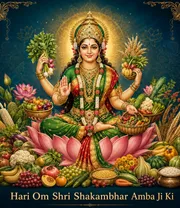
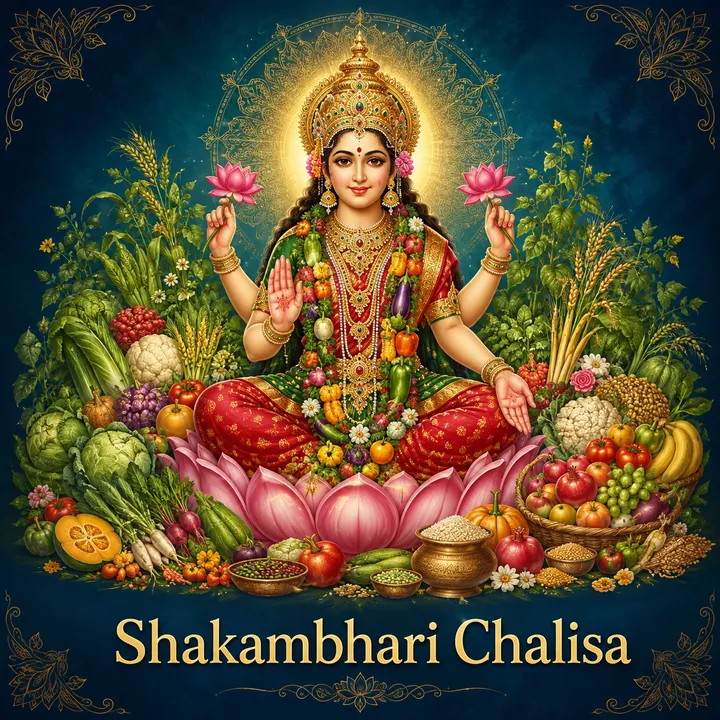
The Shakambhari Chalisa is a Hindi devotional composition of two opening dohas, forty-seven chaupai couplets, and two closing dohas, addressed to Shakambhari, the form of Devi described in the Devi Mahatmyam as the sustainer of vegetation and grain during a great drought. Unlike many chalisas on this site, this one carries an internal signature: its own closing verses name the poet as Kanta Prasad, a resident of Jagadhri, and the composition twice refers to itself as “Kanta’s Chalisa.” The text moves between grand, cosmic praise — calling Shakambhari the ground of Brahma, Vishnu, and Shiva — and highly local devotional detail: a company of named sister-goddesses, guardian figures called Lokada at her shrine, a “five-kos” sacred enclosure, and the offerings (halwa, puri, a coconut, a red chunari) proper to her worship, all pointing to a specific, place-rooted Shakambhari shrine tradition rather than a purely pan-Indian one.
Origin and source
This page’s text is cross-checked against two independently produced sources that agree closely enough to confirm the same underlying composition while still differing in small, expected ways. The primary source is sanskritdocuments.org’s archival transcription (in its Hindi devii collection, filed under shAkambharIchAlisA1), a long-running Sanskrit- and Hindi-text archive rather than a lyrics site. The second is a scan of a printed devotional anthology — pages 272 through 277, running head “श्री शाकम्भरी चालीसा” — that was published as an image gallery on chalisa.co.in from 2014 into at least 2019 and survives today only via the Wayback Machine; the live chalisa.co.in page has since been overwritten with unrelated, thin content unconnected to this chalisa. Notably, sanskritdocuments.org’s own metadata for this text cites chalisa.co.in as one of its two references, so the print scan is likely close to the transcription’s own source rather than a separate, unrelated witness — but as a photographed book page it cannot be a copy of sanskritdocuments.org’s HTML, and it independently corroborates the composition’s wording, its forty-seven-couplet length, and its closing signature.
The two sources differ at a handful of points in the way expected of two separately produced texts of the same orally- and print-transmitted composition, rather than a single lineage copied twice: the scan clearly and legibly reads “अर्पणा” where sanskritdocuments.org has “अपर्णा” (Aparna, the well-known epithet of Parvati, kept here as the more coherent reading in a line listing Brahma-Vishnu-Shiva); the scan’s “कम्पलेश्वर” versus “कमलेश्वर” (kept here, fitting the lotus imagery used elsewhere in the text); and the scan visibly prints “जो कोई जन चालीसा गावे, मात कृपा अति सुख पावे” as two consecutive, identical lines where sanskritdocuments.org has it once (an apparent print duplication, not treated here as a distinct forty-eighth verse). Sanskritdocuments.org’s own text also has one internal inconsistency the scan resolves cleanly — “आंनद चेतन विश्वविधाता” against the scan’s coherent “आनन्द चेतन विश्व विधाता” — and this page follows the scan at that one point. As with this site’s Mahakali Chalisa, the traditional “forty” in the name does not match the actual count of chaupai couplets; both sources agree on forty-seven.
The same scanned anthology’s page 277 carries a short aarti, “आरती श्री शाकम्भरी देवी जी की,” matching — independently confirming, in fact — this site’s separate Hari Om Shri Shakambhar Amba Ji Ki aarti page. This page does not reuse that aarti’s verse text; the two remain separate items despite sharing a source document.
The Durgasura epithet and Durga
This chalisa’s closing doha addresses Shakambhari as “दुर्गासुर संहारणी” — slayer of the demon Durgasura — an epithet both sources agree on (the scan spaces it as “दुर्गा सुर” rather than as one word, but plainly names the same figure). Devotional and Puranic tradition in places ties the Goddess’s name “Durga” itself to a story of her defeating a demon by a very similar name, which is the basis for this page linking Shakambhari to this site’s Durga entry — a more direct, text-internal basis than the general Shakta identification of every Devi form with a single Goddess used more loosely elsewhere. The same doha also calls her “शिवे,” Shiva’s own Shakti, reinforcing the same identification.
How it is recited
The composition itself describes its own use: Chaupai 43 promises grace to whoever recites it a hundred times, and Chaupai 46 describes keeping a lamp lit for nine nights while reciting it with one’s family — a description of Shakambhari Navratri, the nine days of worship that run from Pausha Shukla Ashtami (also called Banada Ashtami) to the following full moon, Shakambhari Purnima, held to mark the Goddess’s incarnation as Shakambhari to end a great famine. As with other chalisas, reciters conventionally close a reading with the exclamation “जय शाकंभरी माँ की जय” (“Victory to Mother Shakambhari”), which appears in the source documents but is not treated here as part of the fixed verse text.
Frequently asked questions
How many verses does Shakambhari Chalisa have?
Who is Shakambhari Chalisa dedicated to?
When is Shakambhari Chalisa typically recited?
What language is Shakambhari Chalisa composed in?
What tradition is Shakambhari Chalisa associated with?
Is an English translation of Shakambhari Chalisa available?
Is there a Roman transliteration of Shakambhari Chalisa?
Sourcing
Checked against independent sources before publishing — see our sourcing and editorial policy. Spotted an error? Report an issue .