The text
Tap Recite along to follow verse by verse — use Next, or the arrow keys.
- Stanza 1 (opening)
जय लक्ष्मी रमणा, स्वामी जय लक्ष्मी रमणा।सत्यनारायण स्वामी, जन पातक हरणा॥जय लक्ष्मी रमणा।
jaya lakṣmī ramaṇā, svāmī jaya lakṣmī ramaṇā।satyanārāyaṇa svāmī, jana pātaka haraṇā॥jaya lakṣmī ramaṇā।
Victory to the beloved of Lakshmi, victory to you, O Lord, beloved of Lakshmi. Lord Satyanarayan, remover of your devotees' sins. Victory to the beloved of Lakshmi.
- Stanza 2
रत्न जड़ित सिंहासन, अद्भुत छवि राजै।नारद करत निराजन, घंटा ध्वनि बाजै॥जय लक्ष्मी रमणा।
ratna jaḍita sinhāsana, adbhuta chavi rājai।nārada karata nirājana, ghaṇṭā dhvani bājai॥jaya lakṣmī ramaṇā।
On a jewel-studded throne, a wondrous splendor shines; Narada performs your lamp-waving worship, as temple bells resound. Victory to the beloved of Lakshmi.
- Stanza 3
प्रगट भये कलि कारण, द्विज को दर्श दियो।बूढ़ो ब्राह्मण बनकर, कंचन महल कियो॥जय लक्ष्मी रमणा।
pragaṭa bhaye kali kāraṇa, dvija ko darśa diyo।būṛho brāhmaṇa banakara, kañcana mahala kiyo॥jaya lakṣmī ramaṇā।
For the sake of the Kali age you appeared, and gave a poor Brahmin your vision; taking the form of an old Brahmin, you turned his home into a golden palace. Victory to the beloved of Lakshmi.
- Stanza 4
दुर्बल भील कठारो, जिन पर कृपा करी।चन्द्रचूड़ एक राजा, तिनकी विपत्ति हरी॥जय लक्ष्मी रमणा।
durbala bhīla kaṭhāro, jina para kṛpā karī।candracūṛa eka rājā, tinakī vipatti harī॥jaya lakṣmī ramaṇā।
On a poor, hard-pressed woodcutter you showed your grace; and for King Chandrachud, you removed all misfortune. Victory to the beloved of Lakshmi.
- Stanza 5
वैश्य मनोरथ पायो, श्रद्धा तज दीनी।सो फल भोग्यो प्रभुजी, फिर स्तुति कीनी॥जय लक्ष्मी रमणा।
vaiśya manoratha pāyo, śraddhā taja dīnī।so phala bhogyo prabhujī, phira stuti kīnī॥jaya lakṣmī ramaṇā।
A merchant obtained his wish, then let his faith and devotion lapse; he bore the consequence of that, O Lord, and afterward praised you again. Victory to the beloved of Lakshmi.
- Stanza 6
भाव भक्ति के कारण, छिन-छिन रूप धरयो।श्रद्धा धारण कीनी, तिनको काज सरयो॥जय लक्ष्मी रमणा।
bhāva bhakti ke kāraṇa, china-china rūpa dharayo।śraddhā dhāraṇa kīnī, tinako kāja sarayo॥jaya lakṣmī ramaṇā।
For the sake of loving devotion, you took on a different form each time; and for those who held to their faith, you brought their work to fulfillment. Victory to the beloved of Lakshmi.
- Stanza 7
ग्वाल-बाल संग राजा, वन में भक्ति करी।मनवांछित फल दीन्हों, दीनदयाल हरी॥जय लक्ष्मी रमणा।
gvāla-bāla saṅga rājā, vana meṃ bhakti karī।manavāñchita phala dīnhoṃ, dīnadayāla hari॥jaya lakṣmī ramaṇā।
Together with cowherd boys, a king performed devotion in the forest; and Hari, ever compassionate to the humble, granted him the fruit of his heart's desire. Victory to the beloved of Lakshmi.
- Stanza 8
चढ़त प्रसाद सवायो, कदली फल मेवा।धूप दीप तुलसी से, राजी सत्यदेवा॥जय लक्ष्मी रमणा।
chaṛhata prasāda savāyo, kadalī phala mevā।dhūpa dīpa tulasī se, rājī satyadevā॥jaya lakṣmī ramaṇā।
Offerings are made in abundance — bananas and dried fruit; with incense, lamp, and tulsi, the true Lord is well pleased. Victory to the beloved of Lakshmi.
- Stanza 9 (closing)
श्री सत्यनारायण जी की आरती, जो कोई नर गावै।ऋद्धि-सिद्धि सुख-संपत्ति, सहज रूप पावे॥जय लक्ष्मी रमणा, स्वामी जय लक्ष्मी रमणा।सत्यनारायण स्वामी, जन पातक हरणा॥
śrī satyanārāyaṇa jī kī āratī, jo koī nara gāvai।ṛddhi-siddhi sukha-sampatti, sahaja rūpa pāve॥jaya lakṣmī ramaṇā, svāmī jaya lakṣmī ramaṇā।satyanārāyaṇa svāmī, jana pātaka haraṇā॥
Whoever sings this aarti of Shri Satyanarayan will easily receive prosperity and well-being. Victory to the beloved of Lakshmi, victory to you, O Lord, beloved of Lakshmi; Lord Satyanarayan, remover of your devotees' sins.
Overview
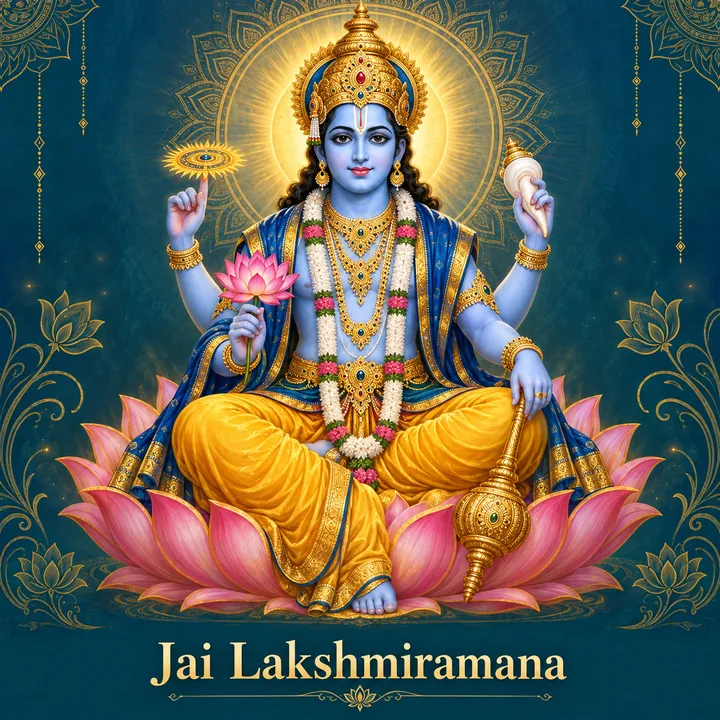
Jai Lakshmiramana is a Hindi aarti of nine stanzas sung to Satyanarayan, addressed in its opening line as “Lakshmiramana” — the beloved of Lakshmi, an epithet of Vishnu. Each stanza closes with a short refrain of the opening line, and the aarti as a whole is sung at the conclusion of the Satyanarayan Katha and Puja, most often on a Purnima (full moon) evening.
Origin and source
Satyanarayan is understood in Vaishnav tradition as a form of Vishnu, worshipped through the Satyanarayan Vrat and Katha — a set of stories, most often five in number, describing a poor Brahmin, a woodcutter, a merchant, and a king, each of whom is rewarded for keeping faith with a vow to worship Satyanarayan and who suffers a setback after neglecting it. The earliest known account of this worship appears in the Reva Khanda of the Skanda Purana, with the puja also described in the Bhavishya Purana; the aarti’s own stanzas retell these same episodes — the poor Brahmin given a golden palace, the woodcutter and King Chandrachud relieved of hardship, and the merchant who let his devotion lapse and paid the price for it before returning to praise. Some scholars of Bengali religious history have traced Satyanarayan worship to an earlier, syncretic figure, Satya Pir, venerated by both Hindus and Muslims in Bengal, with the Puranic Satyanarayan katha developing over time as a Sanskritized, Vaishnav-framed version of that devotion. This is a scholarly account of the tradition’s history rather than a claim made within Vaishnav practice itself, where Satyanarayan is simply received as a form of Vishnu.
How it is recited
Jai Lakshmiramana is sung at the very end of a Satyanarayan Puja, once the katha has been read aloud and prasad — typically banana and other fruit, as the aarti itself describes — has been prepared for distribution. The puja is commonly performed on a Purnima, though families and communities also hold it to mark a wish fulfilled, a new home, or another milestone worth giving thanks for. As with other aartis, a lit diya or camphor flame is circled before the deity’s image while the stanzas are sung, with everyone present joining in the refrain.
Frequently asked questions
How many verses does Jai Lakshmiramana have?
Who is Jai Lakshmiramana dedicated to?
When is Jai Lakshmiramana typically recited?
What language is Jai Lakshmiramana composed in?
What tradition is Jai Lakshmiramana associated with?
Is an English translation of Jai Lakshmiramana available?
Is there a Roman transliteration of Jai Lakshmiramana?
Sourcing
Checked against independent sources before publishing — see our sourcing and editorial policy. Spotted an error? Report an issue .