The text
Tap Recite along to follow verse by verse — use Next, or the arrow keys.
- Stanza 1 (refrain)
जय जय श्री बद्रीनाथ, जयति योग ध्यानी॥
jaya jaya śrī badrīnātha, jayati yoga dhyānī॥
Victory, victory to Shri Badrinath, glory to the great one absorbed in yogic meditation!
- Stanza 2
निर्गुण सगुण स्वरूप, मेघवर्ण अति अनूप।सेवत चरण सुरभूप, ज्ञानी विज्ञानी॥जय जय श्री बद्रीनाथ, जयति योग ध्यानी॥
nirguṇa saguṇa svarūpa, meghavarṇa ati anūpa।sevata caraṇa surabhūpa, jñānī vijñānī॥jaya jaya śrī badrīnātha, jayati yoga dhyānī॥
You are formless and with form, dark as a rain-cloud and beyond compare; the kings of the gods serve at your feet, as do the wise and the deeply learned.
- Stanza 3
झलकत है शीश छत्र, छवि अनूप अति विचित्र।बरनत पावन चरित्र, सकुचत बरबानी॥जय जय श्री बद्रीनाथ, जयति योग ध्यानी॥
jhalakata hai śīśa chatra, chavi anūpa ati vicitra।baranata pāvana caritra, sakucata barabānī॥jaya jaya śrī badrīnātha, jayati yoga dhyānī॥
A canopy gleams above your head, your beauty incomparable and wondrous; in telling of your sacred deeds, even the finest words grow shy.
- Stanza 4
तिलक भाल अति विशाल, गल में मणि-मुक्त-माल।प्रनतपाल अति दयाल, सेवक सुखदानी॥जय जय श्री बद्रीनाथ, जयति योग ध्यानी॥
tilaka bhāla ati viśāla, gala meṃ maṇi-mukta-māla।pranatapāla ati dayāla, sevaka sukhadānī॥jaya jaya śrī badrīnātha, jayati yoga dhyānī॥
A broad tilak marks your brow, a garland of gems and pearls graces your neck; protector of all who bow to you, most compassionate, giver of joy to your servants.
- Stanza 5
कानन कुण्डल ललाम, मूरति सुखमा की धाम।सुमिरत हों सिद्धि काम, कहत गुण बखानी॥जय जय श्री बद्रीनाथ, जयति योग ध्यानी॥
kānana kuṇḍala lalāma, mūrati sukhamā kī dhāma।sumirata hoṃ siddhi kāma, kahata guṇa bakhānī॥jaya jaya śrī badrīnātha, jayati yoga dhyānī॥
Resplendent earrings adorn your ears, your form itself a home of beauty; those who remember you in meditation see their wishes fulfilled — so your virtues are told.
- Stanza 6
गावत गुण शंभु शेष, इन्द्र चन्द्र अरु दिनेश।विनवत श्यामा हमेश, जोरी जुगल पानी॥जय जय श्री बद्रीनाथ, जयति योग ध्यानी॥
gāvata guṇa śambhu śeṣa, indra candra aru dineśa।vinavata śyāmā hameśa, jorī jugala pānī॥jaya jaya śrī badrīnātha, jayati yoga dhyānī॥
Shiva and Shesha sing your praises, as do Indra, the moon, and the sun; the Goddess too entreats you always, her two hands joined together.
Overview
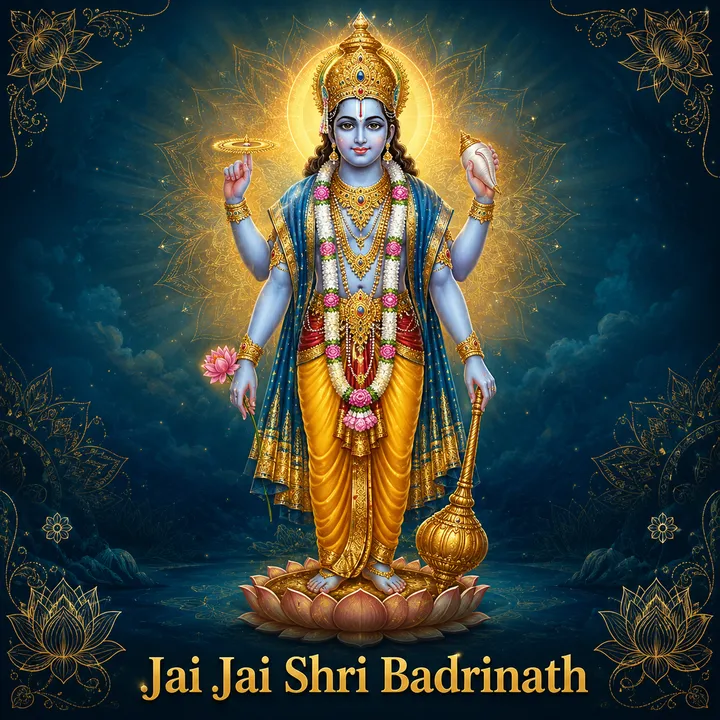
Jai Jai Shri Badrinath is a Hindi aarti of six stanzas — an opening refrain followed by five verses — sung in praise of Badrinath, the form of Vishnu enshrined at the Badrinath temple in the Garhwal Himalayas. Its refrain hails him as “yoga-dhyani,” the one absorbed in yogic meditation, a description that matches the temple’s own murti, which — unlike most standing or reclining images of Vishnu — depicts him seated in a meditative posture. The verses go on to praise his cloud-dark complexion, his ornaments, and his role as protector of those who bow to him, and describe Shiva, Shesha, Indra, the moon, and the sun as joining in his praise.
Origin and source
No individual author is reliably attested for Jai Jai Shri Badrinath; like many aartis sung at pilgrimage temples, it circulates as an anonymous, traditional composition in Hindi aarti-sangrah collections. It is one of at least two Hindi aartis commonly sung to Badrinath — the other, beginning “Pawan mand sugandh shital, hem mandir shobhitam,” describes the temple’s Himalayan setting and its worship more directly, and the two are often printed side by side in devotional collections. Jai Jai Shri Badrinath instead stays close to the deity’s iconography: his dual nature as both nirguna (formless, without attributes) and saguna (manifest, with form) in Vedantic terms, his cloud-dark complexion, and the ornaments — tilak, earrings, a gem-and-pearl garland — traditionally described in Vaishnav devotional poetry. The Badrinath temple itself is counted among the Char Dham, the four pilgrimage sites tradition credits Adi Shankaracharya with reestablishing in the 8th century, and its murti is regarded, unusually among Vishnu’s major shrines, as seated in a meditative yogic posture — the image this aarti’s refrain directly invokes.
How it is recited
Jai Jai Shri Badrinath is sung during the daily aarti at the Badrinath temple and by pilgrims who complete the journey there. Badrinath is one of the four Char Dham of Hindu tradition, and also the last of the smaller Chota Char Dham circuit in Uttarakhand — Yamunotri, Gangotri, Kedarnath, and Badrinath — conventionally visited in that order. The temple is open only for part of the year, closing as winter sets in over the Himalayas around the Diwali season and reopening in spring; the aarti is part of the worship offered while the shrine is accessible. As with most aartis, it is sung with a lit lamp or flame circled before the deity’s image, its refrain repeated by those present after each stanza.
Frequently asked questions
How many verses does Jai Jai Shri Badrinath have?
Who is Jai Jai Shri Badrinath dedicated to?
When is Jai Jai Shri Badrinath typically recited?
What language is Jai Jai Shri Badrinath composed in?
What tradition is Jai Jai Shri Badrinath associated with?
Is an English translation of Jai Jai Shri Badrinath available?
Is there a Roman transliteration of Jai Jai Shri Badrinath?
Sourcing
Checked against independent sources before publishing — see our sourcing and editorial policy. Spotted an error? Report an issue .