The text
Tap Recite along to follow verse by verse — use Next, or the arrow keys.
- Stanza 1 (refrain)
जय धन्वंतरि देवा, जय धन्वंतरि जी देवा।जरा-रोग से पीड़ित, जन-जन सुख देवा॥
jaya dhanvantari devā, jaya dhanvantari jī devā।jarā-roga se pīḍita, jana-jana sukha devā॥
Victory to Lord Dhanvantari, victory to venerable Lord Dhanvantari. To every person afflicted by old age and disease, you give ease.
- Stanza 2
तुम समुद्र से निकले, अमृत कलश लिए।देवासुर के संकट आकर दूर किए॥जय धन्वंतरि देवा, जय धन्वंतरि जी देवा।जरा-रोग से पीड़ित, जन-जन सुख देवा॥
tuma samudra se nikale, amṛta kalaśa lie।devāsura ke saṅkaṭa ākara dūra kie॥jaya dhanvantari devā, jaya dhanvantari jī devā।jarā-roga se pīḍita, jana-jana sukha devā॥
You emerged from the ocean, bearing the pot of nectar; coming forth, you ended the crisis between gods and demons. Victory to Lord Dhanvantari, victory to venerable Lord Dhanvantari. To every person afflicted by old age and disease, you give ease.
- Stanza 3
आयुर्वेद बनाया, जग में फैलाया।सदा स्वस्थ रहने का, साधन बतलाया॥जय धन्वंतरि देवा, जय धन्वंतरि जी देवा।जरा-रोग से पीड़ित, जन-जन सुख देवा॥
āyurveda banāyā, jaga meṃ phailāyā।sadā svastha rahane kā, sādhana batalāyā॥jaya dhanvantari devā, jaya dhanvantari jī devā।jarā-roga se pīḍita, jana-jana sukha devā॥
You created Ayurveda, and spread it through the world; you taught the means of remaining ever healthy. Victory to Lord Dhanvantari, victory to venerable Lord Dhanvantari. To every person afflicted by old age and disease, you give ease.
- Stanza 4
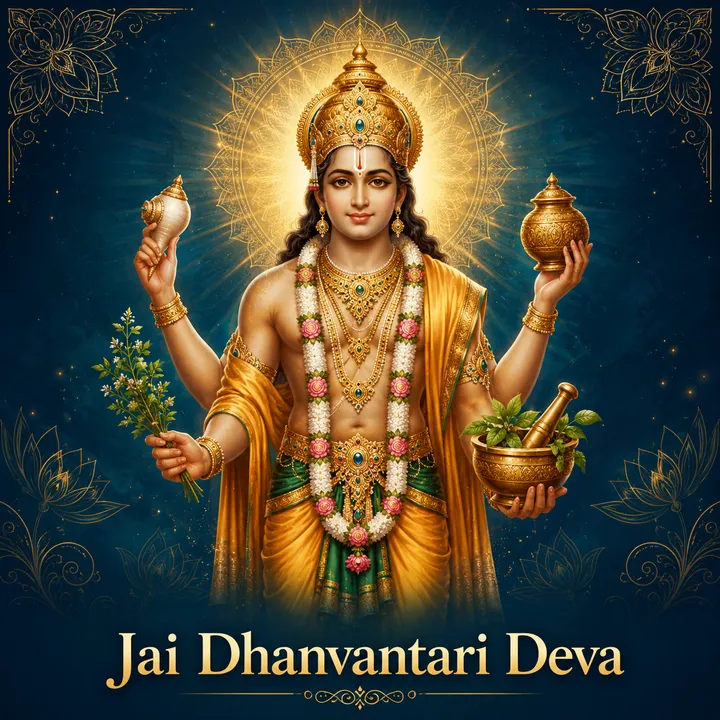
भुजा चार अति सुंदर, शंख सुधा धारी।आयुर्वेद वनस्पति से शोभा भारी॥जय धन्वंतरि देवा, जय धन्वंतरि जी देवा।जरा-रोग से पीड़ित, जन-जन सुख देवा॥
bhujā cāra ati sundara, śaṅkha sudhā dhārī।āyurveda vanaspati se śobhā bhārī॥jaya dhanvantari devā, jaya dhanvantari jī devā।jarā-roga se pīḍita, jana-jana sukha devā॥
Your four arms are most beautiful, holding the conch and the vessel of nectar; you are richly adorned with the plants of Ayurveda. Victory to Lord Dhanvantari, victory to venerable Lord Dhanvantari. To every person afflicted by old age and disease, you give ease.
- Stanza 5
तुम को जो नित ध्यावे, रोग नहीं आवे।असाध्य रोग भी उसका, निश्चय मिट जावे॥जय धन्वंतरि देवा, जय धन्वंतरि जी देवा।जरा-रोग से पीड़ित, जन-जन सुख देवा॥
tuma ko jo nita dhyāve, roga nahīṃ āve।asādhya roga bhī usakā, niścaya miṭa jāve॥jaya dhanvantari devā, jaya dhanvantari jī devā।jarā-roga se pīḍita, jana-jana sukha devā॥
Whoever meditates on you daily, illness does not come to them; even their incurable disease will surely be removed. Victory to Lord Dhanvantari, victory to venerable Lord Dhanvantari. To every person afflicted by old age and disease, you give ease.
- Stanza 6
हाथ जोड़कर प्रभुजी, दास खड़ा तेरा।वैद्य-समाज तुम्हारे चरणों का घेरा॥जय धन्वंतरि देवा, जय धन्वंतरि जी देवा।जरा-रोग से पीड़ित, जन-जन सुख देवा॥
hātha joḍkara prabhujī, dāsa khaḍā terā।vaidya-samāja tumhāre caraṇoṃ kā gherā॥jaya dhanvantari devā, jaya dhanvantari jī devā।jarā-roga se pīḍita, jana-jana sukha devā॥
With joined hands, Lord, your servant stands before you; the community of physicians (vaidyas) gathers at your feet. Victory to Lord Dhanvantari, victory to venerable Lord Dhanvantari. To every person afflicted by old age and disease, you give ease.
- Stanza 7
धन्वंतरि जी की आरती जो कोई नर गावे।रोग-शोक न आए, सुख-समृद्धि पावे॥जय धन्वंतरि देवा, जय धन्वंतरि जी देवा।जरा-रोग से पीड़ित, जन-जन सुख देवा॥
dhanvantari jī kī āratī jo koī nara gāve।roga-śoka na āe, sukha-samṛddhi pāve॥jaya dhanvantari devā, jaya dhanvantari jī devā।jarā-roga se pīḍita, jana-jana sukha devā॥
Whoever sings this aarti of Lord Dhanvantari — disease and sorrow will not come to them, and they will attain happiness and prosperity. Victory to Lord Dhanvantari, victory to venerable Lord Dhanvantari. To every person afflicted by old age and disease, you give ease.
Overview
Jai Dhanvantari Deva is a Hindi aarti of seven stanzas addressed to Dhanvantari, the physician among the gods and the source of Ayurveda. The aarti’s second stanza recounts his best-known origin: he emerged from the ocean bearing a pot (kalash) of amrita, the nectar of immortality, and in doing so ended the dispute between the gods and demons. This refers to Samudra Manthan, the Puranic story of the churning of the cosmic ocean, in which gods and demons together churned the sea of milk in search of amrita, and Dhanvantari rose from the waters holding it. In Puranic and Vaishnav tradition, Dhanvantari is regarded as an avatar, or partial manifestation, of Vishnu who took this form specifically for that moment — a more specialized identification than better-known avatars such as Rama or Krishna, and one kept separate here from the ten principal avatars (the Dashavatara) that Vishnu’s own page describes.
The remaining stanzas turn from that origin story to Dhanvantari’s continuing role: he is credited with creating Ayurveda and spreading it through the world, is described with four arms bearing a conch and the vessel of nectar and adorned with medicinal plants, and is honored as the deity to whom physicians (vaidyas) look for protection. Devotees who meditate on him are said to be kept from disease, including the otherwise incurable, and the final stanza promises the same blessing — freedom from disease and sorrow, and the gaining of happiness and prosperity — to anyone who sings the aarti itself.
Origin and source
Like many aartis in wide circulation, Jai Dhanvantari Deva does not carry a firmly documented individual author; it is transmitted through devotional collections and oral practice rather than attributed to a named poet. Its content draws on the Puranic account of Samudra Manthan, found across Puranic literature, in which Dhanvantari appears among the results of the churning, holding the amrita that had been the reason for the churning in the first place. The identification of Dhanvantari specifically as an avatar of Vishnu, rather than simply a deity who appears in the story, is the position taken within Vaishnav tradition.
How it is recited
Jai Dhanvantari Deva is most closely associated with Dhanteras, the day at the start of the Diwali festival period that is dedicated to Dhanvantari and traditionally treated as auspicious for purchasing new utensils or gold. It is also recited by Ayurveda practitioners and students, including as part of observances on National Ayurveda Day, which is set on Dhanteras itself. As with most aartis, it is sung with a lit diya or camphor flame circled before an image of the deity, with the opening refrain repeated after each stanza by those present.
Frequently asked questions
How many verses does Jai Dhanvantari Deva have?
Who is Jai Dhanvantari Deva dedicated to?
When is Jai Dhanvantari Deva typically recited?
What language is Jai Dhanvantari Deva composed in?
What tradition is Jai Dhanvantari Deva associated with?
Is an English translation of Jai Dhanvantari Deva available?
Is there a Roman transliteration of Jai Dhanvantari Deva?
Sourcing
Checked against independent sources before publishing — see our sourcing and editorial policy. Spotted an error? Report an issue .