The text
Tap Recite along to follow verse by verse — use Next, or the arrow keys.
- Opening dohas
- Doha 1
गणपति की कर वंदना, गुरु चरनन चितलाय।प्रेतराज जी का लिखूं, चालीसा हरषाय॥
gaṇapati kī kara vandanā, guru caranana citalāya।pretarāja jī kā likhūṃ, cālīsā haraṣāya॥
Offering worship to Ganapati, fixing my mind on the feet of the guru, I write this joyful Chalisa of Shri Pretraj ji.
- Doha 2
जय जय भूताधिप प्रबल, हरण सकल दुःख भार।वीर शिरोमणि जयति, जय प्रेतराज सरकार॥
jaya jaya bhūtādhipa prabala, haraṇa sakala duḥkha bhāra।vīra śiromaṇi jayati, jaya pretarāja sarakāra॥
Victory, victory to the mighty lord of spirits, remover of every burden of sorrow. Victory to the foremost of heroes — victory to Pretraj Sarkar.
- The 40 chaupais
- Chaupai 1
जय जय प्रेतराज जग पावन।महा प्रबल त्रय ताप नसावन॥
jaya jaya pretarāja jaga pāvana।mahā prabala traya tāpa nasāvana॥
Victory, victory to Pretraj, purifier of the world — greatly powerful, dispeller of the three kinds of affliction.
- Chaupai 2
विकट वीर करुणा के सागर।भक्त कष्ट हर सब गुण आगर॥
vikaṭa vīra karuṇā ke sāgara।bhakta kaṣṭa hara saba guṇa āgara॥
A fearsome hero, an ocean of compassion — remover of devotees' suffering, a treasury of every virtue.
- Chaupai 3
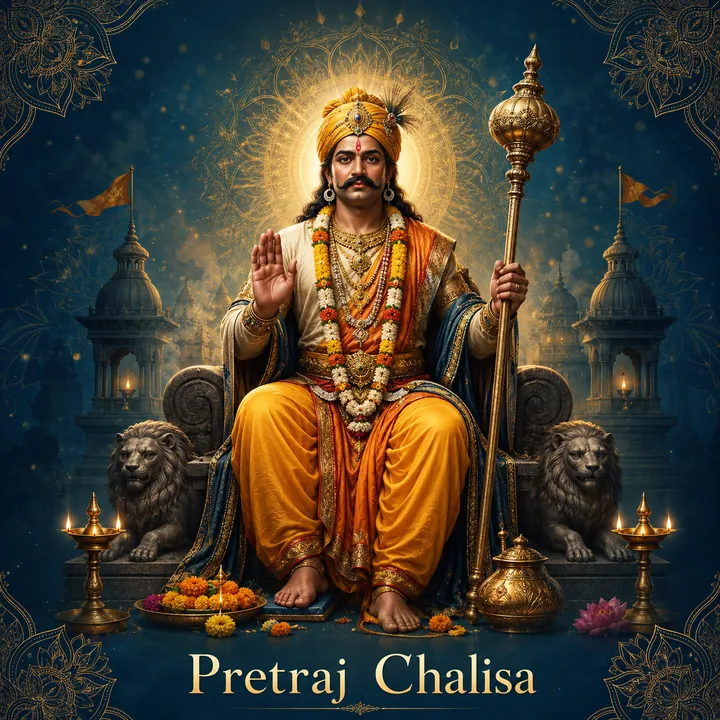
रत्न जटित सिंहासन सोहे।देखत सुन नर मुनि मन मोहे॥
ratna jaṭita siṃhāsana sohe।dekhata suna nara muni mana mohe॥
You shine upon a jewel-studded throne; hearing and seeing of you, the minds of men and sages alike are enchanted.
- Chaupai 4
जगमग सिर पर मुकुट सुहावन।कानन कुण्डल अति मन भावन॥
jagamaga sira para mukuṭa suhāvana।kānana kuṇḍala ati mana bhāvana॥
A glittering, graceful crown adorns your head; earrings in your ears delight the mind.
- Chaupai 5
धनुष कृपाण बाण अरु भाला।वीरवेश अति भृकुटि कराला॥
dhanuṣa kṛpāṇa bāṇa aru bhālā।vīraveśa ati bhṛkuṭi karālā॥
A bow, a sword, arrows, and a spear — in warrior's garb, with a fiercely knit brow.
- Chaupai 6
गजारुढ़ संग सेना भारी।बाजत ढोल मृदंग जुझारी॥
gajāruḍha saṅga senā bhārī।bājata ḍhola mṛdaṅga jujhārī॥
Mounted upon an elephant, with a great army beside you; drums and mridangams sound the call to battle.
- Chaupai 7
छत्र चंवर पंखा सिर डोले।भक्त बृन्द मिलि जय जय बोले॥
chatra caṃvara paṅkhā sira ḍole।bhakta bṛnda mili jaya jaya bole॥
A royal umbrella, fly-whisk, and fan wave above your head; multitudes of devotees gather and cry out, victory, victory.
- Chaupai 8
भक्त शिरोमणि वीर प्रचण्डा।दुष्ट दलन शोभित भुजदण्डा॥
bhakta śiromaṇi vīra pracaṇḍā।duṣṭa dalana śobhita bhujadaṇḍā॥
Foremost among his devotee-servants, a hero of tremendous force — your arm shines as it crushes the wicked.
- Chaupai 9
चलत सैन काँपत भूतलहू।दर्शन करत मिटत कलि मलहू॥
calata saina kā̃pata bhūtalahū।darśana karata miṭata kali malahū॥
As your army marches, the very earth trembles; at your darshan, the impurities of this Kali Age are erased.
- Chaupai 10
घाटा मेंहदीपुर में आकर।प्रगटे प्रेतराज गुण सागर॥
ghāṭā meṃhadīpura meṃ ākara।pragaṭe pretarāja guṇa sāgara॥
Coming to the ravine at Mehandipur, Pretraj, ocean of virtues, manifested there.
- Chaupai 11
लाल ध्वजा उड़ रही गगन में।नाचत भक्त मगन हो मन में॥
lāla dhvajā uḍa rahī gagana meṃ।nācata bhakta magana ho mana meṃ॥
A red flag flies in the sky; devotees dance, their minds lost in joy.
- Chaupai 12
भक्त कामना पूरन स्वामी।बजरंगी के सेवक नामी॥
bhakta kāmanā pūrana svāmī।bajaraṅgī ke sevaka nāmī॥
Lord who fulfills his devotees' wishes — renowned servant of Bajrangi (Hanuman).
- Chaupai 13
इच्छा पूरन करने वाले।दुःख संकट सब हरने वाले॥
icchā pūrana karane vāle।duḥkha saṅkaṭa saba harane vāle॥
You who fulfill every wish, who remove every sorrow and trouble.
- Chaupai 14
जो जिस इच्छा से आते हैं।वे सब मन वाँछित फल पाते हैं॥
jo jisa icchā se āte haiṃ।ve saba mana vā̃chita phala pāte haiṃ॥
Whoever comes with whatever wish, all of them obtain the fruit their heart desired.
- Chaupai 15
रोगी सेवा में जो आते।शीघ्र स्वस्थ होकर घर जाते॥
rogī sevā meṃ jo āte।śīghra svastha hokara ghara jāte॥
The sick who come to serve you return home quickly restored to health.
- Chaupai 16
भूत पिशाच जिन्न वैताला।भागे देखत रुप कराला॥
bhūta piśāca jinna vaitālā।bhāge dekhata rupa karālā॥
Ghosts, demons, jinn, and vetalas flee at the sight of your terrible form.
- Chaupai 17
भौतिक शारीरिक सब पीड़ा।मिटा शीघ्र करते हैं क्रीड़ा॥
bhautika śārīrika saba pīḍā।miṭā śīghra karate haiṃ krīḍā॥
All worldly and bodily pain — you erase it swiftly, as though in play.
- Chaupai 18
कठिन काज जग में हैं जेते।रटत नाम पूरन सब होते॥
kaṭhina kāja jaga meṃ haiṃ jete।raṭata nāma pūrana saba hote॥
Whatever difficult tasks exist in this world, all are accomplished by repeating your name.
- Chaupai 19
तन मन धन से सेवा करते।उनके सकल कष्ट प्रभु हरते॥
tana mana dhana se sevā karate।unake sakala kaṣṭa prabhu harate॥
Those who serve you with body, mind, and wealth — O Lord, you remove all their suffering.
- Chaupai 20
हे करुणामय स्वामी मेरे।पड़ा हुआ हूँ चरणों में तेरे॥
he karuṇāmaya svāmī mere।paḍā huā hūṃ caraṇoṃ meṃ tere॥
O my compassionate Lord, I lie fallen at your feet.
- Chaupai 21
कोई तेरे सिवा न मेरा।मुझे एक आश्रय प्रभु तेरा॥
koī tere sivā na merā।mujhe eka āśraya prabhu terā॥
I have no one but you; you alone, O Lord, are my refuge.
- Chaupai 22
लज्जा मेरी हाथ तिहारे।पड़ा हूँ चरण सहारे॥
lajjā merī hātha tihāre।paḍā hūṃ caraṇa sahāre॥
My honor rests in your hands; I have fallen, taking refuge at your feet.
- Chaupai 23
या विधि अरज करे तन मन से।छूटत रोग शोक सब तन से॥
yā vidhi araja kare tana mana se।chūṭata roga śoka saba tana se॥
Whoever petitions you in this way, with body and mind — every illness and sorrow leaves their body.
- Chaupai 24
मेंहदीपुर अवतार लिया है।भक्तों का दुःख दूर किया है॥
meṃhadīpura avatāra liyā hai।bhaktoṃ kā duḥkha dūra kiyā hai॥
You took avatar at Mehandipur, and you have driven away your devotees' sorrow.
- Chaupai 25
रोगी, पागल सन्तति हीना।भूत व्याधि सुत अरु धन छीना॥
rogī, pāgala santati hīnā।bhūta vyādhi suta aru dhana chīnā॥
The sick, the deranged, those without children, those afflicted by spirits, or robbed of offspring or wealth —
- Chaupai 26
जो जो तेरे द्वारे आते।मन वांछित फल पा घर जाते॥
jo jo tere dvāre āte।mana vāṃchita phala pā ghara jāte॥
whoever comes to your door goes home having received the fruit their heart desired.
- Chaupai 27
महिमा भूतल पर है छाई।भक्तों ने है लीला गाई॥
mahimā bhūtala para hai chāī।bhaktoṃ ne hai līlā gāī॥
Your glory has spread across the earth; devotees sing of your divine play.
- Chaupai 28
महन्त गणेश पुरी तपधारी।पूजा करते तन मन वारी॥
mahanta gaṇeśa purī tapadhārī।pūjā karate tana mana vārī॥
Mahant Ganesh Puri, the ascetic, worships you, offering body and mind.
- Chaupai 29
हाथों में ले मुगदर घोटे।दूत खड़े रहते हैं मोटे॥
hāthoṃ meṃ le mugadara ghoṭe।dūta khaḍe rahate haiṃ moṭe॥
Wielding a mace in hand, your stout messengers stand ready.
- Chaupai 30
लाल देह सिन्दूर बदन में।काँपत थर-थर भूत भवन में॥
lāla deha sindūra badana meṃ।kā̃pata thara-thara bhūta bhavana meṃ॥
Your body red with vermilion — before it, spirits tremble in their abode.
- Chaupai 31
जो कोई प्रेतराज चालीसा।पाठ करत नित एक अरु बीसा॥
jo koī pretarāja cālīsā।pāṭha karata nita eka aru bīsā॥
Whoever recites this Pretraj Chalisa daily, twenty-one times,
- Chaupai 32
प्रातः काल स्नान करावै।तेल और सिन्दूर लगावै॥
prātaḥ kāla snāna karāvai।tela aura sindūra lagāvai॥
bathing you each morning, applying oil and vermilion,
- Chaupai 33
चन्दन इत्र फुलेल चढ़ावै।पुष्पन की माला पहनावै॥
candana itra phulela caḍhāvai।puṣpana kī mālā pahanāvai॥
offering sandal-paste, perfume, and scented oil, adorning you with a garland of flowers,
- Chaupai 34
ले कपूर आरती उतारै।करै प्रार्थना जयति उचारै॥
le kapūra āratī utārai।karai prārthanā jayati ucārai॥
performing arati with camphor, offering prayer while chanting, victory —
- Chaupai 35
उनके सभी कष्ट कट जाते।हर्षित हो अपने घर जाते॥
unake sabhī kaṣṭa kaṭa jāte।harṣita ho apane ghara jāte॥
all of their troubles are cut away; joyfully they return to their own home.
- Chaupai 36
इच्छा पूरण करते जनकी।होती सफल कामना मन की॥
icchā pūraṇa karate janakī।hotī saphala kāmanā mana kī॥
You fulfill the wishes of your people; the desires of their heart are made to succeed.
- Chaupai 37
भक्त कष्टहर अरिकुल घातक।ध्यान धरत छूटत सब पातक॥
bhakta kaṣṭahara arikula ghātaka।dhyāna dharata chūṭata saba pātaka॥
Remover of devotees' suffering, destroyer of the ranks of enemies — holding you in meditation, every sin departs.
- Chaupai 38
जय जय जय प्रेताधिप जय।जयति भुपति संकट हर जय॥
jaya jaya jaya pretādhipa jaya।jayati bhupati saṅkaṭa hara jaya॥
Victory, victory, victory to the lord of spirits! Victory to the sovereign who removes all trouble!
- Chaupai 39
जो नर पढ़त प्रेत चालीसा।रहत न कबहूँ दुख लवलेशा॥
jo nara paḍhata preta cālīsā।rahata na kabahū̃ dukha lavaleśā॥
The one who reads this Pret Chalisa never remains troubled, even in the slightest.
- Chaupai 40
कह भक्त ध्यान धर मन में।प्रेतराज पावन चरणन में॥
kaha bhakta dhyāna dhara mana meṃ।pretarāja pāvana caraṇana meṃ॥
So says the devotee, holding you in meditation — O Pretraj, at your sacred feet.
- Closing dohas
- Doha (closing) 1
दुष्ट दलन जग अघ हरन, समन सकल भव शूल।जयति भक्त रक्षक प्रबल, प्रेतराज सुख मूल॥
duṣṭa dalana jaga agha harana, samana sakala bhava śūla।jayati bhakta rakṣaka prabala, pretarāja sukha mūla॥
Destroyer of the wicked, remover of the world's sin, queller of every worldly torment — victory to the mighty protector of devotees, Pretraj, the very root of happiness.
- Doha (closing) 2
विमल वेश अंजनि सुवन, प्रेतराज बल धाम।बसहु निरन्तर मम हृदय, कहत भक्त सुखराम॥
vimala veśa añjani suvana, pretarāja bala dhāma।basahu nirantara mama hṛdaya, kahata bhakta sukharāma॥
Of pure form, son of Anjani — Pretraj, abode of strength: dwell forever in my heart, says the devotee Sukhram.
Overview
The Pretraj Chalisa is a forty-verse Hindi devotional composition addressed to Shri Pretraj Sarkar, one of the three deities enshrined together at the Mehandipur Balaji temple complex in Dausa district, Rajasthan, alongside Balaji (Hanuman) and Bhairav. Framed by two opening dohas and two closing dohas, its forty chaupai open with an invocation of Ganapati and the guru before turning to a description of Pretraj’s fierce, regal form — jeweled crown and throne, bow and sword, mounted on an elephant with a great retinue — and his manifestation at the ravine (“ghata”) of Mehandipur. The text calls him a servant of “Bajrangi” (Hanuman) and recounts the range of troubles — sickness, misfortune, and what devotees understand as spirit-affliction — that people bring to him, closing with a benediction on whoever recites the Chalisa with devotion.
Origin and source
Like the temple’s companion Bhairav and Balaji chalisas, the Pretraj Chalisa’s composer names himself within the text: the closing doha ends “कहत भक्त सुखराम” (“kahata bhakta sukharāma”), “so says the devotee Sukhram” — a self-attestation rather than an attribution made by outside scholarship, and one that recurs consistently across the sources checked for this page. Nothing further about this “Sukhram” is well documented elsewhere, so this page treats the Chalisa’s authorship as self-named within the verses but not otherwise independently confirmed.
The Chalisa shares specific textual details with the Mehandipur Balaji Chalisa — both name Mahant Ganeshpuri as a devoted attendant of the temple’s deities, and both locate their subject’s manifestation at the same “ghata” at Mehandipur — reflecting that the two compositions grew out of the same devotional tradition built around the temple’s three resident deities. Chaupai 12 calls Pretraj a “renowned servant of Bajrangi” (Hanuman), consistent with the wider Mehandipur tradition’s own internal hierarchy, in which Bhairav and Pretraj are cast as officers in Balaji’s court rather than as identical to him; this page treats that as a description of service and role, not a textual claim that Pretraj is Hanuman himself.
The second closing doha addresses Pretraj as “अंजनि सुवन” (“son of Anjani”), an epithet used elsewhere for Hanuman, in a couplet (“विमल वेश अंजनि सुवन, प्रेतराज बल धाम… बसहु निरन्तर मम हृदय”) that echoes the closing-doha formula of the Hanuman Chalisa itself (”…हृदय बसहु सुर भूप”). Whether this is a deliberate identification, a borrowed formula carried over with the pattern, or simply praise-language shared across the temple’s chalisas is not something the verse itself settles, so this page reports the wording as written without reading it as a claim that Pretraj and Hanuman are one and the same.
Multiple Pretraj Chalisa texts circulate under the same title. This page follows the widely repeated forty-chaupai version beginning “Ganapati ki kar vandana, guru charanan chitalaya,” cross-checked across several independently transcribed sources, including a devotee-run website built specifically for Mehandipur Balaji pilgrims, whose transcription differs in wording from line to line but matches this version’s structure and content chaupai for chaupai. A separately worded chalisa of the same name, beginning “Shri Bhrigu kamal pad dhyan dhar,” also circulates and is not the version reproduced here.
How it is recited
The Pretraj Chalisa is recited by devotees of Mehandipur Balaji, typically alongside the temple’s Balaji and Bhairav chalisas, with Tuesday and Saturday observed as the traditional days for visiting and worship there. Mehandipur Balaji is popularly known as a place where people affected by illness, misfortune, or what they understand as spirit-affliction seek relief, and the Chalisa’s own verses reflect that directly — chaupai 25 and 26 name specific categories of distress and describe devotees receiving what they sought after coming to Pretraj’s door. The text also describes simple acts of devotion — bathing the deity’s image, applying oil and vermilion, offering sandal-paste and flowers, and performing arati with camphor — as part of how it is traditionally read.
Frequently asked questions
How many verses does Pretraj Chalisa have?
Who is Pretraj Chalisa dedicated to?
When is Pretraj Chalisa typically recited?
What language is Pretraj Chalisa composed in?
Is an English translation of Pretraj Chalisa available?
Is there a Roman transliteration of Pretraj Chalisa?
Sourcing
Checked against independent sources before publishing — see our sourcing and editorial policy. Spotted an error? Report an issue .