Overview
Bhairav (भैरव, Bhairava) is the fierce, tantric manifestation of Shiva, central to Shaivism generally and, philosophically, to Kashmir Shaivism specifically, where the name is used for the Supreme Reality itself rather than only for an iconographic form. He emerged, in the Shiva Purana’s account, directly from Shiva’s own wrath, and is not usually treated as a separately born deity.
This page also covers Batuk Bhairava, a youthful and comparatively gentle form of the same underlying principle — jaapdaily.com carries a chalisa for each, and both belong on this one page rather than being treated as unrelated figures.
Mythology
The best-known legend behind Bhairava’s origin, told in the Shiva Purana’s Shatarudra Samhita, concerns a dispute between Brahma and Vishnu over which of them was supreme. When Brahma falsely claimed to have found the top of an infinite, blazing pillar of light manifested by Shiva, Bhairava is said to have severed Brahma’s fifth head for the lie. This act brought upon Bhairava the sin of brahmahatya, the killing of a Brahmin, from which he was freed only upon reaching Varanasi — the origin, in this telling, of his enduring role as the city’s guardian deity.
Iconography and forms
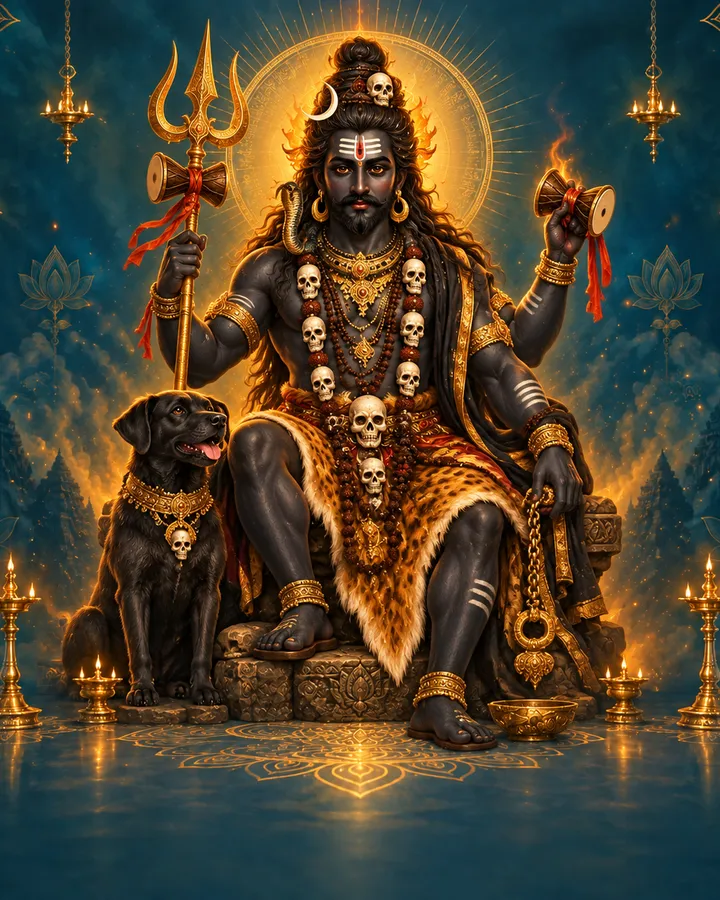
Bhairava’s vehicle, a dog, is consistent across sources and forms. He is typically shown dark-complexioned, garlanded with skulls, ash-smeared, and carrying implements that vary by form and region — trishula, khatvanga, sword, kapala, and damaru among them. Tradition recognizes eight forms collectively known as the Ashta Bhairava (Asitanga, Ruru, Chanda, Krodha, Unmatta, Kapala, Bhishana, and Samhara Bhairava), with Kaal Bhairav traditionally regarded as chief among them.
Batuk Bhairava, per texts such as the Sharadatilaka Tantra, is depicted as a youth, sometimes eight-armed, carrying a khatvanga, noose, trident, damaru, skull-cup, and serpent, with one hand raised in abhaya mudra, a gesture of protection, and accompanied by a dog matching his own body color. A 13th-century sculpture of this form, from the Vijayanagar school, survives today in the Bharat Kala Bhavan museum at Banaras Hindu University, confirming a long history of dedicated veneration for this youthful form specifically.
Bhairava as guardian of Varanasi
Bhairava’s most enduring living role is as the Kotwal, or chief guardian, of Varanasi — popular belief holds that no one may reside in the city without his tacit sanction, and even the chief priests of the Kashi Vishwanath Temple customarily seek his blessing as a matter of course. This guardianship theme extends to Kashmir Shaivism’s philosophical use of “Bhairava,” where the name refers not to a single iconographic deity but to Paramashiva, the Supreme Reality underlying the entire manifest universe — a genuinely different, more abstract register of meaning from the temple worship described elsewhere on this page.
Worship and festivals
Kala Bhairava Jayanti, also called Bhairava Ashtami, falls on the eighth day of the waning moon (Krishna Paksha Ashtami) in the month of Margashirsha, typically November or December, and commemorates Bhairava’s manifestation; it is a major observance at both Ujjain and Varanasi. Kalashtami, the same eighth-day observance repeated monthly, is a smaller, recurring version of the same worship. At the Kal Bhairav Temple in Ujjain, on the banks of the Shipra River and historically a center of Kapalika and Aghora Bhairava worship, liquor is offered directly to the deity’s idol as prasad, an unusual and well-documented ritual distinct from most Hindu temple practice.
In scripture
- Shiva Purana (Shatarudra Samhita) — source of the Brahma’s-fifth-head legend.
- Skanda Purana (Avanti Khanda) — the textual basis for the Ujjain temple’s traditional history.
- Vijnana Bhairava Tantra, Rudrayamala Tantra, and Sharadatilaka Tantra — tantric texts, the last of which sets out Batuk Bhairava’s iconography specifically.
Iconography at a glance
Major temples
Kaal Bhairav Mandir
Varanasi, Uttar Pradesh, India
Structure estimated to the mid-17th century; a silver-faced idol seated on a dog vehicle, holding a trident. Bhairava is traditionally regarded as the Kotwal, or chief guardian, of Varanasi, and popular belief holds that no one may reside in the city without his tacit sanction.
Open in Maps ↗Kal Bhairav Temple
Ujjain, Madhya Pradesh, India
On the banks of the Shipra River, its origins traced to the Skanda Purana's Avanti Khanda and developed under King Bhadrasen; historically a center of Kapalika and Aghora Bhairava worship, known for its unusual liquor-offering ritual, with Bhairava regarded here as Senapati, commander, of the town.
Open in Maps ↗Map loads when scrolled into view.
Worth knowing
- In the Shiva Purana's account, Bhairava is said to have severed Brahma's fifth head after Brahma falsely claimed to have found the top of Shiva's infinite pillar of light — an act that brought Bhairava the sin of brahmahatya, absolved only upon his reaching Varanasi.
- Bhairava is traditionally called the Kotwal, or chief guardian, of Varanasi, and even the chief priests of the Kashi Vishwanath Temple customarily seek his blessing.
- In Kashmir Shaivism, "Bhairava" is used philosophically as a name for the Supreme Reality itself (Paramashiva), not only as an iconographic deity.
- Batuk Bhairava, a youthful form of the same principle, is iconographically and devotionally distinct from Kaal Bhairav chiefly by temperament — gentler and more approachable, in contrast to Kaal Bhairav's mature, disciplinarian character.
- At the Kaal Bhairav temple in Ujjain, liquor is offered as prasad directly to the deity's idol, a well-documented and unusual ritual distinguishing it from most Hindu temple practice.