The text
Tap Recite along to follow verse by verse — use Next, or the arrow keys.
- Stanza 1 (refrain)
आरती कीजै हनुमान लला की।दुष्ट दलन रघुनाथ कला की॥
āratī kījai hanumāna lalā kī।duṣṭa dalana raghunātha kalā kī॥
Let us perform the aarti of beloved Hanuman, crusher of the wicked, embodiment of Raghunath's (Rama's) power.
- Stanza 2
जाके बल से गिरिवर काँपे।रोग दोष जाके निकट न झाँपे॥अंजनि पुत्र महा बलदाई।संतन के प्रभु सदा सहाई॥आरती कीजै हनुमान लला की।दुष्ट दलन रघुनाथ कला की॥
jāke bala se girivara kā̃pe।roga doṣa jāke nikaṭa na jhā̃pe॥añjani putra mahā baladāī।santana ke prabhu sadā sahāī॥āratī kījai hanumāna lalā kī।duṣṭa dalana raghunātha kalā kī॥
At whose strength even great mountains tremble; disease and affliction dare not come near him. Son of Anjani, giver of great strength — ever the helper of saints. Let us perform the aarti of beloved Hanuman, crusher of the wicked, embodiment of Raghunath's power.
- Stanza 3
दे बीरा रघुनाथ पठाए।लंका जारि सिया सुधि लाए॥लंका सो कोट समुद्र सी खाई।जात पवनसुत बार न लाई॥आरती कीजै हनुमान लला की।दुष्ट दलन रघुनाथ कला की॥
de bīrā raghunātha paṭhāe।laṅkā jāri siyā sudhi lāe॥laṅkā so koṭa samudra sī khāī।jāta pavanasuta bāra na lāī॥āratī kījai hanumāna lalā kī।duṣṭa dalana raghunātha kalā kī॥
Raghunath sent forth this hero; he burned Lanka and brought back news of Sita. Lanka's fortress had a moat as wide as the ocean, yet the son of the Wind crossed it without a moment's delay. Let us perform the aarti of beloved Hanuman, crusher of the wicked, embodiment of Raghunath's power.
- Stanza 4
लंका जारि असुर संहारे।सियारामजी के काज सवारे॥लक्ष्मण मूर्छित पड़े सकारे।आनि संजीवन प्राण उबारे॥आरती कीजै हनुमान लला की।दुष्ट दलन रघुनाथ कला की॥
laṅkā jāri asura sanhāre।siyārāmajī ke kāja savāre॥lakṣmaṇa mūrchita paḍe sakāre।āni sanjīvana prāṇa ubāre॥āratī kījai hanumāna lalā kī।duṣṭa dalana raghunātha kalā kī॥
Burning Lanka, he destroyed the demons, and accomplished the tasks of Sita and Ram. When Lakshmana lay unconscious at dawn, he brought the sanjivani herb and restored his life. Let us perform the aarti of beloved Hanuman, crusher of the wicked, embodiment of Raghunath's power.
- Stanza 5
पैठि पाताल तोरि जमकारे।अहिरावण की भुजा उखारे॥बाईं भुजा असुर दल मारे।दाहिने भुजा संतजन तारे॥आरती कीजै हनुमान लला की।दुष्ट दलन रघुनाथ कला की॥
paiṭhi pātāla tori jamakāre।ahirāvaṇa kī bhujā ukhāre॥bāī̃ bhujā asura dala māre।dāhine bhujā santajana tāre॥āratī kījai hanumāna lalā kī।duṣṭa dalana raghunātha kalā kī॥
Entering the netherworld, he overcame death itself, and tore off the arm of the demon Ahiravana. With his left arm he strikes down demon hosts; with his right arm he carries devotees across. Let us perform the aarti of beloved Hanuman, crusher of the wicked, embodiment of Raghunath's power.
- Stanza 6
सुर नर मुनि जन आरती उतारें।जय जय जय हनुमान उचारें॥कंचन थार कपूर लौ छाई।आरती करत अंजना माई॥जो हनुमानजी की आरती गावे।बसि बैकुण्ठ परम पद पावे॥आरती कीजै हनुमान लला की।दुष्ट दलन रघुनाथ कला की॥
sura nara muni jana āratī utārẽ।jaya jaya jaya hanumāna ucārẽ॥kañcana thāra kapūra lau chāī।āratī karata añjanā māī॥jo hanumānajī kī āratī gāve।basi baikuṇṭha parama pada pāve॥āratī kījai hanumāna lalā kī।duṣṭa dalana raghunātha kalā kī॥
Gods, men, and sages perform his aarti, chanting, 'Victory, victory, victory to Hanuman!' On a golden plate the camphor flame glows, as Mother Anjana herself performs the aarti. Whoever sings this aarti of Hanuman attains Vaikuntha, the highest abode. Let us perform the aarti of beloved Hanuman, crusher of the wicked, embodiment of Raghunath's power.
Overview
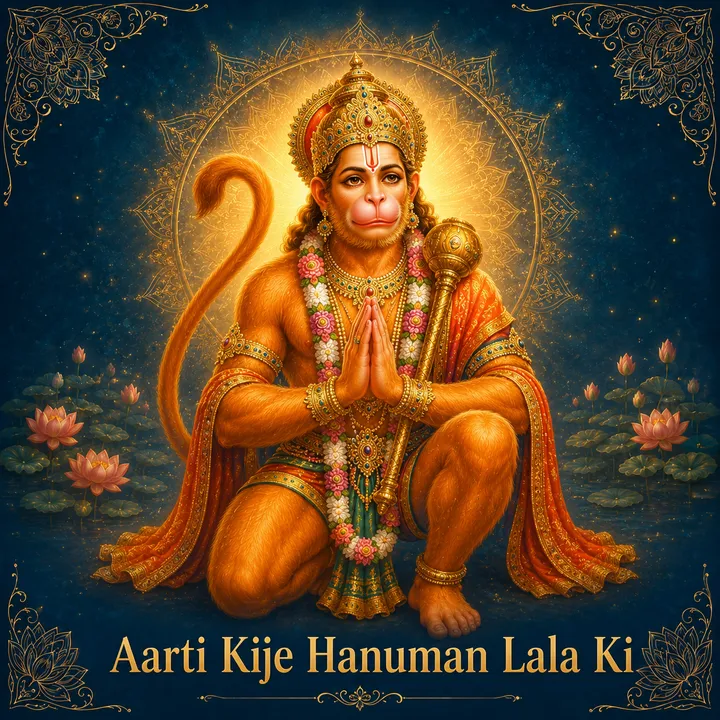
Aarti Kije Hanuman Lala Ki is a Hindi aarti of six stanzas in praise of Hanuman, addressed to him affectionately as “lala” — a term of endearment for a beloved child. After an opening refrain, each of the following stanzas narrates an episode from Hanuman’s story and then returns to that same refrain, so “Aarti kije Hanuman lala ki, dusht dalan Raghunath kala ki” recurs throughout, in the call-and-response pattern familiar from other Hindi aartis. It is a widely sung invocation of Hanuman in North Indian devotional practice, and is very commonly performed immediately at the close of a Hanuman Chalisa recitation.
Origin and source
Unlike the Hanuman Chalisa, whose authorship is firmly attributed to Tulsidas, Aarti Kije Hanuman Lala Ki circulates without a settled attribution to a single named poet — printed devotional collections rarely credit a composer, and where a name is offered, sources disagree. The stanzas move through several episodes central to Hanuman’s story: his sea-crossing to Lanka and search for Sita, his burning of Lanka, his return with the sanjivani herb to revive the unconscious Lakshmana, and, in the fifth stanza, his descent into the netherworld (Patal) to defeat the demon Ahiravana — an episode found in regional and later Ramayana traditions such as the Bengali Krittivasa Ramayana rather than in Valmiki’s original Sanskrit text. The closing stanza turns from narrating Hanuman’s deeds to describing the aarti ceremony itself — gods, sages, and Hanuman’s mother Anjana performing the aarti with a camphor flame — before closing with the promised fruit of singing it.
How it is recited
Aarti Kije Hanuman Lala Ki is sung daily by many Hanuman devotees, and is especially associated with Tuesday and Saturday, the two days most closely linked to Hanuman in North Indian practice. It is very commonly recited right after the Hanuman Chalisa, forming a short closing sequence — chalisa first, then this aarti — in both home shrines and temple worship. As with most aartis, it is sung while a lit diya or camphor flame is circled before Hanuman’s image, with the refrain taken up by everyone present after each stanza.
Frequently asked questions
How many verses does Aarti Kije Hanuman Lala Ki have?
Who is Aarti Kije Hanuman Lala Ki dedicated to?
When is Aarti Kije Hanuman Lala Ki typically recited?
What language is Aarti Kije Hanuman Lala Ki composed in?
What tradition is Aarti Kije Hanuman Lala Ki associated with?
Is an English translation of Aarti Kije Hanuman Lala Ki available?
Is there a Roman transliteration of Aarti Kije Hanuman Lala Ki?
Sourcing
Checked against independent sources before publishing — see our sourcing and editorial policy. Spotted an error? Report an issue .