The text
Tap Recite along to follow verse by verse — use Next, or the arrow keys.
- Stanza 1 (refrain)
जय भैरव देवा, प्रभु जय भैरव देवा।जय काली और गौर देवी कृत सेवा॥
jaya bhairava devā, prabhu jaya bhairava devā।jaya kālī aura gaura devī kṛta sevā॥
Victory to Lord Bhairav, victory to you, O Bhairav Deva! Victory — Kali and Gaura Devi themselves perform your service.
- Stanza 2
तुम्ही पाप उद्धारक दुःख सिन्धु तारक।भक्तो के सुख कारक भीषण वपु धारक॥जय भैरव देवा, प्रभु जय भैरव देवा।जय काली और गौर देवी कृत सेवा॥
tumhī pāpa uddhāraka duḥkha sindhu tāraka।bhakto ke sukha kāraka bhīṣaṇa vapu dhāraka॥jaya bhairava devā, prabhu jaya bhairava devā।jaya kālī aura gaura devī kṛta sevā॥
You are the deliverer from sin, the one who carries devotees across the ocean of sorrow — giver of happiness to your devotees, bearing a form both terrible and mighty. Victory to Lord Bhairav, victory to you, O Bhairav Deva! Victory — Kali and Gaura Devi themselves perform your service.
- Stanza 3
वाहन श्वान विराजत कर त्रिशूल धारी।महिमा अमित तुम्हारी जय जय भयहारी॥जय भैरव देवा, प्रभु जय भैरव देवा।जय काली और गौर देवी कृत सेवा॥
vāhana śvāna virājata kara triśūla dhārī।mahimā amita tumhārī jaya jaya bhayahārī॥jaya bhairava devā, prabhu jaya bhairava devā।jaya kālī aura gaura devī kṛta sevā॥
Your mount is the dog, and you hold the trident in your hand; boundless is your glory — victory, victory to you, remover of fear! Victory to Lord Bhairav, victory to you, O Bhairav Deva! Victory — Kali and Gaura Devi themselves perform your service.
- Stanza 4
तुम बिन देवा सेवा सफल नहीं होवे।चौमुख दीपक दर्शन दुःख खोवे॥जय भैरव देवा, प्रभु जय भैरव देवा।जय काली और गौर देवी कृत सेवा॥
tuma bina devā sevā saphala nahīṃ hove।caumukha dīpaka darśana duḥkha khove॥jaya bhairava devā, prabhu jaya bhairava devā।jaya kālī aura gaura devī kṛta sevā॥
Without you, O Lord, no worship bears fruit; by the light of the four-faced lamp, seeing you, all sorrow is lost. Victory to Lord Bhairav, victory to you, O Bhairav Deva! Victory — Kali and Gaura Devi themselves perform your service.
- Stanza 5
तेल चटकी दधि मिश्रित भाषावाली तेरी।कृपा कीजिये भैरव, करिए नहीं देरी॥जय भैरव देवा, प्रभु जय भैरव देवा।जय काली और गौर देवी कृत सेवा॥
tela caṭakī dadhi miśrita bhāṣāvālī terī।kṛpā kījiye bhairava, kariye nahīṃ derī॥jaya bhairava devā, prabhu jaya bhairava devā।jaya kālī aura gaura devī kṛta sevā॥
Oil and curd, mixed together, are offered to you. Show your grace, Bhairav; do not delay. Victory to Lord Bhairav, victory to you, O Bhairav Deva! Victory — Kali and Gaura Devi themselves perform your service.
- Stanza 6
पाँव घुँघरू बाजत अरु डमरू दम्कावत।बटुकनाथ बन बालक जन मन हरषावत॥जय भैरव देवा, प्रभु जय भैरव देवा।जय काली और गौर देवी कृत सेवा॥
pā̃va ghũgharū bājata aru ḍamarū damkāvata।baṭukanātha bana bālaka jana mana haraṣāvata॥jaya bhairava devā, prabhu jaya bhairava devā।jaya kālī aura gaura devī kṛta sevā॥
The anklets ring at your feet, and the damaru drum resounds; as Batuknath, the child form, you delight the hearts of your devotees. Victory to Lord Bhairav, victory to you, O Bhairav Deva! Victory — Kali and Gaura Devi themselves perform your service.
- Stanza 7
बटुकनाथ जी की आरती जो कोई नर गावे।कहे धरनी धर नर मनवांछित फल पावे॥जय भैरव देवा, प्रभु जय भैरव देवा।जय काली और गौर देवी कृत सेवा॥
baṭukanātha jī kī āratī jo koī nara gāve।kahe dharanī dhara nara manavāñchita phala pāve॥jaya bhairava devā, prabhu jaya bhairava devā।jaya kālī aura gaura devī kṛta sevā॥
Whoever sings this aarti of Shri Batuknath, says Dharanidhar, obtains the fruit of their heart's desire. Victory to Lord Bhairav, victory to you, O Bhairav Deva! Victory — Kali and Gaura Devi themselves perform your service.
Overview
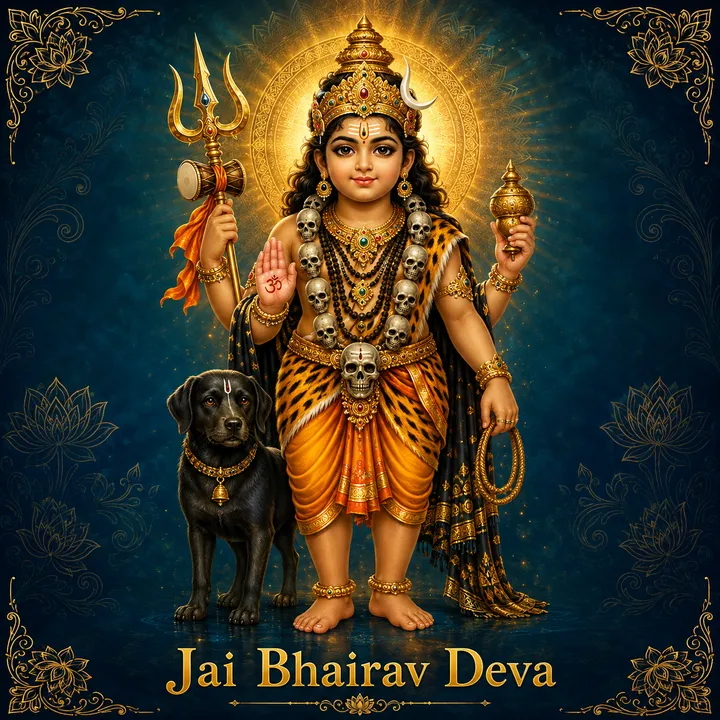
Jai Bhairav Deva is a short Hindi aarti of seven stanzas addressed to Batuk Bhairava, the youthful, child-like (bālaka) form of Bhairava. The aarti’s own text names this form directly — “बटुकनाथ बन बालक” (“as Batuknath, the child form”) — distinguishing it from Bhairava’s other well-known aspect, Kaal Bhairav, the fierce, time-governing guardian of Kashi described in other Bhairava hymns. The stanzas describe Batuk Bhairava’s iconography (his dog mount, his trident, the anklets and damaru that accompany his form) and his role as a remover of fear and sin, closing with the promise that whoever sings this aarti with devotion obtains the fulfillment of their heart’s wishes.
Each stanza is followed by its own opening couplet as a refrain, in keeping with the usual convention for aartis of this kind — the same “Jai Bhairav Deva, Prabhu Jai Bhairav Deva” invocation recurs after every stanza. In the print and web sources this page draws from, that repetition is usually abbreviated with an ellipsis after the first stanza rather than spelled out in full each time; this page spells it out in full for every stanza, matching how the aarti is actually sung and how comparable aarti pages on this site (such as Jai Ambe Gauri) present their own refrains.
Origin and source
No named composer is confidently documented for this aarti in scholarly sources. The closing stanza contains a self-reference — “कहे धरनी धर” (“says Dharanidhar”) — that devotional sources commonly read as the composer signing the hymn, in the same way the Bhairav Chalisa’s closing verses name “Sundar Das.” As with that chalisa, this identification rests on the verse’s own internal wording rather than independent literary-historical confirmation.
This aarti’s own verses do not make the explicit claim, found in the Bhairav Chalisa (“भैरव रूप कियो शिव धारण” — “Shiva took on the form of Bhairav”), that identifies Bhairava as a form Shiva assumed. Here, the text instead names Kali and Gaura Devi as the ones who perform seva (service) for Bhairav Deva. Because this specific aarti does not carry the Shiva-identification found elsewhere in Bhairava devotional literature, this page does not link Batuk Bhairava to a Shiva deity page or to Shiva-specific mantras — that association may still hold in the wider tradition, but it isn’t something this text itself states.
The verbatim text on this page was checked against several devotional-lyrics sources and one line required a correction: most sources render the sixth stanza as “जन मन हरषावत” (“delighting the hearts of devotees”), while a couple of otherwise-identical sources print “जल मन हरषावत” (“delighting the water-mind”), which does not parse as sensible Hindi. This page follows the “जन मन” reading, which is well attested and grammatically coherent.
One word could not be settled the same way. Of five Bhairav aarti sources checked, two carry this stanza, and both print “भाषावाली”; the one of those two that supplies a commentary glosses the oil and the curd and passes over that word. The English meaning given for the stanza therefore renders only the offering the rest of the line names, and the plea that follows it.
How it is recited
Jai Bhairav Deva is recited by devotees seeking Batuk Bhairava’s protection from fear and misfortune, typically during an aarti with a lit lamp, in the same devotional setting as other Bhairava hymns. It is closely associated with Kaal Bhairav Ashtami — the eighth day of the waning moon in the month of Margashirsha (November–December), Bhairava’s principal festival — and is also recited by many devotees on Sunday and Tuesday, the days of the week traditionally linked to Bhairava.
Frequently asked questions
How many verses does Jai Bhairav Deva have?
Who is Jai Bhairav Deva dedicated to?
When is Jai Bhairav Deva typically recited?
What language is Jai Bhairav Deva composed in?
What tradition is Jai Bhairav Deva associated with?
Is an English translation of Jai Bhairav Deva available?
Is there a Roman transliteration of Jai Bhairav Deva?
Sourcing
Checked against independent sources before publishing — see our sourcing and editorial policy. Spotted an error? Report an issue .