The text
Tap Recite along to follow verse by verse — use Next, or the arrow keys.
- Stanza
- Stanza 1
युगे अठ्ठावीस विटेवरी उभा।वामांगी रखुमाई दिसे दिव्य शोभा।पुंडलिकाचे भेटी परब्रह्म आले गा।चरणी वाहे भीमा उद्धरी जगा॥
yuge aṭṭhāvīsa viṭevarī ubhā।vāmāṅgī rakhumāī dise divya śobhā।puṇḍalikāce bheṭī parabrahma āle gā।caraṇī vāhe bhīmā uddharī jagā॥
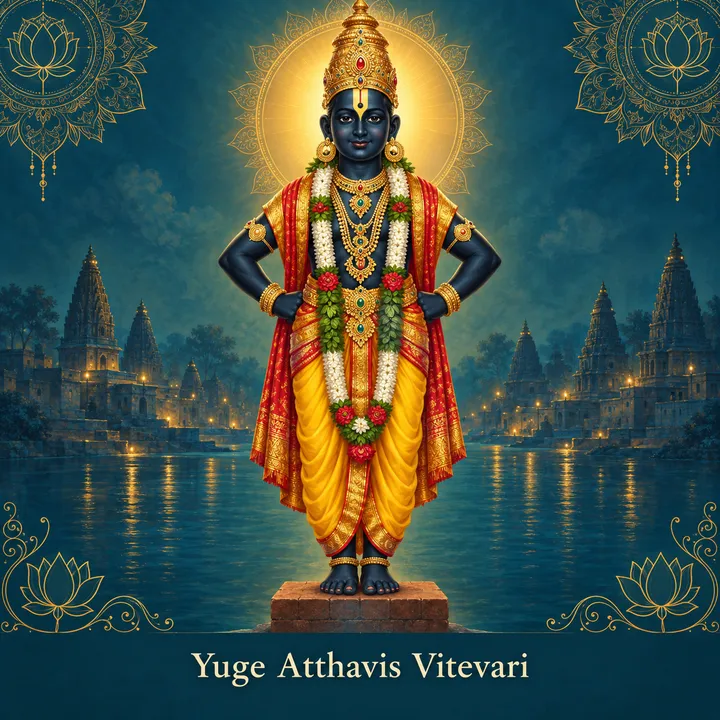
For twenty-eight ages he has stood upon the brick, Rukmini at his left in radiant, divine splendor. The Supreme Being came here for Pundalik's sake, and the Bhima flows at his feet, redeeming the world.
- Refrain
- Refrain (Dhrupad)
जय देव जय देव जय पांडुरंगा।रखुमाईवल्लभा राईच्या वल्लभा पावे जिवलगा॥
jaya deva jaya deva jaya pāṇḍuraṅgā।rakhumāīvallabhā rāīcyā vallabhā pāve jivalagā॥
Glory, glory, glory to Panduranga — beloved of Rukmini, beloved of Rai, come to me, my own dear one.
- The 4 stanzas
- Stanza 2
तुळसीमाळा गळा कर ठेवुनी कटी।कासे पीतांबर कस्तुरी लल्लाटी।देव सुरवर नित्य येती भेटी।गरुड हनुमंत पुढे उभे राहती॥
tuḷasīmāḷā gaḷā kara ṭhevunī kaṭī।kāse pītāmbara kasturī lallāṭī।deva suravara nitya yetī bheṭī।garuḍa hanumanta puḍhe ubhe rāhatī॥
A tulsi garland at his throat, hands resting on his hips, clad in yellow silk, musk marking his brow. Gods and celestials come daily for his darshan, while Garuda and Hanuman stand ever before him.
- Stanza 3
धन्य वेणुनाद अनुक्षेत्रपाळा।सुवर्णाची कमळे वनमाळा गळा।राई रखुमाबाई राणीया सकळा।ओवाळिती राजा विठोबा सावळा॥
dhanya veṇunāda anukṣetrapāḷā।suvarṇācī kamaḷe vanamāḷā gaḷā।rāī rakhumābāī rāṇīyā sakaḷā।ovāḷitī rājā viṭhobā sāvaḷā॥
Blessed is the sound of the flute across this sacred precinct; golden lotuses and a forest garland hang at his throat. Rai, Rukmini, and all his queens together wave the lamp before dark-complexioned King Vithoba.
- Stanza 4
ओवाळू आरत्या कुरवंड्या येती।चंद्रभागेमाजी सोडुनिया देती।दिंड्या पताका वैष्णव नाचती।पंढरीचा महिमा वर्णावा किती॥
ovāḷū āratyā kuravaṇḍyā yetī।candrabhāgemājī soḍuniyā detī।diṇḍyā patākā vaiṣṇava nācatī।paṇḍharīcā mahimā varṇāvā kitī॥
Lamps are waved, and offerings circled round the flame are brought and set afloat upon the Chandrabhaga river. Bearing banners, Vaishnav pilgrims dance in procession — how much can be told of Pandhari's glory?
- Stanza 5
आषाढी कार्तिकी भक्तजन येती।चंद्रभागेमाजी स्नान जे करिती।दर्शनहेळामात्रे तया होय मुक्ती।केशवासी नामदेव भावे ओवाळिती॥
āṣāḍhī kārtikī bhaktajana yetī।candrabhāgemājī snāna je karatī।darśanaheḷāmātre tayā hoya muktī।keśavāsī nāmadeva bhāve ovāḷitī॥
On Ashadhi and Kartiki Ekadashi, devotees come and bathe in the Chandrabhaga; a mere moment of his darshan grants them liberation. With loving devotion, Namdev waves the lamp before Keshava.
Overview
Yuge Atthavis Vitevari (“for twenty-eight ages, upon the brick”) is one of the principal Marathi aartis sung to Vitthal, also called Vithoba or Panduranga — the deity enshrined at Pandharpur, on the banks of the Chandrabhaga (Bhima) river in Maharashtra. Vitthal is the object of devotion of the Varkari sampradaya, a centuries-old bhakti tradition built around the twice-yearly wari, a pilgrimage on foot to Pandharpur, and around the continuous singing of abhangs (devotional verses) by saint-poets from Dnyaneshwar and Namdev onward. Each of the aarti’s five stanzas is followed by the same refrain — “Jai Dev Jai Dev Jai Panduranga” — praising Vitthal as the beloved of his queens Rukmini and Rai.
Some printed aarti sangraha (collection) booklets insert an additional stanza, beginning “dhanya pushpavati bhimasangam,” between the third and fourth stanzas given here. That stanza is not consistently attested across the widely used printed and recited versions checked for this page, so it is left out rather than guessed at.
Origin and source
The aarti’s closing line — “keshavasi Namdev bhave ovalati,” “with loving devotion, Namdev waves the lamp before Keshava” — carries the same first-person signature convention used throughout the Varkari sant tradition’s abhangs, and the aarti is traditionally attributed on that basis to Namdev, the thirteenth-century Varkari saint-poet. The opening stanza references the Pundalik legend at the heart of Vitthal’s iconography and his very name: Vitthal is said to have come to Pandharpur to meet his devotee Pundalik, who, absorbed in caring for his aged parents, threw him a brick (a “vit”) to stand on rather than interrupt his service — the origin, in this telling, of both the place name and Vitthal’s standing, brick-footed form (vitevari ubha, “standing on the brick”).
Within the Varkari tradition and in Vaishnav practice more broadly, Vitthal is understood as a regional form of Krishna, an identification also reflected in this aarti’s own reference to “Keshava,” one of Krishna’s names. That identification is old and widely held, but not the only view: some scholarship has traced Vitthal’s origins to a pre-existing pastoral or Shaiva-linked folk deity of the Deccan, later absorbed into Vaishnav devotion and merged with Krishna; and within Varkari theology itself, Vitthal is often approached less as an alias for Krishna than as a complete, self-standing form of the Supreme in his own right, addressed directly as Panduranga or Vithoba rather than by comparison to any other deity.
How it is recited
Yuge Atthavis Vitevari is sung with its refrain repeated after every stanza, typically as the aarti thali — a plate bearing a lit lamp — is circled before Vitthal’s image, both in home worship and at the Vitthal Rukmini temple in Pandharpur. It carries particular weight during the wari, when dindis (organized pilgrim processions, named in the aarti’s own fourth stanza) walk to Pandharpur for Ashadhi Ekadashi and again, in a smaller pilgrimage, for Kartiki Ekadashi, and pilgrims bathe in the Chandrabhaga river exactly as the aarti’s closing stanza describes.
Frequently asked questions
How many verses does Yuge Atthavis Vitevari have?
Who is Yuge Atthavis Vitevari dedicated to?
When is Yuge Atthavis Vitevari typically recited?
What language is Yuge Atthavis Vitevari composed in?
What tradition is Yuge Atthavis Vitevari associated with?
Is an English translation of Yuge Atthavis Vitevari available?
Is there a Roman transliteration of Yuge Atthavis Vitevari?
Sourcing
Checked against independent sources before publishing — see our sourcing and editorial policy. Spotted an error? Report an issue .