The text
Tap Recite along to follow verse by verse — use Next, or the arrow keys.
- Stanza 1
श्री रामचन्द्र कृपालु भजु मन हरण भवभय दारुणं।नवकंज लोचन कंज मुख कर कंज पद कंजारुणं॥
śrī rāmacandra kṛpālu bhaju mana haraṇa bhavabhaya dāruṇaṃ।navakañja locana kañja mukha kara kañja pada kañjāruṇaṃ॥
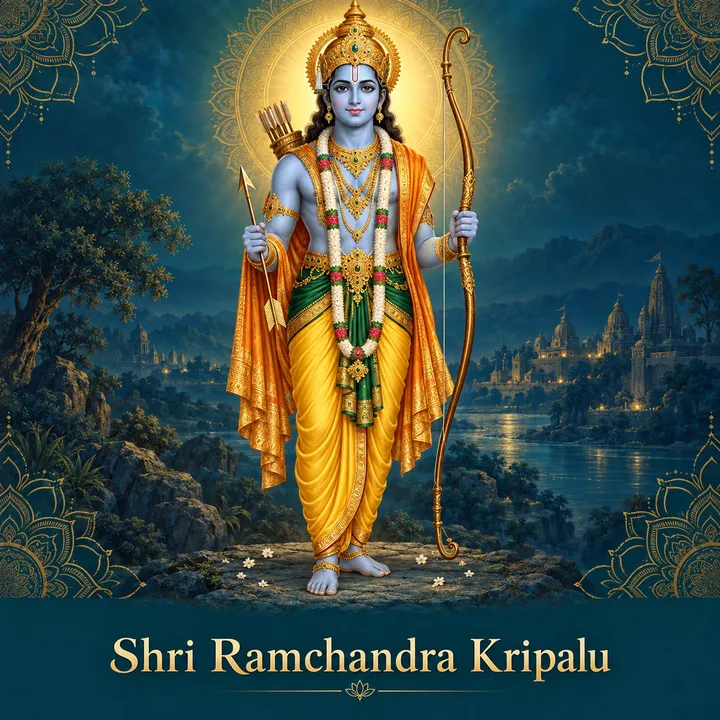
O mind, worship the compassionate Ramachandra, remover of the terrible fear of worldly existence — whose eyes are a fresh-opened lotus, whose face, hands, and feet are lotuses, his feet reddish as the lotus's heart.
- Stanza 2
कंदर्प अगणित अमित छवि नव नील नीरद सुन्दरं।पटपीत मानहुं तड़ित रुचि शुचि नौमि जनक सुतावरं॥
kandarpa agaṇita amita chavi nava nīla nīrada sundaraṃ।paṭapīta mānahuṃ taḍita ruci śuci naumi janaka sutāvaraṃ॥
His beauty outshines countless Kamadevas beyond measure; he is lovely as a fresh, dark rain-cloud. His yellow silk garment gleams like lightning — I bow to the pure and radiant lord who is husband to Janaka's daughter, Sita.
- Stanza 3
भजु दीनबन्धु दिनेश दानव दैत्यवंशनिकन्दनं।रघुनन्द आनन्दकन्द कोसलचन्द्र दशरथनन्दनं॥
bhaju dīnabandhu dineśa dānava daityavaṃśanikandanaṃ।raghunanda ānandakanda kosalacandra daśarathanandanaṃ॥
Worship him, friend of the humble, sun to the lineage of demons and daityas he uproots; joy of the Raghu clan, root of all bliss, moon of Kosala, son of Dasharatha.
- Stanza 4
सिर मुकुट कुण्डल तिलक चारु उदारु अंग विभूषणं।आजानुभुज शरचापधर संग्राम जित खरदूषणं॥
sira mukuṭa kuṇḍala tilaka cāru udāru aṅga vibhūṣaṇaṃ।ājānubhuja śaracāpadhara saṅgrāma jita kharadūṣaṇaṃ॥
A crown on his head, earrings, a tilak on his brow — his generous form adorned with ornaments; his arms reach to his knees, he bears bow and arrow, and in battle he conquered Khara and Dushana.
- Stanza 5
इति वदति तुलसीदास शंकर शेष मुनि मन रंजनं।मम हृदयकंज निवास कुरु कामादिखलदलगंजनं॥
iti vadati tulasīdāsa śaṅkara śeṣa muni mana rañjanaṃ।mama hṛdayakañja nivāsa kuru kāmādikhaladalagañjanaṃ॥
Thus speaks Tulsidas: O delighter of the minds of Shankara, Shesha, and the sages — make your dwelling in the lotus of my heart, destroyer of the ranks of lust and the other enemies within.
Overview
Shri Ramchandra Kripalu — also known as Shri Ram Stuti — is a five-stanza hymn to Rama, composed in a Sanskrit-heavy register of Awadhi. Each stanza is built from short, tightly packed epithets rather than narrative sentences: Rama’s eyes, face, hands, and feet are each called a lotus in the space of a single line; his complexion is likened to a fresh rain-cloud; his ornaments, bow, and arms are named one after another. The hymn addresses the reciting mind directly — “bhaju mana,” “O mind, worship” — and closes with Tulsidas naming himself and asking Rama to dwell in his heart. Traditional commentary identifies its metre as Harigitika chhand.
Origin and source
Shri Ramchandra Kripalu is a composition of Goswami Tulsidas, the 16th-century poet-saint best known for the Ramcharitmanas. Its final stanza names its author directly (“iti vadati Tulsidas,” “thus speaks Tulsidas”), which is how devotional sources trace it back to him. Devotional sources commonly place this particular stuti in his Vinaya Patrika, a separate collection of hymns and petitions to Rama distinct from the Ramcharitmanas’s continuous narrative — though, as with much devotional literature that circulates primarily through recitation, its exact place within Tulsidas’s body of work is treated with more certainty in popular sources than in scholarship on the manuscript tradition.
How it is recited
Shri Ramchandra Kripalu is sung as a bhajan and recited as part of Rama devotion year-round, with particular prominence around Ram Navami, the festival of Rama’s birth. It is commonly sung in front of a lit lamp, either on its own or alongside the separate Ram Aarti, and is a familiar opening or closing piece in Rama-focused kirtan and satsang gatherings. Its short, epithet-based lines make it easy to sing from memory, which has helped keep it in wide daily circulation among Rama’s devotees.
Frequently asked questions
How many verses does Shri Ramchandra Kripalu have?
Who is Shri Ramchandra Kripalu dedicated to?
When is Shri Ramchandra Kripalu typically recited?
What language is Shri Ramchandra Kripalu composed in?
What tradition is Shri Ramchandra Kripalu associated with?
Is an English translation of Shri Ramchandra Kripalu available?
Is there a Roman transliteration of Shri Ramchandra Kripalu?
Sourcing
Checked against independent sources before publishing — see our sourcing and editorial policy. Spotted an error? Report an issue .