Overview
Dhanteras — Dhana Trayodashi, the thirteenth day of the waning fortnight of Kartika — opens the five days of Diwali. Its name pairs dhana, wealth, with the tithi, and its two pujas follow from that: one to Dhanvantari, the physician of the gods who rose from the ocean of milk carrying the pot of amrita, and one to Lakshmi with Kubera, keeper of the gods’ treasury. Households buy something new for the home on this day, light the first lamps of the season, and set a single lamp outside the door for Yama.
The stories
Dhanvantari and the churning of the ocean. The Bhagavata Purana (8.8) tells how, when the gods and asuras churned the ocean of milk, Dhanvantari emerged last of all, holding the pot of amrita. Ayurvedic tradition counts him as its founding teacher, and the Indian government’s Ministry of AYUSH has kept Dhanteras as National Ayurveda Day since 2016 on the strength of that association. The puja to Dhanvantari is older in the physicians’ communities than in ordinary households, where the day is more about Lakshmi.
Yama and the lamp. A widely told story, not attached to a single scripture, concerns a young prince fated to die of a snakebite on the fourth day after his wedding. His wife kept him awake all night with songs and stories, heaped her ornaments and gold coins at the doorway and lit lamps all around them; Yama, arriving as a serpent, was dazzled by the light, sat listening until dawn and left without taking the prince. From this comes the Yama Deepam — one lamp, facing south, lit at dusk on Trayodashi. The Skanda Purana’s Kartika Mahatmya prescribes lamp offerings through the month; the Yama lamp is the one this day keeps.
How the day is kept
The house is already being cleaned for Diwali; Dhanteras is when the first rangoli goes down and the first lamps are lit. During the day, families buy a new utensil — traditionally brass or silver — or a coin, or a piece of jewellery, and bring it home before the puja. The purchase is a custom, not a requirement; a family that buys nothing still keeps the day with the lamp and the puja.
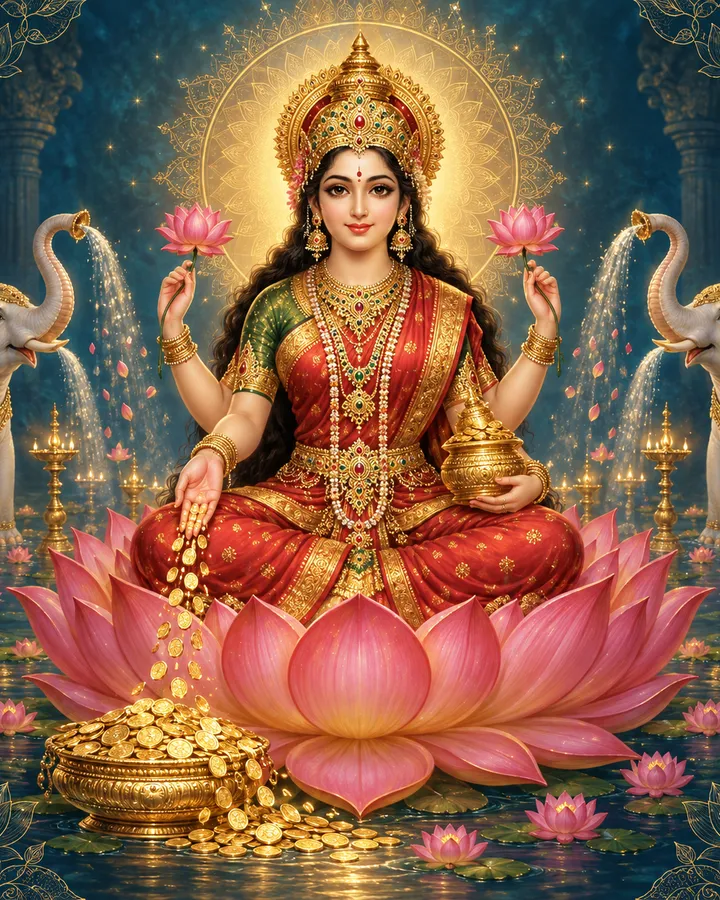
The evening puja. After sunset, in pradosh kala, Lakshmi and Kubera are worshipped together — Lakshmi’s image or a coin for her, a small mound of rice or a written Shri for Kubera — with flowers, sweets and the new purchase placed before them. Dhanvantari is invoked, in homes that do so, with a short prayer for health. The Jai Dhanvantari Deva aarti and the Kubera aarti linked below are the ones sung. Jaap on this evening is usually a Lakshmi mantra; the Kubera mantra is also kept in trading households.
Yama Deepam. As the light fails, one lamp of wheat-flour dough or clay, filled with mustard oil, is placed outside the main door facing south and left to burn out. It is the only lamp of Diwali that faces away from the house.
Regional forms
- North and West India: the observance described above, with the metal purchase most prominent in cities. Gujarat’s trading families begin the Diwali account-closing on this day.
- Maharashtra: Dhanatrayodashi; households offer a preparation of dry coriander seed and jaggery (dhane) — a play on the day’s name — and the Yama lamp is widely kept.
- South India: the day is quieter; the Tamil and Kannada emphasis falls on Naraka Chaturdashi the next morning.
- Physicians and Ayurvedic institutions: Dhanvantari Jayanti, with a formal puja to the deity, independent of the household festival.
The date
Dhanteras is the day Trayodashi is current in pradosh kala in one’s own city. When Trayodashi begins during the day and runs into the next evening as well, the calendars choose the evening it covers more fully; the date can therefore sit a day apart between Delhi and the south, and a day apart between calendars that use different rules. The table shows New Delhi with its pradosh window.
Dates 2026 and 2027
Dates are for New Delhi (IST), computed from the tithi rule for 1 Sept 2026 to 31 Dec 2027. Rows marked computed have not yet been checked against a published panchang — confirm with a local calendar before planning around them. Dates already past are kept for reference.
| Date | Observance | Tithi at sunrise | Tithi (IST) | Notes |
|---|---|---|---|---|
| Dhanteras | Krishna Dwadashi, Kartika | 6 Nov 10:31 → 7 Nov 10:48 | Pradosh kala 17:32–19:56 (New Delhi) verified | |
| Dhanteras | Krishna Trayodashi, Kartika | 27 Oct 01:04 → 27 Oct 22:50 | Pradosh kala 17:40–20:04 (New Delhi) computed |
Mantra, aarti and chalisa for Dhanteras
Frequently asked questions
When is Dhanteras in 2026?
When is Dhanteras in 2027?
Is Dhanteras the first day of Diwali?
Why do people buy metal on Dhanteras?
What is the lamp outside the door for?
When exactly is the Dhanteras puja done?
Sourcing
Checked against independent sources before publishing — see our sourcing and editorial policy. Spotted an error? Report an issue .