Overview
Lakshmi (लक्ष्मी, Lakṣmī) is the goddess of wealth, fortune, and abundance, and the consort of Vishnu. She is attested as early as the Rig Veda, in the dedicated hymn known as the Shri Sukta, and remains one of the most widely worshipped goddesses in Hindu practice today, central above all to the annual celebration of Diwali.
This page also covers Mahalakshmi, a name closely associated with Lakshmi that this page treats as an honorific form of the same goddess rather than a separate deity — the reasoning for that is laid out below, since the two names are easy to conflate incorrectly.
Is Mahalakshmi a separate goddess?
Not in the way the question is often assumed to mean. “Mahalakshmi” is used in two distinct contexts, and it’s worth keeping them apart.
In devotional literature such as the Skanda Purana’s Lakshmi Sahasranama, and at major temples such as Kolhapur and Mumbai, “Mahalakshmi” is simply an honorific, superlative title — “great Lakshmi” — applied to the same goddess. This is the dominant, uncontested usage across mainstream tradition.
Separately, the Devi Mahatmya, a roughly 700-verse text within the Markandeya Purana, describes the Goddess taking three functional forms in battle: Mahakali, Mahalakshmi, and Mahasaraswati, each slaying a different demon (Mahakali kills Madhu and Kaitabha; Mahalakshmi kills Mahishasura; Mahasaraswati kills Shumbha and Nishumbha). These are described as aspects of one Supreme Shakti rather than separate, independently-originated deities, and the “Mahalakshmi” aspect within this triad is explicitly the wealth-and-preservation energy associated with Vishnu’s shakti — in other words, still conceptually Lakshmi, personified here as one face of the Goddess for the purposes of this specific narrative.
This is a different concept from the Tridevi — Lakshmi, Parvati, and Saraswati — which genuinely are three separate goddesses, each paired with a different god. The two triads are sometimes blurred together in casual retellings; this page keeps them distinct.
Family
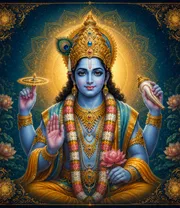
Lakshmi’s consort is Vishnu, in the well-established Lakshmi-Narayana pairing. Her parentage, however, is genuinely contested within a single text: the Vishnu Purana itself contains two different accounts. The more popular version describes her rising fully formed from the Samudra Manthan, the churning of the cosmic ocean of milk, on a lotus, and choosing Vishnu as her husband. The same text elsewhere names her daughter of the sage Bhrigu and his wife Khyati, born under the name Bhargavi — and the narrator of the Vishnu Purana itself acknowledges the tension between the two accounts rather than resolving it. This page presents the ocean-birth account as the more widely known, and notes the Bhrigu-Khyati account as a real, alternate Puranic tradition.
Iconography
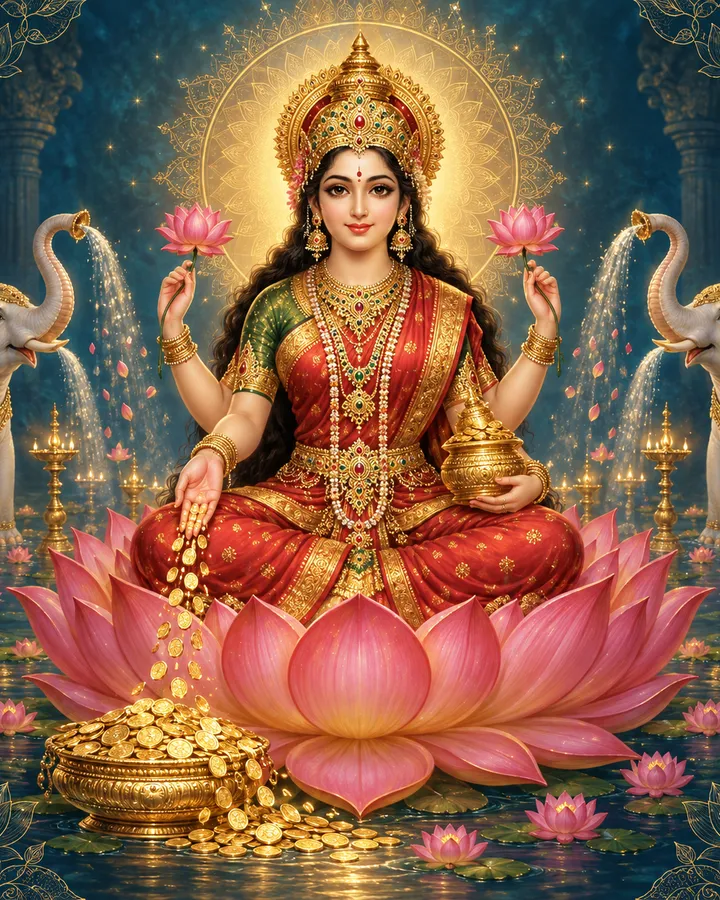
Lakshmi is shown seated or standing on a fully bloomed lotus, usually with four arms, her golden or reddish complexion dressed in red and gold. Her vehicle varies genuinely across regions and periods — an owl in Bengali folk tradition, an elephant in the very old Gaja-Lakshmi motif found on ancient coins and seals, a lion in Gupta-period imagery — and no single vahana should be treated as her “official” one. A separate eighteen-armed form, Mahasri, is described in the Pancharatra Vaishnava text known as the Lakshmi Tantra, though this belongs to a specific tantric tradition rather than everyday temple iconography.
Worship and festivals
Diwali is Lakshmi’s central festival: its main night is dedicated specifically to Lakshmi Puja, worship performed in homes and businesses across India seeking her blessing for the year ahead. Sharad Purnima, also called Kojagiri Purnima, the autumn full moon, is marked in western and eastern India with a night vigil in her honor. Varalakshmi Vratam, a Friday vrat observed mainly in Andhra Pradesh, Tamil Nadu, and Karnataka, falls before Sharad Purnima. She is also honored on one night of Navaratri, in the preservation-and-wealth framing of the festival’s nine nights.
The Ashta Lakshmi, eight named manifestations of the goddess, each presiding over a distinct source of wealth — material, agricultural, royal, courage, knowledge, progeny, victory, and spiritual — form a well-attested devotional set in their own right, often invoked together in temple worship and daily prayer.
In scripture
- Rigveda — the Shri Sukta, her earliest dedicated hymn.
- Vishnu Purana — source of both the Samudra Manthan and Bhrigu-Khyati origin accounts.
- Skanda Purana — the Lakshmi Sahasranama, source of the “Mahalakshmi” honorific.
- Devi Mahatmya (Markandeya Purana) — the Mahakali-Mahalakshmi-Mahasaraswati battle-form triad, distinct from the Tridevi shared with Durga and Kali.
Iconography at a glance
Major temples
Mahalakshmi Temple, Kolhapur
Kolhapur, Maharashtra, India
Locally known as Ambabai; regarded as one of India's Shakti Peethas, with a black-stone idol in the Hemadpanti architectural style. Its construction is commonly, though only approximately, dated to the Chalukya period.
Open in Maps ↗Mahalakshmi Temple, Mumbai
Breach Candy, Mumbai, Maharashtra, India
Houses images of Mahalakshmi, Mahakali, and Mahasaraswati together, reflecting the Devi Mahatmya's three-goddess battle-form tradition described below. Its exact founding date is disputed across sources.
Open in Maps ↗Worth knowing
- Lakshmi is attested from the Vedic period, in the Shri Sukta hymn, but her fixed pairing with Vishnu as consort solidified later, particularly by the late epic period.
- The Vishnu Purana itself contains two differing accounts of her origin — one describing her rising from the Samudra Manthan, the churning of the ocean of milk, the other naming her daughter of the sage Bhrigu — and the text does not fully resolve the tension between them.
- "Mahalakshmi" functions primarily as an honorific, superlative epithet for Lakshmi ("great Lakshmi"), as in the Skanda Purana's Lakshmi Sahasranama, rather than naming a separate goddess.
- In the Devi Mahatmya, "Mahalakshmi" also names one of three functional forms taken by the Goddess in battle, alongside Mahakali and Mahasaraswati — a different, tantric concept from the Tridevi (Lakshmi, Parvati, Saraswati), which are three distinct goddesses rather than three aspects of one.
- The Ashta Lakshmi, a set of eight named manifestations each presiding over a distinct source of wealth — material, agricultural, royal, courage, knowledge, progeny, victory, and spiritual — is a well-attested devotional tradition in its own right.