Overview
Kubera (कुबेर, Kubera), also widely known as Vaishravana, is the treasurer of the gods, king of the Yakshas, and guardian deity of the north among the Ashta Dikpalas, the eight directional guardians of Hindu cosmology. He is worshipped across three major Indian religious traditions — as Kubera in Hinduism, Vaishravana (one of the Four Heavenly Kings) in Buddhism, and Sarvanubhuti in Jainism — a genuinely cross-traditional figure rather than one confined to a single religion.
Family
Kubera’s exact parentage differs by text: the Mahabharata names him son of Prajapati Pulastya and Idavida, making him brother to Vishrava; Puranic tradition instead makes him son of Vishrava (Pulastya’s own son), placing him a generation later. This page does not assert one version over the other. His half-siblings by the same father, Vishrava, but a different mother, the rakshasi princess Kaikesi, are Ravana, Kumbhakarna, Vibhishana, and Shurpanakha — a relationship well established across the Ramayana tradition. His consort is Bhadra, also called Riddhi, daughter of the asura Mura; his best-attested sons are Nalakubara and Manigriva, also called Manibhadra.
Mythology
Kubera originally ruled the golden city of Lanka, gifted to him by Brahma along with the flying palace Pushpaka Vimana. His half-brother Ravana later overthrew and expelled him from the city, forcing Kubera to resettle at Alaka, near Mount Kailash in the Himalayas, where he presides over the garden Chaitraratha — both described in classical poetry, notably Kalidasa’s Meghaduta, as places of extraordinary, almost surreal wealth.
His textual character has shifted markedly over time. In early Vedic-era texts such as the Shatapatha Brahmana, he is characterized less favorably, described as a lord of thieves and chief of malevolent spirits. By the time of the epics and Puranas, he has been rehabilitated into a respected Lokapala, treasurer of the Devas, and guardian of the north — a genuine change in his standing across the textual tradition, not simply a difference of emphasis.
Iconography
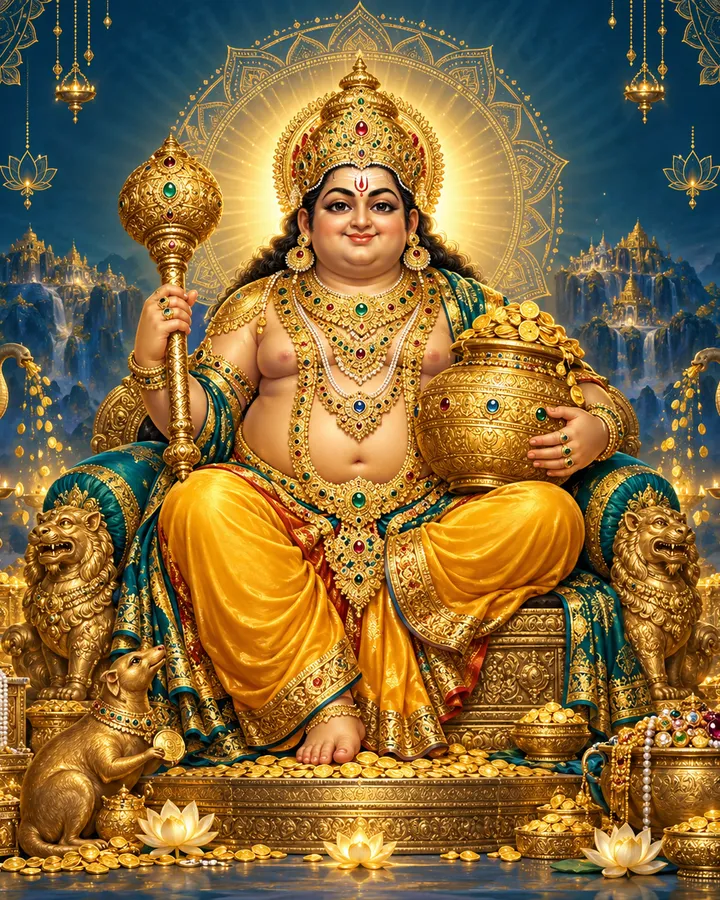
Kubera’s physical form is deliberately unhandsome: dwarfish and pot-bellied, with a single eye and broken teeth described in some Puranic accounts, symbolizing that the guardian of wealth need not himself be beautiful. He is typically shown holding a mace and a money-pot, sometimes a pomegranate or a sheaf of jewels. His vehicle varies by tradition — a man in the older nara-vahana convention, a mongoose spitting jewels in Buddhist Vaishravana iconography, or occasionally an elephant or horse in regional depictions — and no single vahana should be treated as canonical.
Worship
Dhanteras, the first day of the Diwali festival cluster, falling on Krishna Trayodashi in Ashwin or Kartika, is Kubera’s principal occasion for worship, honoring him alongside Lakshmi and Dhanvantari. He is also worshipped alongside Lakshmi on the main Diwali night in many households and temples, in his role as her treasurer and steward.
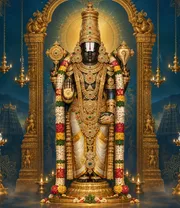
At the Tirumala Venkateswara Temple in Tirupati, Kubera is central to a well-known legend rather than being the temple’s presiding deity: Vishnu, in his Venkateswara form, is said to have borrowed a vast sum from Kubera to fund his wedding to Padmavati, a debt devotees are traditionally said to help repay through donations to the temple’s hundi — the origin, in popular belief, of that donation-box tradition.
In scripture
- Atharvaveda — his earliest textual appearance.
- Ramayana — his conflict with Ravana and loss of Lanka.
- Mahabharata — his court and status as a respected Lokapala.
- Meghaduta (Kalidasa) — a classical poetic description of his city, Alaka.
Iconography at a glance
Major temples
Tirumala Venkateswara Temple
Tirupati, Andhra Pradesh, India
Not a dedicated Kubera temple, but central to a well-known legend in which Vishnu, as Venkateswara, borrowed a vast sum from Kubera to fund his wedding — the traditional explanation offered for why devotees still contribute to the temple's donation hundi today.
Open in Maps ↗Kubera Temple
Chalavara, Palakkad district, Kerala, India
A modern, purpose-built, dedicated Kubera temple, inaugurated in 2021 — real and verifiable, though recent rather than historic.
Open in Maps ↗Worth knowing
- Kubera is the half-brother of Ravana, Kumbhakarna, and Vibhishana, sharing their father Vishrava but not their mother — the reason, per the Ramayana tradition, that he lost the city of Lanka to Ravana.
- He is one of the Ashta Dikpalas, the eight guardians of the directions, specifically guardian of the north.
- His city, Alaka, and his garden, Chaitraratha, are described in classical poetry, notably Kalidasa's Meghaduta, as places of extraordinary wealth.
- In early Vedic-era texts such as the Shatapatha Brahmana, Kubera was characterized less favorably, as a lord of thieves and malevolent spirits, before his later rehabilitation into a respected guardian deity in the epics and Puranas.
- He is worshipped across three religious traditions under different names — Kubera or Vaishravana in Hinduism, Vaishravana (one of the Four Heavenly Kings) in Buddhism, and Sarvanubhuti in Jainism.