The text
Tap Recite along to follow verse by verse — use Next, or the arrow keys.
- Stanza 1 (refrain)
आरती कीजै श्री रघुवर जी की।सत् चित् आनंद शिव सुंदर की॥
āratī kījai śrī raghuvara jī kī।sat cit ānanda śiva sundara kī॥
Let us perform the aarti of Shri Raghuvar (Rama) — truth, consciousness, and bliss; auspicious and beautiful.
- Stanza 2
दशरथ तनय कौशल्या नंदन।सुर मुनि रक्षक दैत्य निकंदन॥अनुगत भक्त भक्त उर चंदन।मर्यादा पुरुषोत्तम वर की॥आरती कीजै श्री रघुवर जी की।सत् चित् आनंद शिव सुंदर की॥
daśaratha tanaya kauśalyā nandana।sura muni rakṣaka daitya nikandana॥anugata bhakta bhakta ura candana।maryādā puruṣottama vara kī॥āratī kījai śrī raghuvara jī kī।sat cit ānanda śiva sundara kī॥
Son of Dasharatha, joy of Kausalya, protector of gods and sages, destroyer of demons. Sandalwood to the hearts of the devoted, best among those who uphold the bounds of right conduct (Maryada Purushottam). Let us perform the aarti of Shri Raghuvar — truth, consciousness, and bliss; auspicious and beautiful.
- Stanza 3
निर्गुण सगुण अनूप रूप निधि।सकल लोक वंदित विभिन्न विधि॥हरण शोक-भय दायक नव निधि।माया रहित दिव्य नर वर की॥आरती कीजै श्री रघुवर जी की।सत् चित् आनंद शिव सुंदर की॥
nirguṇa saguṇa anūpa rūpa nidhi।sakala loka vandita vibhinna vidhi॥haraṇa śoka-bhaya dāyaka nava nidhi।māyā rahita divya nara vara kī॥āratī kījai śrī raghuvara jī kī।sat cit ānanda śiva sundara kī॥
Formless and with form beyond compare, a treasure worshipped by every world in its own way. Remover of sorrow and fear, granter of the nine treasures, the divine and perfect one, untouched by illusion. Let us perform the aarti of Shri Raghuvar — truth, consciousness, and bliss; auspicious and beautiful.
- Stanza 4
जानकी पति सुर अधिपति जगपति।अखिल लोक पालक त्रिलोक गति॥विश्व वंदित अनवद्य अमित गति।एक मात्र गति सचराचर की॥आरती कीजै श्री रघुवर जी की।सत् चित् आनंद शिव सुंदर की॥
jānakī pati sura adhipati jagapati।akhila loka pālaka triloka gati॥viśva vandita anavadya amita gati।eka mātra gati sacarācara kī॥āratī kījai śrī raghuvara jī kī।sat cit ānanda śiva sundara kī॥
Husband of Janaki (Sita), lord of the gods, lord of the world, sustainer of every realm, the motion within all three worlds. Worshipped by the universe, blameless, of boundless glory — the one motive force behind all that moves and does not move. Let us perform the aarti of Shri Raghuvar — truth, consciousness, and bliss; auspicious and beautiful.
- Stanza 5
शरणागत वत्सल व्रतधारी।भक्त कल्प तरुवर असुरारी॥नाम लेत जग पावनकारी।वानर सखा दीन दुःख हर की॥आरती कीजै श्री रघुवर जी की।सत् चित् आनंद शिव सुंदर की॥
śaraṇāgata vatsala vratadhārī।bhakta kalpa taruvara asurārī॥nāma leta jaga pāvanakārī।vānara sakhā dīna duḥkha hara kī॥āratī kījai śrī raghuvara jī kī।sat cit ānanda śiva sundara kī॥
Loving toward those who take refuge in him, keeper of his vows, a wish-fulfilling tree for devotees, foe of demons. Uttering his name purifies the world; friend of the vanaras (Hanuman among them), remover of the sorrows of the humble. Let us perform the aarti of Shri Raghuvar — truth, consciousness, and bliss; auspicious and beautiful.
Overview
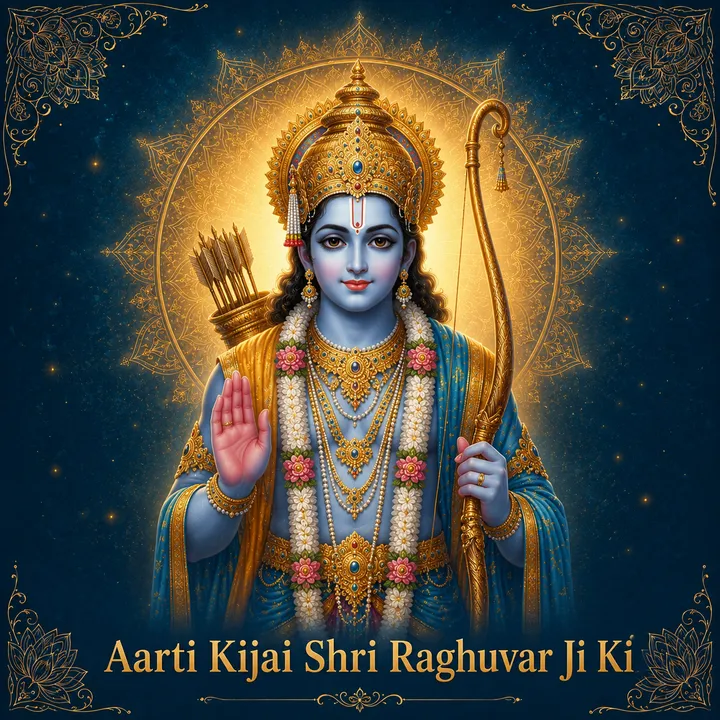
Aarti Kijai Shri Raghuvar Ji Ki is a Hindi aarti of five stanzas in praise of Rama, addressed as “Raghuvar” — best of the descendants of Raghu, an ancestor-king of Rama’s solar dynasty. Like other North Indian aartis of this kind, each new stanza is followed by the opening refrain repeated in full, so “Aarti kijai Shri Raghuvar ji ki, sat chit anand shiv sundar ki” recurs throughout the song as it is sung and printed in devotional collections. It moves through Rama’s family and birth, his standing as Maryada Purushottam — the ideal of righteous conduct — and his role as husband of Sita (Janaki), refuge-giver, and destroyer of demons.
Origin and source
Aarti Kijai Shri Raghuvar Ji Ki circulates in North Indian Vaishnav practice without a settled attribution to a single named poet — printed aarti collections generally present it as traditional, without crediting a composer. Its language and structure place it alongside other 19th- and 20th-century Hindi aartis composed for daily temple and home worship, rather than within the Ramcharitmanas or Valmiki Ramayana texts themselves. The stanzas draw on titles and ideas closely associated with the Ramcharitmanas tradition — Rama as Maryada Purushottam, husband of Janaki, and friend to the vanaras (monkey allies, chief among them Hanuman) — without quoting Tulsidas’s text directly.
How it is recited
Aarti Kijai Shri Raghuvar Ji Ki is sung by many Rama devotees as part of daily worship, and is especially prominent around Ram Navami, Rama’s birth anniversary. It is also commonly performed at the close of a Ramcharitmanas path — a full or partial recitation of Tulsidas’s retelling of the Ramayana — marking the end of the reading in the same way Aarti Kije Hanuman Lala Ki closes a Hanuman Chalisa recitation. As with most aartis, it is sung while a lit diya or camphor flame is circled before Rama’s image, with the refrain taken up by everyone present after each stanza.
Frequently asked questions
How many verses does Aarti Kijai Shri Raghuvar Ji Ki have?
Who is Aarti Kijai Shri Raghuvar Ji Ki dedicated to?
When is Aarti Kijai Shri Raghuvar Ji Ki typically recited?
What language is Aarti Kijai Shri Raghuvar Ji Ki composed in?
What tradition is Aarti Kijai Shri Raghuvar Ji Ki associated with?
Is an English translation of Aarti Kijai Shri Raghuvar Ji Ki available?
Is there a Roman transliteration of Aarti Kijai Shri Raghuvar Ji Ki?
Sourcing
Checked against independent sources before publishing — see our sourcing and editorial policy. Spotted an error? Report an issue .