

The text
Tap Recite along to follow verse by verse — use Next, or the arrow keys.
- Stanza 1 (refrain)
आरती कीजै श्रीजनक लली की।राममधुपमन कमल कली की॥
āratī kījai śrījanaka lalī kī।rāmamadhupamana kamala kalī kī॥
Let the aarti be sung to the revered daughter of Janak — the lotus-bud cherished in Ram's heart, to which he is drawn as a bee to a flower.
- Stanza 2
रामचन्द्र, मुखचन्द्र चकोरी।अन्तर साँवर बाहर गोरी।सकल सुमन्गल सुफल फली की॥आरती कीजै श्रीजनक लली की।राममधुपमन कमल कली की॥
rāmacandra, mukhacandra cakorī।antara sā̃vara bāhara gorī।sakala sumaṅgala suphala phalī kī॥āratī kījai śrījanaka lalī kī।rāmamadhupamana kamala kalī kī॥
She is the chakori bird gazing upon Ramachandra's moon-like face — dark within, fair without — she who is wholly auspicious, ripened with every good fruit. Let the aarti be sung to the revered daughter of Janak — the lotus-bud cherished in Ram's heart, to which he is drawn as a bee to a flower.
- Stanza 3
पिय दृगमृग जुग-वन्धन डोरी, पीय प्रेम रस-राशि किशोरी।पिय मन गति विश्राम थली की॥आरती कीजै श्रीजनक लली की।राममधुपमन कमल कली की॥
piya dṛgamṛga juga-vandhana ḍorī, pīya prema rasa-rāśi kiśorī।piya mana gati viśrāma thalī kī॥āratī kījai śrījanaka lalī kī।rāmamadhupamana kamala kalī kī॥
Her beloved's deer-like eyes are bound to her by love's own cord; she, ever youthful, is an ocean of the nectar of love — the resting place where her beloved's heart comes to rest. Let the aarti be sung to the revered daughter of Janak — the lotus-bud cherished in Ram's heart, to which he is drawn as a bee to a flower.
- Stanza 4
रूप-रास गुननिधि जग स्वामिनि, प्रेम प्रवीन राम अभिरामिनि।सरबस धन हरिचन्द अली की॥आरती कीजै श्रीजनक लली की।राममधुपमन कमल कली की॥
rūpa-rāsa gunanidhi jaga svāmini, prema pravīna rāma abhirāmini।sarabasa dhana haricanda alī kī॥āratī kījai śrījanaka lalī kī।rāmamadhupamana kamala kalī kī॥
She is the very essence of beauty, a treasury of virtues, mistress of the world, wise in love and Ram's delight — she who is the whole wealth and joy of the Lord. Let the aarti be sung to the revered daughter of Janak — the lotus-bud cherished in Ram's heart, to which he is drawn as a bee to a flower.
Overview
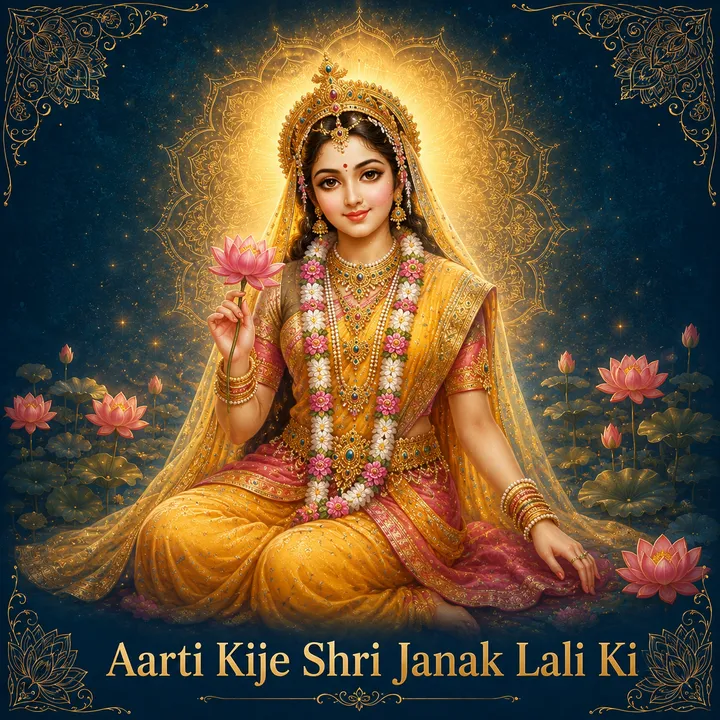
Aarti Kije Shri Janak Lali Ki is a short Hindi aarti of four stanzas addressed to Sita as “Janak lali” — the beloved daughter of King Janak of Mithila. After an opening refrain, each of the following stanzas dwells on her beauty and devotion and then returns to that same refrain, in the call-and-response pattern common to Hindi aartis. Unlike aartis built around a narrative of trials or battles, its verses stay close to a single image: Sita as the lotus-bud cherished in Ram’s heart, and Ram as the bee drawn to her.
Origin and source
No single named composer is credited for this aarti in the devotional collections that carry it; like many short aartis of its kind, it circulates as part of the shared North Indian aarti-sangraha (aarti collection) repertoire rather than as a text with a fixed literary attribution. Its language sits in the same literary Hindi register as other traditional Ram-Sita aartis such as Aarti Kije Ram Lala Ki, built from short rhyming couplets rich in classical Indian poetic imagery — Sita as a chakori bird fixed on the moon of Ram’s face, her eyes bound to her beloved’s by a cord of love — rather than a chronological retelling of her story.
How it is recited
This aarti is sung on most occasions connected to Goddess Sita, alongside her daily worship in Vaishnav households devoted to Sita-Ram. It has particular significance on Sita Navami, her traditional birth anniversary, observed on the ninth day of Vaishakha’s bright fortnight, when married women keep a fast for their husbands’ long life. It is also sung around Vivah Panchami, the anniversary of Sita and Ram’s wedding observed on the fifth day of Margashirsha’s bright fortnight and celebrated with particular devotion at Janakpur and Ayodhya. As with other aartis, it is typically sung while a lit diya or camphor flame is circled before the deity’s image, with the refrain repeated after each stanza.
Frequently asked questions
How many verses does Aarti Kije Shri Janak Lali Ki have?
Who is Aarti Kije Shri Janak Lali Ki dedicated to?
When is Aarti Kije Shri Janak Lali Ki typically recited?
What language is Aarti Kije Shri Janak Lali Ki composed in?
What tradition is Aarti Kije Shri Janak Lali Ki associated with?
Is an English translation of Aarti Kije Shri Janak Lali Ki available?
Is there a Roman transliteration of Aarti Kije Shri Janak Lali Ki?
Sourcing
Checked against independent sources before publishing — see our sourcing and editorial policy. Spotted an error? Report an issue .

