

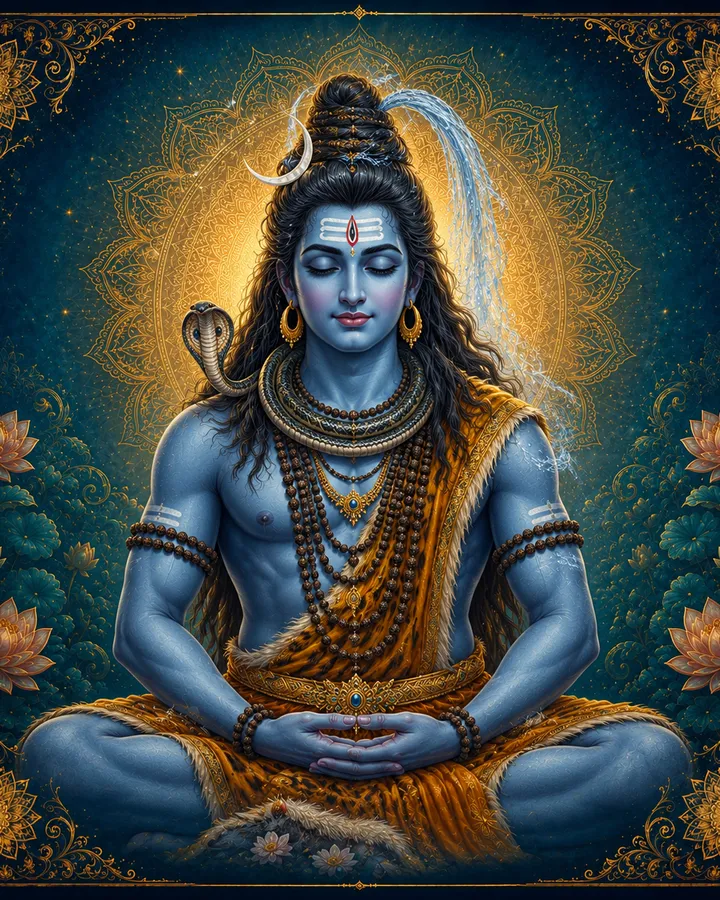
Overview
Maha Shivaratri, “the great night of Shiva,” is Phalguna Krishna Chaturdashi (Magha Krishna Chaturdashi in the amanta calendar of the west and south): the night before the new moon in the last month of the year. Where most festivals are days, this one is a night — a fast through the day, a vigil through the night, and the worship of the Shiva linga in four watches until dawn. See the Shiva page for the deity; this page is the night.
Story and scripture
The Shiva Purana gives the observance its charter in two places. The Vidyeshvara Samhita tells the Lingodbhava: Brahma and Vishnu quarrel over which of them is supreme, and a column of light rises between them without top or bottom; Brahma flies up and Vishnu digs down for ages, neither finds an end, and Shiva appears from the column — the origin of the linga as the form in which Shiva is worshipped. South Indian temples read this as the event of Shivaratri night, and the Lingodbhava image on the west wall of Tamil Shiva temples is worshipped at midnight.
The Koti Rudra Samhita and the Skanda and Garuda Puranas tell the vrata story: a hunter, treed by a tiger through a Shivaratri night, drops bilva leaves and water all night on a linga below without knowing it, and is freed by the unintended worship. The story is told to explain why the night’s worship is held to count even when kept in ignorance.
Two other stories are attached to the night by different traditions: Shiva’s wedding to Parvati, kept in the Kashi and Himachal traditions with a bridegroom’s procession, and the night Shiva drank the Halahala poison from the churning of the ocean and held it in his throat — Neelkanth — while the gods kept him awake till morning.
How the night is kept
The day: fast; the temple visit with water, milk and bilva leaves for the linga; in many places a procession of Shiva’s wedding party (Shiv Barat) in the afternoon.
The night: the linga’s abhisheka in each of the four prahars — beginning with the first watch after sunset — with milk, curd, honey, ghee, sugar, water and bilva leaves, the Rudram or the Shiva Panchakshara stotra recited, and the Om Namah Shivaya mantra kept as jaap or kirtan through the hours between. Temples stay open all night; the vigil is the observance, and sleeping through it is what the vrata rules forbid. The fast is broken after the morning’s puja.
Jaap. Om Namah Shivaya, without a fixed count — a night of it is the practice; the Mahamrityunjaya mantra; the Shiv Chalisa and the Om Jai Shiv Omkara aarti. Linked below.
Regional forms
- Varanasi: the Shiv Barat through the old city in the afternoon, and Kashi Vishwanath open all night.
- Ujjain, Somnath, and the other Jyotirlingas: the largest temple crowds of the year.
- Tamil Nadu: the Lingodbhava puja at midnight in every Shiva temple; Tiruvannamalai’s Arunachaleswarar and Chidambaram draw pilgrims from across the south.
- Kashmir: Herath, kept by Kashmiri Pandits over several days ending on Trayodashi, with the Vatuk puja at home — a distinct tradition that predates the night-vigil form.
- Nepal: Pashupatinath in Kathmandu, with sadhus gathering from across the subcontinent.
- Andhra and Telangana: Srisailam’s Mallikarjuna temple; night-long jagarana.
The date
The day whose night has Chaturdashi current at nishita kala — the 48 minutes around local midnight — in one’s own city. Because the tithi is a night one, calendars agree more often than for daytime festivals, but a Chaturdashi that ends just before midnight can still move the date. The table gives New Delhi.
Dates 2027
Dates are for New Delhi (IST), computed from the tithi rule for 1 Sept 2026 to 31 Dec 2027. Rows marked computed have not yet been checked against a published panchang — confirm with a local calendar before planning around them. Dates already past are kept for reference.
| Date | Observance | Tithi at sunrise | Tithi (IST) | Notes |
|---|---|---|---|---|
| Maha Shivaratri | Krishna Trayodashi, Phalguna | 6 Mar 12:04 → 7 Mar 13:47 | computed |
Mantra, aarti and chalisa for Maha Shivaratri
Frequently asked questions
When is Maha Shivaratri in 2027?
What is the difference between Maha Shivaratri and the monthly Shivaratri?
Why is the puja at night and in four parts?
Is it a fast without water?
Which mantra is chanted?
Sourcing
Checked against independent sources before publishing — see our sourcing and editorial policy. Spotted an error? Report an issue .

