

Overview
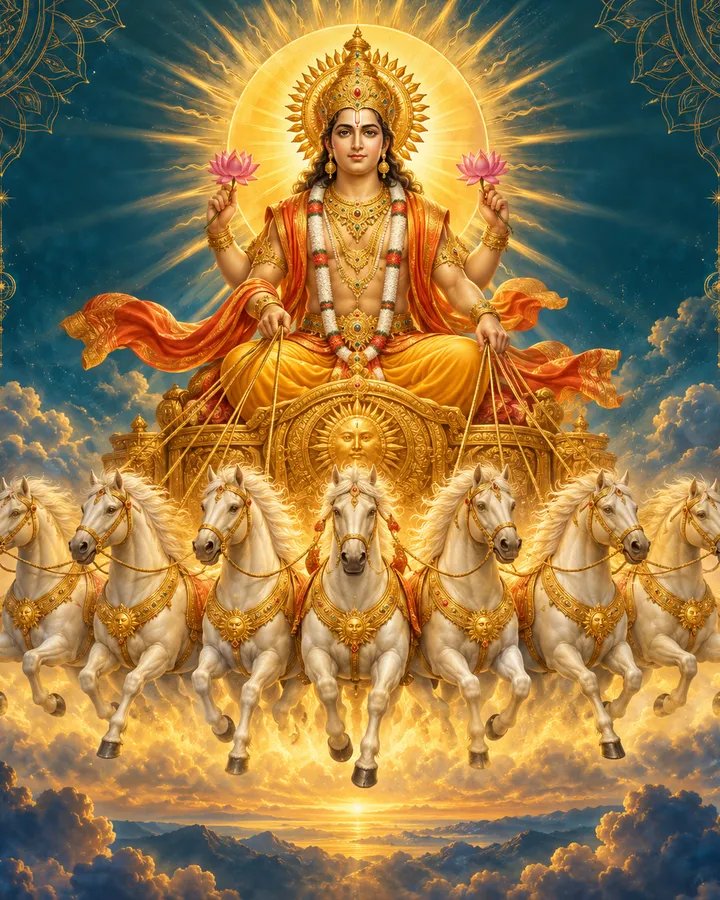
Chhath is the Sun festival of Bihar, Jharkhand, eastern Uttar Pradesh and Nepal’s Terai: four days from Kartika Shukla Chaturthi to Saptami, with the main observance on Shashthi (chhath, the sixth), when the vrati stands in a river or pond at sunset and offers arghya to the setting Sun, and returns before dawn to offer it to the rising one. It is kept for Surya and for Chhathi Maiya, the goddess of the sixth day, for the protection of children, and it is among the most demanding of Hindu observances — a fast without water for a day and a half, a night on the ghat, and rules of purity that govern the whole household for four days. See the Surya page for the deity.
Story and scripture
Chhath’s charter is the Vedic Sun rather than a Puranic story: the tradition reads the Rigveda’s hymns to Surya and Usha as the festival’s ground, and the offering of water to the Sun at dawn as the oldest Vedic act. The stories told at the ghat are epic: Karna, son of the Sun, standing in water to worship his father each day; Draupadi keeping the Sun fast on Dhaumya’s advice to end the Pandavas’ troubles; and Rama and Sita keeping Kartika Shashthi on their return to Ayodhya. The Skanda Purana names Kartika Shukla Shashthi as Surya Shashthi. Chhathi Maiya’s identification with Usha and with the sixth of the Shashthi goddesses of childbirth belongs to the Bihar tradition.
The four days
- Nahay Khay (Chaturthi): a bath in the river; the house cleaned; the vrati eats one meal of rice, gram dal and gourd cooked in a new or purified vessel.
- Kharna (Panchami): a fast all day; after sunset the vrati makes rasiao (rice cooked in jaggery and milk) on a mud stove and eats it alone, with a roti; from that meal the nirjala fast begins.
- Sandhya Arghya (Shashthi): the family carries the daura (bamboo baskets of fruit, sugarcane, coconut and the thekua — wheat-flour and jaggery biscuits fried in ghee) to the ghat; the vrati stands in the water and offers the baskets and water to the setting Sun; the songs are sung; many families keep the night on the ghat.
- Usha Arghya (Saptami): before dawn the same offering to the rising Sun; the vrati breaks the fast with the prasad, and it is shared with everyone present.
Jaap. The Sun’s twelve names at each arghya; the Surya Chalisa at home; the Chhath songs on the ghat.
Regional forms
- Bihar and Jharkhand: the festival’s home; Patna’s Ganga ghats hold hundreds of thousands, and the state empties as people go home for it.
- Eastern UP: Varanasi, Gorakhpur and the Purvanchal districts keep it as in Bihar.
- Nepal (Terai and Kathmandu): Chhath Parva, a public holiday.
- Delhi, Mumbai, Kolkata, and abroad: municipal ghats built for the day at the Yamuna, at Juhu beach and at Kolkata’s Hooghly; the observance travels with the migrant community intact.
- Chaiti Chhath: a smaller Chhath is kept in Chaitra, six days after the Chaitra Navratri begins, by some families.
The dates
The main day is Kartika Shukla Shashthi at sunrise in one’s own city; Nahay Khay and Kharna are the two days before, Usha Arghya the morning after. The table gives the four days for New Delhi. Patna’s sunrise is about twenty minutes earlier than Delhi’s and can, in a year when Shashthi ends near sunrise, put the main day a day earlier; this site computes Kolkata rather than Patna as its eastern reference, and the row notes when Kolkata’s date differs.
Dates 2026 and 2027
Dates are for New Delhi (IST), computed from the tithi rule for 1 Sept 2026 to 31 Dec 2027. Rows marked computed have not yet been checked against a published panchang — confirm with a local calendar before planning around them. Dates already past are kept for reference.
| Date | Observance | Tithi at sunrise | Tithi (IST) | Notes |
|---|---|---|---|---|
| Nahay Khay | Shukla Chaturthi, Kartika | 14 Nov 23:25 → 16 Nov 02:02 | computed | |
| Kharna | Shukla Panchami, Kartika | 14 Nov 23:25 → 16 Nov 02:02 | computed | |
| Sandhya Arghya (Chhath) | Shukla Shashthi, Kartika | 14 Nov 23:25 → 16 Nov 02:02 | computed | |
| Usha Arghya | Shukla Saptami, Kartika | 14 Nov 23:25 → 16 Nov 02:02 | computed | |
| Nahay Khay | Shukla Chaturthi, Kartika | 3 Nov 19:32 → 4 Nov 21:39 | computed | |
| Kharna | Shukla Panchami, Kartika | 3 Nov 19:32 → 4 Nov 21:39 | computed | |
| Sandhya Arghya (Chhath) | Shukla Shashthi, Kartika | 3 Nov 19:32 → 4 Nov 21:39 | computed | |
| Usha Arghya | Shukla Saptami, Kartika | 3 Nov 19:32 → 4 Nov 21:39 | computed |
Mantra, aarti and chalisa for Chhath Puja
Frequently asked questions
When is Chhath Puja in 2026?
When is Chhath Puja in 2027?
Who is Chhathi Maiya?
Why is Chhath so strict?
Where is Chhath celebrated?
Is there a mantra for the day?
Sourcing
Checked against independent sources before publishing — see our sourcing and editorial policy. Spotted an error? Report an issue .

