

Overview
Surya (सूर्य, Sūrya) is the sun god of Hindu tradition, one of the oldest deities in the Vedic pantheon and historically the focus of an independent sect, the Saura tradition, one of the five historic Panchayatana traditions alongside Shaiva, Vaishnava, Shakta, and Ganapatya worship. That sect declined sharply after roughly the 13th century, and today Surya is chiefly honored through festival worship, above all Chhath Puja, and through his continued place in Smarta Panchayatana puja, rather than as the center of an independent living sect.
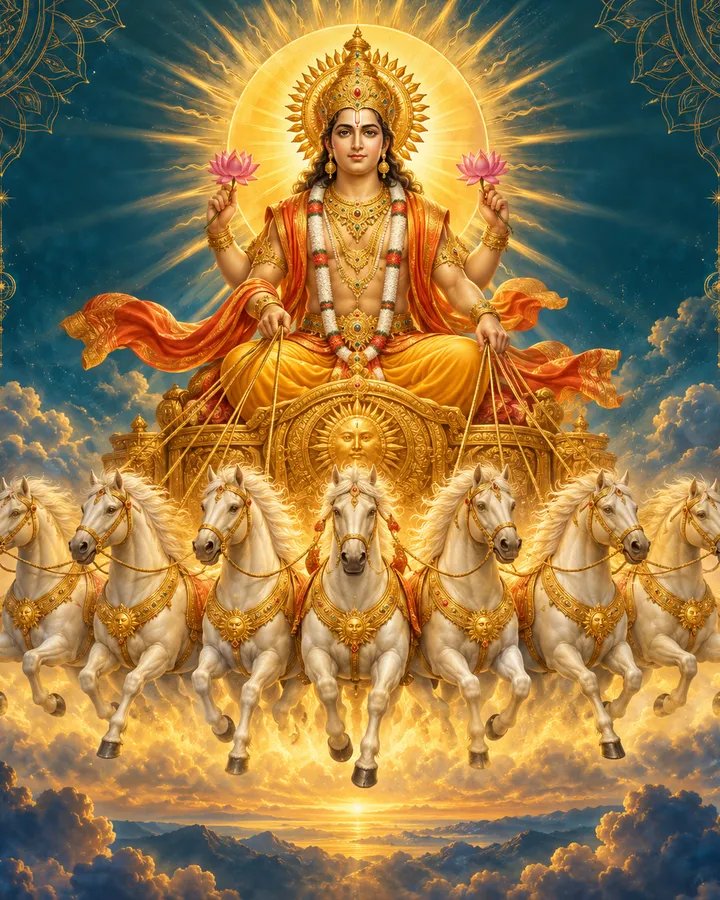
He is depicted riding a chariot drawn by seven horses, driven by his charioteer Aruna, the personification of dawn — an image so central to his identity that the Konark Sun Temple itself is built in the form of that chariot.
Iconography
Surya’s seven horses are traditionally read as representing either the seven colors of visible light or the seven days of the week; some traditions name them after Vedic poetic meters. He holds a lotus in each hand, is often shown crowned and in the “Northern style” of dress prescribed by the Brihat Samhita’s iconographic rules, and is frequently flanked by the dawn goddesses Usha and Pratyusha.
Family
Surya’s parents are the sage Kashyapa and Aditi. His two wives, Sanjna (also called Saranyu) and Chhaya, are at the center of one of the better-known stories associated with him: unable to bear the full intensity of her husband’s radiance, Sanjna is said to have created a shadow double of herself, Chhaya, to take her place while she withdrew. By Sanjna, Surya is father to Vaivasvata Manu, the current Manu of Hindu cosmology; the twins Yama, god of death, and Yami (also called Yamuna); and the Ashvins, twin divine physicians. By Chhaya, he is father to the next Manu, Savarni, and to Shani, the planet Saturn. In the Mahabharata, he is also father to Karna, born to the unmarried princess Kunti before her marriage — a parentage central to that epic’s plot.
Worship and festivals
Chhath Puja is Surya’s principal living festival today, observed above all in Bihar, eastern Uttar Pradesh, and the Nepal Terai. A four-day observance falling in the lunar month of Kartik, it is distinguished among Hindu festivals by worshipping both the setting and the rising sun, and centers as much on the goddess Chhathi Maiya, identified with the Vedic dawn goddess Ushas, as on Surya himself.
Makar Sankranti, marking the sun’s transit into Capricorn, is a harvest festival observed across India under a range of regional names. Ratha Saptami celebrates the turning of Surya’s chariot toward the northern hemisphere. In Tamil Nadu, the second day of Pongal, known as Surya Pongal, is dedicated specifically to him as part of the wider harvest festival.
Beyond named festivals, the Gayatri Mantra, among the most widely recited daily prayers in Hindu practice, is addressed to Savitr, a solar deity closely identified with Surya — making daily mantra recitation, for many practitioners, the most consistent ongoing form of his worship.
Decline and continuity
Formal sun-temple worship in North India declined sharply from around the 13th century onward, and the Saura tradition no longer exists as an independent sect the way Shaivism or Vaishnavism do. Konark and Modhera are the best-preserved major examples of the temple architecture that tradition produced; the Martand Sun Temple in Jammu and Kashmir, by contrast, survives only as a ruin. Despite this institutional decline, Surya’s place in the five-deity Panchayatana puja tradition, and the living strength of festivals like Chhath Puja, mean his worship has continued in practice even as the sect built specifically around him faded.
In scripture
- Rigveda (1.115) — among the earliest and most direct Vedic hymns to Surya.
- Ramayana — the Adityahridayam stotra, given to Rama before his battle with Ravana.
- Mahabharata — describes Surya as the “eye of the universe” and tells of Karna’s birth.
- Surya Siddhanta — a classical astronomical and mythological text bearing his name.
Parentage
 Child Surya
Iconography at a glance
Major temples
Konark Sun Temple
Konark, Odisha, India
A 13th-century UNESCO World Heritage Site built under the Eastern Ganga dynasty, shaped as a colossal stone chariot with twelve wheels drawn by seven horses.
Open in Maps ↗Modhera Sun Temple
Modhera, Gujarat, India
Built in the 11th century under King Bhimdev I of the Chaulukya (Solanki) dynasty.
Open in Maps ↗Martand Sun Temple
Jammu and Kashmir, India
An 8th-century temple, now in ruins, once a major center of the historic Saura tradition of sun worship.
Open in Maps ↗Worth knowing
- Surya's chariot is traditionally drawn by seven horses, read as symbolizing either the seven colors of visible light or the seven days of the week.
- Karna, a central figure of the Mahabharata, is described as Surya's son by the unmarried princess Kunti.
- Surya is one of the five deities of Smarta Panchayatana worship, alongside Ganesha, Shiva, Vishnu, and Devi.
- Chhath Puja, the main living festival dedicated to him, is distinguished by worshipping both the setting and the rising sun over four days.
- The Gayatri Mantra, among the most widely recited daily prayers in Hindu practice, is addressed to Savitr, a solar deity closely identified with Surya.

