Overview
Bhai Dooj — Bhai Dwitiya, Bhau Beej in Marathi, Bhai Phonta in Bengali, Bhai Bij in Gujarati — closes the five days of Diwali on Kartika Shukla Dwitiya, the second day of the bright fortnight. It is the sister’s festival: she applies a tilak to her brother’s forehead, performs a short aarti, and feeds him; he brings a gift. The ritual is small and domestic, and the day’s other name, Yama Dwitiya, points to its story.
The story
The Puranic account, told in the Skanda Purana and the Bhavishya Purana’s Uttara Parva, has Yama, the lord of death, visit his twin sister Yamuna, whom he had long neglected. She welcomes him with a tilak and a meal. Pleased, Yama grants that any brother who visits his sister on this day and eats what she serves will be freed from the fear of death, and that a bath in the Yamuna on Yama Dwitiya carries the same protection. The story explains the two things the day still does: the brother comes to the sister’s house, and in Braj people bathe in the Yamuna at Mathura.
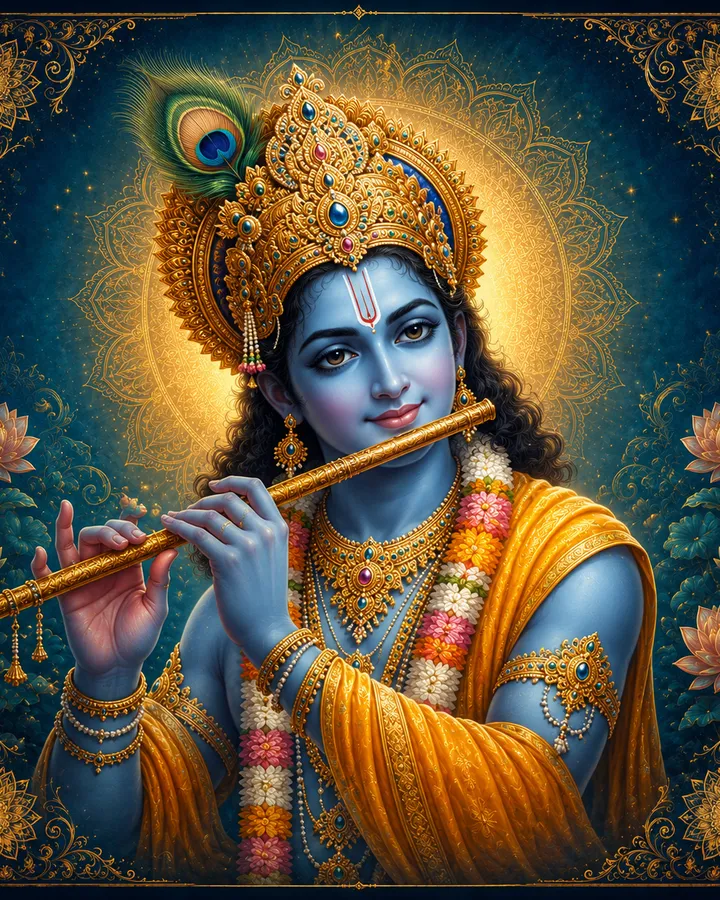
A second story, current in Braj and Maharashtra, brings Krishna to his sister Subhadra after killing Narakasura; she greets him with lamps and a tilak. It is told alongside the Yama story rather than instead of it.
How the day is kept
The sister prepares a thali with roli or kumkum, rice grains, a lamp, sweets and sometimes a coconut. The brother sits facing east; she applies the tilak, presses a few grains of rice onto it, performs aarti and offers him something sweet. In many families she draws a small square of rice paste on the floor for him to sit on. The brother touches her feet if she is older, or she his if she is younger, and gives a gift — money, clothes, whatever the family does. The meal that follows is the point of the day: Yama’s promise was for the brother who eats at his sister’s house.
There is no temple ritual attached to the day, and no fixed jaap. Families who keep a daily count keep their usual mantra; the day’s link to Krishna makes the mahamantra a common choice in Braj households.
Regional forms
- North India: Bhai Dooj as described; in Braj, the Yamuna bath at Vishram Ghat in Mathura, where tradition places Yama and Yamuna’s meeting.
- Maharashtra and Goa: Bhau Beej; the brother is seated within a square drawn on the floor, and basundi-puri or a sweet the brother likes is served. Sisters without brothers worship the moon.
- West Bengal: Bhai Phonta. The sister fasts until she has applied the phonta (a sandal-paste dot) with the words of a rhyme asking that Yama’s door be barred to her brother; the meal follows, often lavish.
- Gujarat: Bhai Bij, the last day of the Diwali holidays, kept with the same tilak and meal.
- Nepal: the corresponding day of Tihar is Bhai Tika, with the sister drawing a seven-coloured tika.
The date
Dwitiya at sunrise, in the reckoning of one’s own city. When Dwitiya begins after sunrise on one day and runs past sunrise the next, calendars take the second day; the table shows New Delhi.
Dates 2026 and 2027
Dates are for New Delhi (IST), computed from the tithi rule for 1 Sept 2026 to 31 Dec 2027. Rows marked computed have not yet been checked against a published panchang — confirm with a local calendar before planning around them. Dates already past are kept for reference.
| Date | Observance | Tithi at sunrise | Tithi (IST) | Notes |
|---|---|---|---|---|
| Bhai Dooj | Shukla Dwitiya, Kartika | 10 Nov 14:01 → 11 Nov 15:54 | computed | |
| Bhai Dooj | Shukla Dwitiya, Kartika | 30 Oct 17:52 → 31 Oct 17:14 | computed |
Frequently asked questions
When is Bhai Dooj in 2026?
When is Bhai Dooj in 2027?
Is Bhai Dooj related to Raksha Bandhan?
Why 'Yama Dwitiya'?
What if a woman has no brother?
Is Bhai Dooj a public holiday?
Sourcing
Checked against independent sources before publishing — see our sourcing and editorial policy. Spotted an error? Report an issue .