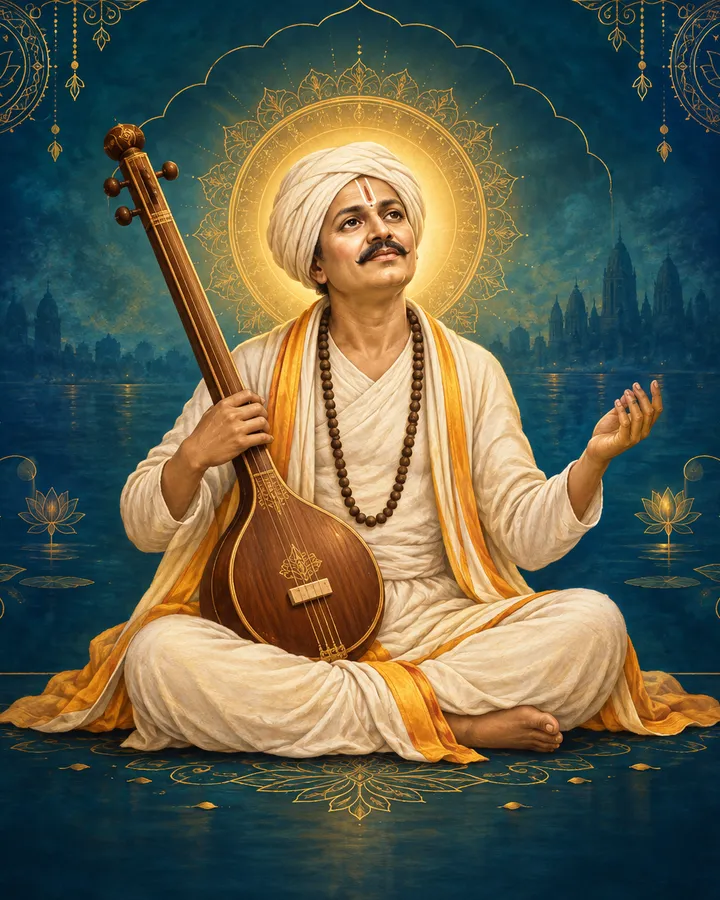
Overview
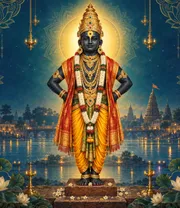
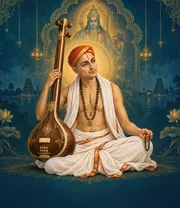
Tukaram was a Marathi poet-saint of the Varkari sampradaya, the bhakti tradition centered on devotion to Panduranga, worshipped at Pandharpur. Born and based at Dehu, near Pune, he is remembered chiefly through his abhangas — thousands of short devotional poems in Marathi — and through a tradition that his life did not end in an ordinary death, addressed below.
Life
Tradition places his birth at Dehu, commonly dated to 1608, into a family engaged in trade, money-lending, and agriculture. His family’s caste background is described inconsistently across sources — most describe them as Kunbi, a cultivator caste, while some older scholarship instead classifies them as Vani, a trading caste — two accounts that don’t agree, and neither is favored here. He composed the bulk of his abhangas over roughly the last two decades of his life, and his collected verses, known as the Tukaram Gatha, run to approximately 4,500 to 4,600 poems.
A widely repeated tradition connects him to the Maratha ruler Shivaji, but historians describe the specific claims made about their relationship — including that Tukaram personally saved Shivaji’s life — as legendary rather than documented. A more modest and better-supported claim is that Bhakti-movement poets, Tukaram among them, helped shape the devotional and cultural climate of the era in which Shivaji’s rule took shape.
Legacy
Tradition holds that Tukaram’s life did not end in an ordinary death: accounts describe him ascending bodily to Vaikuntha, carried by Garuda during an ecstatic kirtan, leaving no body behind — one account of the tradition puts it plainly, “we have samadhis of all the other saints, but not of Tukaram.” A shrine, the Tukaram Maharaj Samadhi Mandir, nonetheless stands today at Dehu, built at the site associated with this event, functioning as a memorial and pilgrimage site even without an accompanying claim of physical remains. This page presents the ascension account as the tradition’s own understanding of his passing rather than as verified history, the same caution given elsewhere on this site to Chaitanya Mahaprabhu’s own disputed death.
Tukaram is consistently grouped with Dnyaneshwar and Namdev as one of the central poet-saints of the Varkari sant-parampara — the devotional literary tradition underlying the twice-yearly wari pilgrimage to Pandharpur, in which his own palanquin is still carried each year from Dehu.
In his own words
- Abhangas — his life’s work: thousands of short devotional poems in Marathi, addressed to Vitthal, composed largely over the final two decades of his life and collected as the Tukaram Gatha.
Worth knowing
- His family's caste background is described differently across sources — most describe them as Kunbi (cultivators), while some older scholarship instead classifies them as Vani (traders) — and this page does not resolve the disagreement.
- His collected verses, the Tukaram Gatha, run to roughly 4,500 to 4,600 abhangas, composed across the last two decades of his life.
- Tradition holds he did not die but ascended bodily to Vaikuntha, carried by Garuda during an ecstatic kirtan — as one account of the tradition puts it, "we have samadhis of all the other saints, but not of Tukaram." A commemorative shrine nonetheless stands at Dehu, at the site associated with the event.
- A tradition connecting him to the Maratha ruler Shivaji is widely repeated, but specific claims about their relationship — such as that Tukaram personally saved Shivaji's life — are considered legendary by historians rather than documented; more defensibly, Bhakti-movement poets including Tukaram are credited with shaping the devotional and cultural climate of the era in which Shivaji rose to power.
- He is consistently grouped with Dnyaneshwar and Namdev as one of the central poet-saints of the Varkari sant-parampara, the devotional literary tradition underlying the wari pilgrimage to Pandharpur.