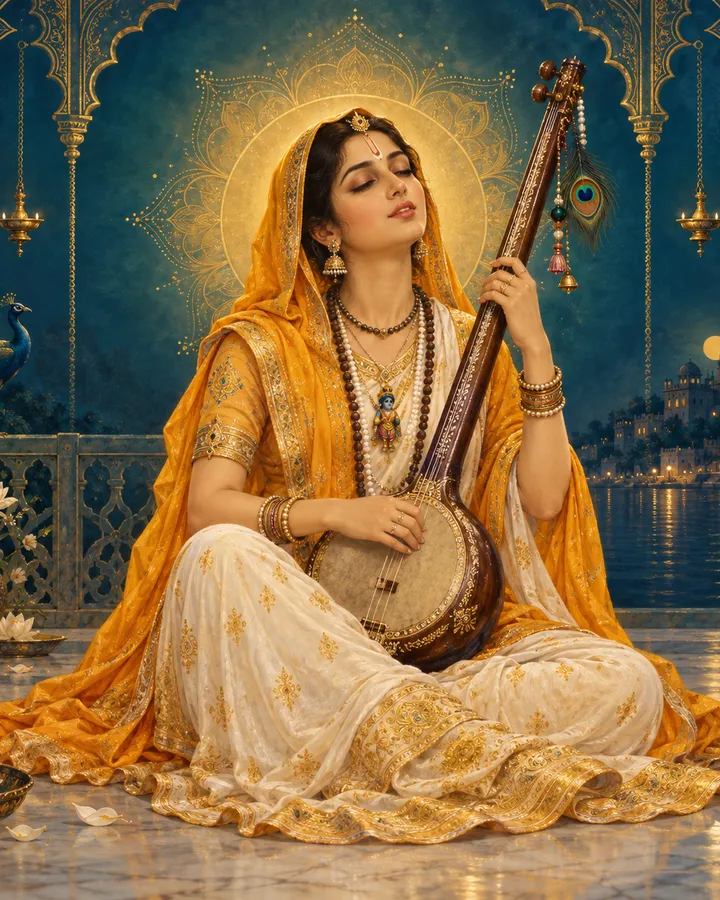
Overview
Meerabai (Mirabai) was a Rajput princess whose devotional poetry to Krishna became one of the most celebrated narratives of the Bhakti movement, especially as a prominent female voice within it. This page treats her traditional biography with real caution: much of what is popularly told about her life comes from sources written well over a century after she is thought to have lived, and historians genuinely disagree about how much of it reflects documented fact rather than later devotional reconstruction.
What is documented, and what is legend
Her best-attested biographical anchor is her marriage to Bhoj Raj, eldest son of Rana Sanga of Mewar, in 1516, and his death in 1521, leaving her a widow in her early twenties — corroborated by independent dynastic record rather than devotional literature alone. Beyond this, the documentary trail thins considerably. The earliest known mention of her as a figure is Nabhadas’s Bhaktamal, written around 1600, and the oldest surviving biographical commentary about her dates to 1712 — more than 150 years after her presumed lifetime. Only two poems attributed to her survive in manuscripts datable earlier than the early 18th century; scholars regard perhaps a few hundred of the vast body of hymns popularly attributed to her as plausibly authentic, and even that narrower figure remains debated.
Much of her traditional story belongs to this later, legendary layer rather than to documented history. Accounts describe poison sent by hostile in-laws disguised as nectar, and a snake concealed among flowers, both said to have failed to harm her through divine protection; a widely told meeting with the Mughal court musician Tansen, which does not survive chronological scrutiny, since Tansen is documented as having joined Akbar’s court only around 1562, some fifteen years after her commonly cited death; and her eventual disappearance into a Krishna deity image at Dwarka. This page presents all of this as devotional tradition, not verified biography. Some historians argue that whatever difficulty she faced after her widowhood is better explained by the general political instability and military conflict in Mewar at the time than by a specifically religious persecution, a further point on which the traditional narrative and historical reconstruction diverge. Tradition separately names Ravidas, a saint from a leatherworking background, as her guru — a claim with real cultural resonance but no independent corroboration beyond the tradition itself.
Poetry and legacy
Her surviving corpus consists of bhajans and padas, devotional songs in Rajasthani and Braj Bhasha addressed to Krishna, often in a mood of intense personal longing. Scholar John Stratton Hawley’s assessment is a fair summary of her overall documentary situation: there remains “always a question about whether there is any real relation between the poems we cite and a historical Mira.” Whatever the uncertainty of the historical record, her cultural influence is not in doubt — she remains one of the most widely known figures of the Bhakti movement, referenced continually across Indian music, film, and literature.
Worth knowing
- Her documented biography rests almost entirely on sources written well after her death: the earliest known mention of her as a figure is Nabhadas's Bhaktamal, c. 1600, and the oldest surviving biographical commentary on her dates to 1712 — over 150 years after her presumed lifetime.
- Only two poems attributed to her survive in manuscripts datable earlier than the early 18th century. Popular tradition attributes a vast body of hymns to her, but scholars regard only a few hundred as plausibly authentic, and even that smaller number remains debated.
- Her documented marriage, to Bhoj Raj of Mewar in 1516, and his death in 1521 leaving her a widow in her early twenties, is the best-attested anchor in her biography, corroborated by independent dynastic records rather than devotional retelling alone.
- A widely told story of a meeting between her and the Mughal court musician Tansen is chronologically implausible — Tansen is documented as having joined Akbar's court only around 1562, roughly fifteen years after Meerabai's commonly cited death date.
- Stories of poison sent by hostile in-laws, a snake concealed among flowers, and her eventual disappearance into a Krishna image at Dwarka are told uniformly across devotional tradition but have no independent historical corroboration; some historians argue that whatever hardship she faced after widowhood is better explained by the political instability and conflict in Mewar at the time than by religious persecution specifically.
- Scholar John Stratton Hawley has cautioned that there remains "always a question about whether there is any real relation between the poems we cite and a historical Mira" — a fair summary of how much of her traditional life story rests on later devotional reconstruction rather than documented fact.