Overview
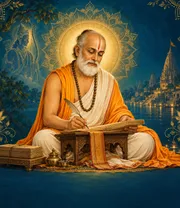
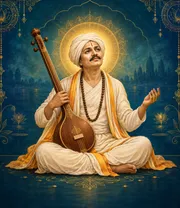
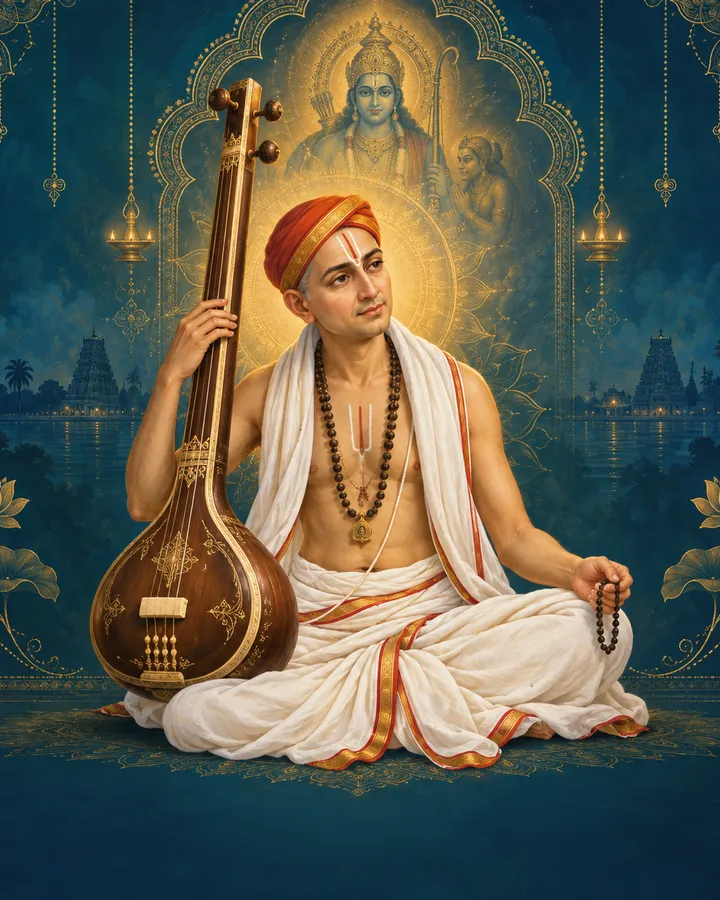
Thyagaraja was a South Indian composer-saint whose devotional compositions to Rama, written in Telugu and Sanskrit, remain central to Carnatic classical music today. He is counted among the “Trinity of Carnatic Music,” alongside Muthuswami Dikshitar and Syama Sastri, credited collectively with a major turning point in the tradition’s history.
Life
Born Kakarla Tyagabrahmam at his maternal grandfather’s house in Tiruvarur, Tamil Nadu, to a Telugu-speaking Brahmin family steeped in Vedic tradition, he was named after the deity presiding over the Tiruvarur temple. His maternal grandfather was a noted veena player who gave him early exposure to music, and he later trained formally under Sonti Venkataramanayya, a court musician under the Thanjavur ruler Thuljaji.
Tradition holds that when the Thanjavur king Serfoji II invited him to court with gifts, Thyagaraja declined, composing a kriti reflecting on whether wealth actually brings happiness rather than accepting royal patronage — a story widely and consistently repeated, presented here as tradition rather than independently documented court record, and one that has come to define his popular image as a composer devoted entirely to music and worship rather than court favor.
Compositions
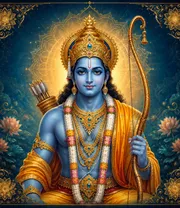
Thyagaraja is traditionally credited with composing around 24,000 kritis, devotional compositions almost entirely addressed to Rama — a figure that traces to an estimate based on his teaching method rather than an independently documented count, and one scholars treat with real skepticism. Around 700 compositions survive today in documented, notated form. Among his best-known works are the Pancharatna Kritis, “five gems,” a set of five kritis systematically exploring five classical ragas, frequently performed together; and two musical-dramatic works, Prahlada Bhakti Vijayam (45 kritis across 28 ragas) and Nauka Charitam (21 kritis across 13 ragas).
Legacy
Thyagaraja died at Thiruvaiyaru, on the banks of the Kaveri river, in 1847, traditionally described as attaining siddhi at age 79. His samadhi there is the site of the annual Thyagaraja Aradhana, a festival at which musicians from around the world gather to perform, including a mass group rendition of the Pancharatna Kritis — a genuinely major, ongoing living tradition rather than a purely historical commemoration. He is credited with the largest disciple lineage of any composer in Carnatic music history, a significant part of why his compositions remain so central to the tradition’s core repertoire today.
Worth knowing
- He is one of the "Trinity of Carnatic Music," alongside Muthuswami Dikshitar and Syama Sastri, credited collectively with a major turning point in the history of South Indian classical music.
- Approximately 700 of his compositions survive today in documented form; a much larger traditional figure of around 24,000 is often cited but rests on an estimate from his teaching method rather than an independently documented count, and this page presents it as such.
- When the Thanjavur king Serfoji II invited him to court with gifts, Thyagaraja is said to have declined, composing a kriti reflecting on whether wealth actually brings happiness — presented here as tradition rather than court-documented fact, though widely and consistently repeated.
- His samadhi at Thiruvaiyaru is the site of the annual Thyagaraja Aradhana festival, at which musicians from around the world gather to perform, including a mass rendition of his Pancharatna Kritis — a genuinely major, ongoing living tradition rather than only a historical commemoration.
- He is credited with the largest disciple lineage of any composer in Carnatic music history, a significant part of why his compositions remain so central to the tradition's core repertoire today.