Overview
Panduranga (पाण्डुरङ्ग, Pāṇḍuraṅga), far more commonly called Vitthal or Vithoba, is the deity worshipped at Pandharpur, Maharashtra, and the center of the Varkari sampradaya, a bhakti tradition built around the twice-yearly wari, a mass pilgrimage on foot, and around continuous devotional singing rather than elaborate temple ritual.
Who Vitthal is
Popular devotional tradition and several major Varkari poet-saints — Namdev, Eknath, and Tukaram among them — identify Vitthal directly with Krishna. Core Varkari theology instead takes a different view, holding him to be Vishnu‘s own original form rather than an avatar the way Krishna or Rama are understood to be. A separate hereditary priestly lineage at the Pandharpur temple holds a third position again — that Vitthal is neither Vishnu nor Shiva, but an independent deity in his own right. All three are genuinely held within the tradition, and none is treated here as the correct one.
The Pundalik legend and his form
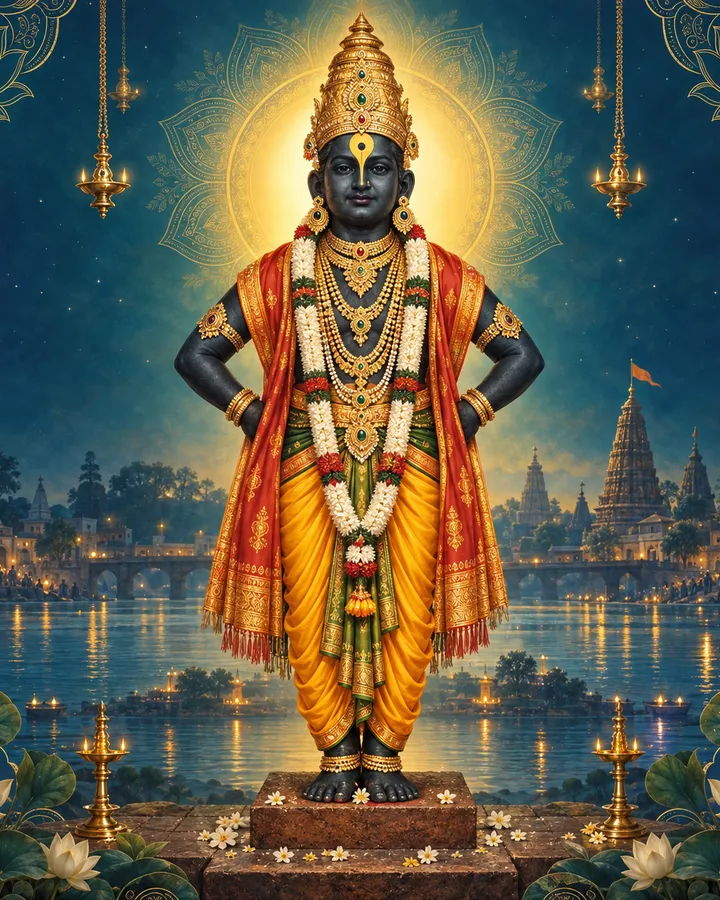
Vitthal’s standing, hands-on-hips form traces to the story of Pundalik, a devotee so consumed by caring for his aged parents that, when the Lord came to visit him, he could not rise to receive him properly and instead threw out a brick for him to stand on until his care for his parents was finished. Moved by this devotion, the Lord is said to have chosen to remain standing on that brick permanently — the origin, in this telling, of both the name Vitthal (built from vit, brick, and sthal or thal, standing place) and his enduring iconography. His image is notably plain compared to the richly ornamented forms typical of Krishna or Vishnu elsewhere — dark stone, arms akimbo, standing simply on the brick — a visual restraint some read as reflecting the tradition’s own emphasis on accessible, unadorned devotion.
Consort and temple
His consort Rukmini is worshipped at Pandharpur as Rakhumai, in her own dedicated shrine within the temple complex rather than as a subordinate attendant figure; Rahi and Satyabhama are also named in some sources as further consorts honored within the wider complex. The Vithoba Temple itself, on the bank of the river Bhima — locally known as Chandrabhaga for its crescent-moon bend at this point — has attested worship activity from at least the late 12th century by inscription, with royal patronage recorded under the Hoysala and Yadava dynasties in the centuries after; the larger structure seen today substantially dates to the 17th century and later expansions. In 2014, the temple became the first major Indian temple to formally open its priesthood to women and to people from historically marginalized castes.
The wari and the Varkari tradition
Twice each year, for Ashadhi Ekadashi (June–July) and the smaller Kartiki Ekadashi (October–November), Varkari pilgrims converge on Pandharpur on foot in a mass pilgrimage called the wari, organized in processions carrying the palanquins of poet-saints — most prominently Dnyaneshwar’s from Alandi and Tukaram’s from Dehu, each walking roughly three weeks to reach Pandharpur. Recent estimates put attendance at 1.5 to 2 million pilgrims for the larger of the two Ekadashis, among the largest annual religious gatherings in Maharashtra. The Varkari tradition built around this pilgrimage is explicitly caste-open, its poet-saints drawn from across a wide range of backgrounds — among them Namdev the tailor, Sena the barber, Gora the potter, Sheikh Muhammad, a Muslim devotee, and Tukaram, whose own family background is described differently across sources, variously as cultivators (Kunbi) or traders (Vani) — a defining feature of the tradition rather than an incidental one.
In scripture
- Abhangas — short devotional poems in Marathi, composed across generations by the Varkari poet-saints, forming the core devotional literature associated with his worship.
Iconography at a glance
Major temple
Vithoba Temple, Pandharpur
Pandharpur, Solapur district, Maharashtra, India
On the bank of the river Bhima, locally called Chandrabhaga for its crescent-moon bend at this point. Worship at the site is attested from at least the late 12th century by inscription, with the present structure substantially rebuilt and expanded from the 17th century onward. In 2014 it became the first major Indian temple to formally open its priesthood to women and to people from historically marginalized castes.
Open in Maps ↗Worth knowing
- Popular devotional tradition and several Varkari poet-saints identify Vitthal directly with Krishna, but core Varkari theology instead holds him to be Vishnu's own original form rather than an avatar in the way Krishna or Rama are understood to be — a genuine, longstanding distinction this page presents rather than resolves.
- His standing, hands-on-hips form traces to the legend of Pundalik, a devotee so absorbed in caring for his aged parents that he threw the visiting Lord a brick to stand on rather than interrupt his care — the origin, in this telling, of both his name and his iconography.
- A twice-yearly mass walking pilgrimage, the wari, converges on Pandharpur for Ashadhi and Kartiki Ekadashi, with the palanquins of poet-saints Dnyaneshwar and Tukaram carried from Alandi and Dehu respectively; recent estimates put attendance at 1.5 to 2 million pilgrims for the larger of the two.
- The Varkari tradition that centers on him is explicitly caste-open, with poet-saints drawn from a wide range of backgrounds — among them a tailor, a grocer, a barber, a potter, and a Muslim devotee — a defining trait of the tradition rather than an incidental detail.
- His consort Rukmini, worshipped at Pandharpur as Rakhumai, has her own dedicated shrine within the temple complex rather than standing simply as an attendant figure.