Overview
Tulsidas was a North Indian poet-saint and devotee of Ram, best known as the author of the Ramcharitmanas, an Awadhi-language retelling of the Rama story that remains the most widely recited version of that story in North India today. Even his basic dates are genuinely disputed: commonly given as approximately 1532, sources range from the late 1490s to the 1540s for his birth, and his birthplace is named differently across sources as either Rajapur or Soron in present-day Uttar Pradesh. Neither question has a single settled answer.
Life
Born under the name Rambola Dubey, Tulsidas is said in tradition to have had an unusual birth — a twelve-month gestation, teeth already present, and the word “Rama” uttered instead of an infant’s cry — details this page presents as devotional legend, not biographical fact. He is named across sources as a disciple of Narharidas, who performed his sacred-thread ceremony at Ayodhya, and later of Shesha Sanatana, under whom tradition holds he studied Sanskrit grammar, the Vedas, and philosophy for some fifteen years at Varanasi.
A well-known story describes his wife, Ratnavali, rebuking him after he swam across a river at night, driven by longing to see her, telling him that if he showed even half that devotion toward God as toward her own body, he would find liberation — a rebuke tradition holds triggered his renunciation and turn fully to devotion. That rebuke is best read as tradition, not verified history; some scholars, including the modern Ramanandi scholar Rambhadracharya, go further and question the entire episode, arguing Tulsidas was celibate from childhood and that the marriage narrative itself was added to his biography later. The Ramanandi sect separately holds him to be a reincarnation of Valmiki, the Sanskrit poet credited with the original Ramayana — a devotional belief within that tradition, presented here as such.
Major works
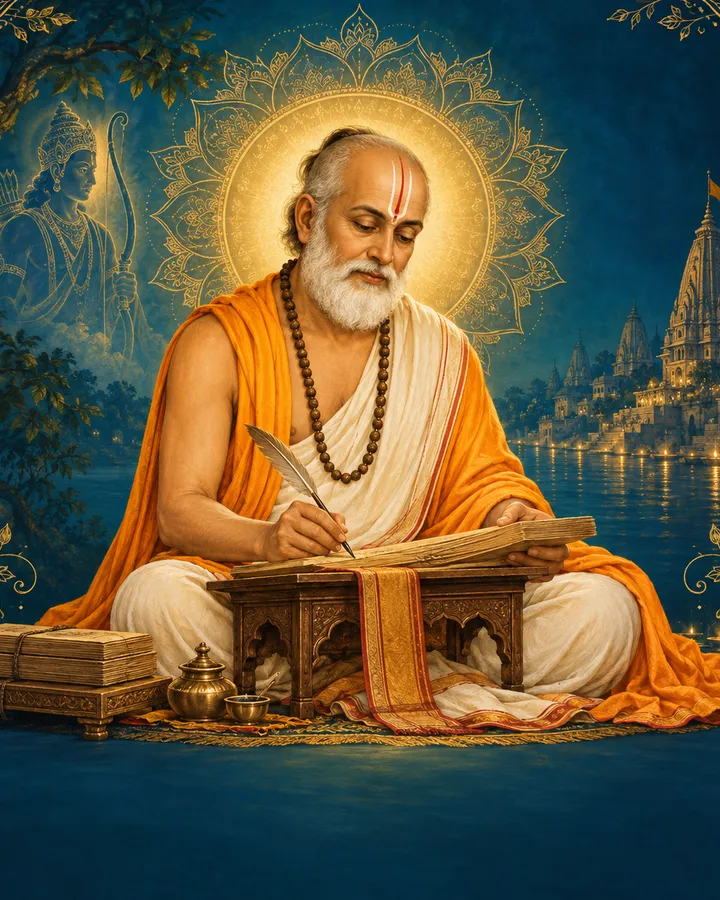
The Ramcharitmanas, his central work, retells the Rama story in Awadhi rather than Sanskrit, traditionally begun at Ayodhya and composed largely during his years at Varanasi in the 1570s. Its use of a vernacular language rather than Sanskrit is a major reason for its enduring popularity — it remains the version of the Rama story most widely recited in North Indian households and performed in Ramlila theatre today. The Hanuman Chalisa is traditionally attributed to him, the same framing this site’s own Hanuman Chalisa page uses, though this page notes the same caveat that page does: no commentary on the text is documented before the 1980s, and some early printed editions of his collected works reportedly omit it, so the attribution stays traditional rather than certain. His Vinaya Patrika, a collection of devotional hymns composed in a mood of humility, is also associated with his years at Varanasi.
Legacy
Tulsidas is credited with founding the Sankat Mochan Hanuman Temple in Varanasi, said to mark the site of a vision he had of Hanuman. His place within the wider North Indian Bhakti movement rests chiefly on the Ramcharitmanas’ role in bringing Rama devotion into vernacular language rather than Sanskrit scholarship — a shift that parallels how contemporaries elsewhere in India were doing the same for other regional bhakti traditions in their own languages.
Worth knowing
- The Ramcharitmanas, his major work, is an Awadhi-language retelling of the Rama story drawing on the Valmiki Ramayana, traditionally begun at Ayodhya and composed largely at Varanasi in the 1570s — it remains the most widely recited version of the Rama story in North India today.
- The Hanuman Chalisa is traditionally attributed to him, the same attribution this site's own Hanuman Chalisa page uses — but the attribution is not free of scholarly question, since no commentary on the text is documented before the 1980s and it is reportedly absent from some early printed editions of his collected works.
- Tradition holds that a rebuke from his wife, Ratnavali, after he crossed a river at night driven by longing to see her, triggered his renunciation and turn to devotion — a widely told story that some scholars, including the modern Ramanandi scholar Rambhadracharya, question entirely, arguing instead that he was celibate from childhood and that the marriage episode itself is a later addition to his biography.
- Devotional tradition surrounding his birth includes clearly legendary details — a twelve-month gestation, all thirty-two teeth already present, and uttering "Rama" instead of crying — presented here as tradition, not biographical fact.
- The Ramanandi sect regards him as a reincarnation of the Sanskrit poet Valmiki, author of the original Ramayana — a devotional belief held within that tradition, not a claim of formal institutional founding by Tulsidas himself.