The text
Tap Recite along to follow verse by verse — use Next, or the arrow keys.
- Stanza 1 (refrain)
जय कश्यप-नन्दन, ॐ जय अदिति नन्दन।त्रिभुवन-तिमिर-निकन्दन, भक्त-हृदय-चन्दन॥
jaya kaśyapa-nandana, oṃ jaya aditi nandana।tribhuvana-timira-nikandana, bhakta-hṛdaya-candana॥
Victory to the son of Kashyapa, O victory to the son of Aditi! Destroyer of the darkness of the three worlds, sandalwood balm to the devotee's heart.
- Stanza 2
सप्त-अश्वरथ राजित, एक चक्रधारी।दुःखहारी, सुखकारी, मानस-मल-हारी॥जय कश्यप-नन्दन, ॐ जय अदिति नन्दन।त्रिभुवन-तिमिर-निकन्दन, भक्त-हृदय-चन्दन॥
sapta-aśvaratha rājita, eka cakradhārī।duḥkhahārī, sukhakārī, mānasa-mala-hārī॥jaya kaśyapa-nandana, oṃ jaya aditi nandana।tribhuvana-timira-nikandana, bhakta-hṛdaya-candana॥
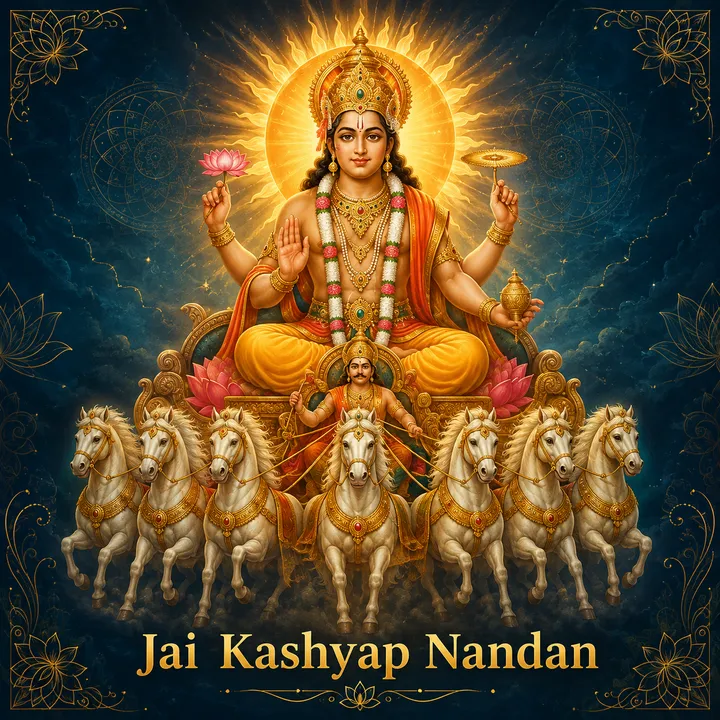
Resplendent upon a chariot of seven horses, bearing a single wheel; remover of sorrow, giver of joy, remover of the mind's impurities. Victory to the son of Kashyapa, O victory to the son of Aditi! Destroyer of the darkness of the three worlds, sandalwood balm to the devotee's heart.
- Stanza 3
सुर-मुनि-भूसुर-वन्दित, विमल विभवशाली।अघ-दल-दलन दिवाकर, दिव्य किरण माली॥जय कश्यप-नन्दन, ॐ जय अदिति नन्दन।त्रिभुवन-तिमिर-निकन्दन, भक्त-हृदय-चन्दन॥
sura-muni-bhūsura-vandita, vimala vibhavaśālī।agha-dala-dalana divākara, divya kiraṇa mālī॥jaya kaśyapa-nandana, oṃ jaya aditi nandana।tribhuvana-timira-nikandana, bhakta-hṛdaya-candana॥
Revered by gods, sages, and earthly brahmins, pure and full of majesty; Divakara, crusher of the mass of sins, garlanded with divine rays. Victory to the son of Kashyapa, O victory to the son of Aditi! Destroyer of the darkness of the three worlds, sandalwood balm to the devotee's heart.
- Stanza 4
सकल-सुकर्म-प्रसविता, सविता शुभकारी।विश्व-विलोचन मोचन, भव-बन्धन भारी॥जय कश्यप-नन्दन, ॐ जय अदिति नन्दन।त्रिभुवन-तिमिर-निकन्दन, भक्त-हृदय-चन्दन॥
sakala-sukarma-prasavitā, savitā śubhakārī।viśva-vilocana mocana, bhava-bandhana bhārī॥jaya kaśyapa-nandana, oṃ jaya aditi nandana।tribhuvana-timira-nikandana, bhakta-hṛdaya-candana॥
Generator of all good deeds, Savita, the auspicious doer; eye of the universe, liberator from the heavy bonds of worldly existence. Victory to the son of Kashyapa, O victory to the son of Aditi! Destroyer of the darkness of the three worlds, sandalwood balm to the devotee's heart.
- Stanza 5
कमल-समूह विकासक, नाशक त्रय तापा।सेवत सहज हरत अति, मनसिज-संतापा॥जय कश्यप-नन्दन, ॐ जय अदिति नन्दन।त्रिभुवन-तिमिर-निकन्दन, भक्त-हृदय-चन्दन॥
kamala-samūha vikāsaka, nāśaka traya tāpā।sevata sahaja harata ati, manasija-santāpā॥jaya kaśyapa-nandana, oṃ jaya aditi nandana।tribhuvana-timira-nikandana, bhakta-hṛdaya-candana॥
He who makes the lotuses bloom, destroyer of the three-fold suffering; whoever serves him has the torments of desire swiftly and utterly removed. Victory to the son of Kashyapa, O victory to the son of Aditi! Destroyer of the darkness of the three worlds, sandalwood balm to the devotee's heart.
- Stanza 6
नेत्र-व्याधि हर सुरवर, भू-पीड़ा-हारी।वृष्टि विमोचन संतत, परहित व्रतधारी॥जय कश्यप-नन्दन, ॐ जय अदिति नन्दन।त्रिभुवन-तिमिर-निकन्दन, भक्त-हृदय-चन्दन॥
netra-vyādhi hara suravara, bhū-pīḍā-hārī।vṛṣṭi vimocana santata, parahita vratadhārī॥jaya kaśyapa-nandana, oṃ jaya aditi nandana।tribhuvana-timira-nikandana, bhakta-hṛdaya-candana॥
Foremost of the gods, remover of eye disease and the earth's afflictions; ever the sender of rain, one bound by the vow of others' welfare. Victory to the son of Kashyapa, O victory to the son of Aditi! Destroyer of the darkness of the three worlds, sandalwood balm to the devotee's heart.
- Stanza 7
सूर्यदेव करुणाकर, अब करुणा कीजै।हर अज्ञान-मोह सब, तत्त्वज्ञान दीजै॥जय कश्यप-नन्दन, ॐ जय अदिति नन्दन।त्रिभुवन-तिमिर-निकन्दन, भक्त-हृदय-चन्दन॥
sūryadeva karuṇākara, aba karuṇā kījai।hara ajñāna-moha saba, tattvajñāna dījai॥jaya kaśyapa-nandana, oṃ jaya aditi nandana।tribhuvana-timira-nikandana, bhakta-hṛdaya-candana॥
O Surya Deva, fountain of compassion, show your compassion now; remove all ignorance and delusion, and grant the knowledge of ultimate truth. Victory to the son of Kashyapa, O victory to the son of Aditi! Destroyer of the darkness of the three worlds, sandalwood balm to the devotee's heart.
Overview
Jai Kashyap Nandan is a Hindi aarti of six stanzas in praise of Surya, the sun, opening with two of his best-known epithets: Kashyap Nandan, “son of the sage Kashyapa,” and Aditi Nandan, “son of Aditi” — the same parentage that gives Surya his more common name Aditya. Each stanza is followed by the aarti’s refrain, so the opening invocation recurs after every stanza and again at the close, in the manner shared by most Hindi aartis. The stanzas move through Surya’s iconography — his single-wheeled, seven-horse chariot — and a series of benedictions: relief from sorrow and the mind’s impurities, protection from sin, the blossoming of the lotus at sunrise, relief from eye disease and affliction, timely rain, and finally a plea for compassion and true knowledge.
Origin and source
As with many Hindi aartis, Jai Kashyap Nandan circulates as a traditional composition without a single named author or an agreed original source text — it is simply a widely sung aarti addressed to Surya, appearing across devotional collections in essentially the same six stanzas and refrain. It is a distinct composition from the Surya Chalisa, a separate forty-verse hymn to Surya also found on this site; the two share some of the same descriptive vocabulary for the sun — this aarti’s “Divakara” and “Savita,” for instance, are both among the twelve names gathered in the Surya Dwadasha Naam — but the aarti and the chalisa are recited independently of one another.
How it is recited
Jai Kashyap Nandan is sung, like most aartis, while a lit diya or camphor flame is circled before an image of Surya, with the refrain repeated by everyone present after each stanza. It is recited on Sunday, the day of the week traditionally linked to Surya, and is a fixture of Chhath Puja, the multi-day festival of sun worship observed mainly in Bihar, eastern Uttar Pradesh, and Nepal. It is also sung at Ratha Saptami, the festival marking Surya’s chariot and the seven horses that draw it — a fitting occasion for an aarti whose second stanza names that very chariot. Some households pair it with the longer Surya Chalisa on these same occasions, reciting this aarti as a shorter closing invocation.
Frequently asked questions
How many verses does Jai Kashyap Nandan have?
Who is Jai Kashyap Nandan dedicated to?
When is Jai Kashyap Nandan typically recited?
What language is Jai Kashyap Nandan composed in?
What tradition is Jai Kashyap Nandan associated with?
Is an English translation of Jai Kashyap Nandan available?
Is there a Roman transliteration of Jai Kashyap Nandan?
Sourcing
Checked against independent sources before publishing — see our sourcing and editorial policy. Spotted an error? Report an issue .