

Overview
Saraswati (सरस्वती, Sarasvatī) is the goddess of speech, knowledge, music, and the arts, one of the Tridevi alongside Lakshmi and Parvati. Her name comes from saras, “pooling water,” and vatī, “she who possesses” — she began as the deified form of the Saraswati River in the Rig Veda, long before the figure of speech and learning that most devotees know today took shape.
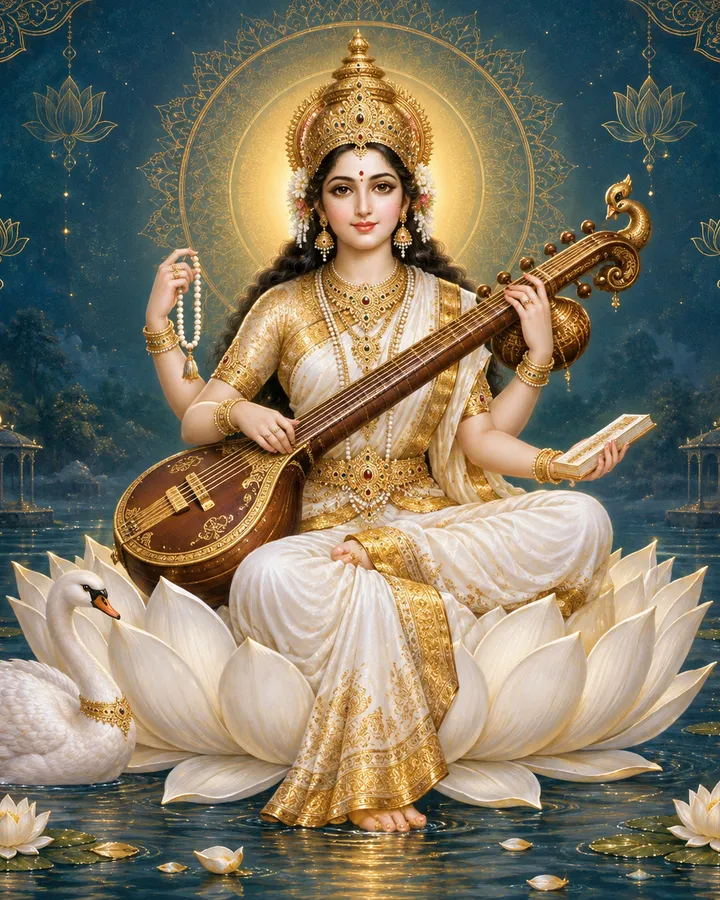
She is depicted in four-armed form holding a manuscript representing the Vedas, a japamala for mantra counting, a kamandalu, and a veena, a stringed instrument standing for music and the arts. Unlike many other goddesses, she is consistently shown in white, a color associated in this context with purity and clarity of mind.
From river to goddess of speech
The shift in Saraswati’s identity, from a specific sacred river to an abstract goddess of speech and wisdom, is one of the more clearly documented deity transformations in Hindu religious history. The Rig Veda praises her as a river bringing abundance and purification; by the time of the later Vedic Brahmanas, she is already merging conceptually with Vāc, the personification of speech itself, and is called “mother of the Vedas.” The river she was named for is now believed by most geologists to have dried up or gone underground in antiquity — the goddess, meanwhile, endured and grew into one of Hinduism’s most consistently venerated figures.
Family
Saraswati’s relationship to Brahma is described differently across different Puranas, and this page does not resolve the disagreement. Some texts name her only as his mind-born daughter; others name her only as his consort; a few describe her as both, and some traditions describe her as celibate, without a consort at all. A separate and less mainstream strand, found in some Devi Bhagavata Purana material and medieval Bengal sculpture, instead describes her as a co-wife of Vishnu alongside Lakshmi.
Worship and Vasant Panchami
Vasant Panchami, celebrated on the fifth day of the bright half of the lunar month Magha, typically in late January or February, is Saraswati’s principal festival and marks the arrival of spring. In many parts of India, it is also the traditional day for a child’s first formal lesson in writing (vidyarambham or akshara-abhyasam), a specific ritual tied directly to her role as patron of learning rather than a generic addition to festival worship. She is also honored on certain days during Navaratri, alongside Gayatri and the wider Devi tradition.
Beyond Hinduism
Saraswati’s reach extends further than most Hindu deities’: she is actively worshipped within Jainism and Buddhism as a goddess of learning and speech, and Buddhist transmission carried her figure, under different names, into East Asia — as Benzaiten in Japan and under related names in China. Few Hindu deities have this degree of cross-religious presence.
In scripture
- Rig Veda — her earliest appearance, as a river goddess associated with abundance, fertility, and purification.
- Brahmanas — the period in which she merges conceptually with Vāc, speech personified, and gains the title “mother of the Vedas.”
- Devi Mahatmya — situates her within the Tridevi alongside Mahakali and Mahalakshmi.
Iconography at a glance
Major temples
Gnana Saraswati Temple
Basar, Nirmal district, Telangana, India
On the banks of the Godavari River; one of only two widely cited standalone Saraswati temples in the subcontinent.
Open in Maps ↗Sringeri Sharadamba Temple
Sringeri, Chikkamagaluru district, Karnataka, India
Seat of the Sringeri Sharada Peetham, one of the four cardinal mathas traditionally founded by Adi Shankara, and a major center of Advaita Vedanta scholarship as well as Saraswati worship.
Open in Maps ↗Map loads when scrolled into view.
Worth knowing
- Saraswati began as a Rigvedic river goddess — the Saraswati River, now believed by most geologists to have dried up in antiquity — before her identity shifted almost entirely to a goddess of speech, knowledge, and the arts.
- She is one of the few major Hindu deities also actively worshipped in Jainism and Buddhism, with counterparts as far as Japan (Benzaiten) and China, reached through Buddhist transmission.
- Dedicated standalone Saraswati temples are notably rare compared to temples for goddesses like Durga or Lakshmi, despite how widely she is honored in festival and school life.
- Vasant Panchami, her main festival, is traditionally also the day children are first taught to write letters (vidyarambham), a specific ritual distinct from general festival worship.
- Hindu texts do not agree on her relationship to Brahma: some describe her only as his mind-born daughter, others only as his consort, a few as both, and some traditions describe her as without a consort at all.

