

Overview
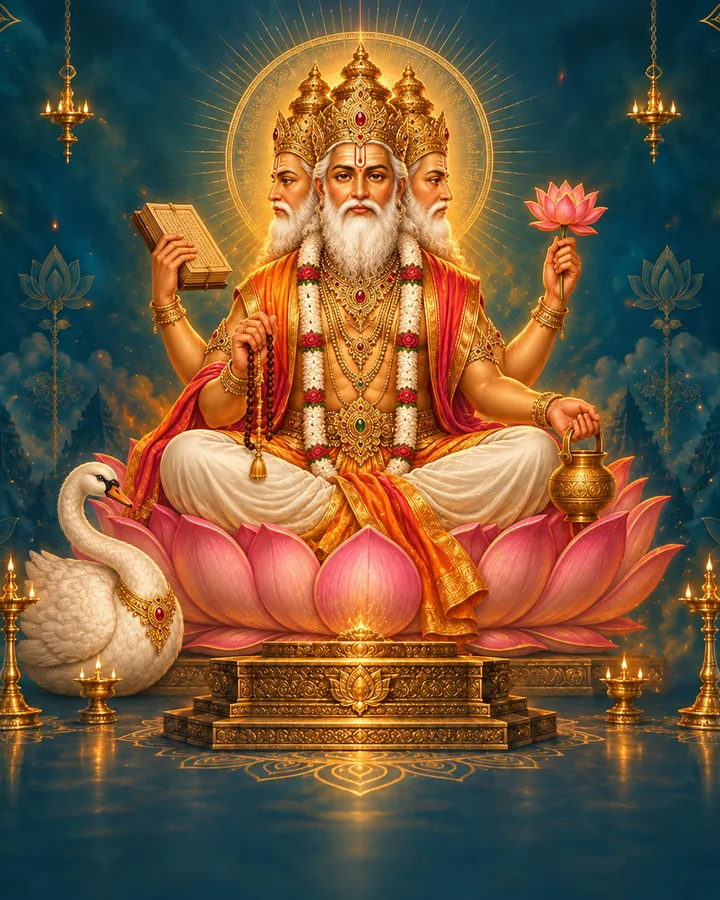
Brahma (ब्रह्मा, Brahmā) is the creator god of the Trimurti, the triad completed by Vishnu the preserver and Shiva the destroyer. He is traditionally shown with four heads, each reciting one of the four Vedas, and rides a hamsa, a swan or goose associated in Hindu symbolism with the ability to discern what is essential from what is not.
Despite this central theological position, Brahma is, by most accounts, the least actively worshipped of the three. He has no dedicated sect, and only a small number of temples are built to him anywhere in the world — a genuine oddity among major Hindu deities, and one this page treats directly rather than passing over.
Name
Brahma (the personal, masculine deity) is distinct from brahman, the neuter term in Vedantic philosophy for the impersonal Ultimate Reality underlying the universe — the two are related in concept but not the same thing, and this page is about the former. He is also called Svayambhu, “self-born,” and identified in earlier Vedic literature with Prajapati, an older creator deity whose role Brahma absorbed over time.
Iconography
Brahma is usually depicted with four heads and four arms, red or golden in complexion, with a white beard signifying age and wisdom. His hands hold the Vedas in manuscript form, a lotus, a japamala for counting mantra repetitions, and a kamandalu, a water pot associated with ascetics. Tradition holds that he originally had five heads, and that the fifth was removed by Shiva — the subject of the best-known account of why he goes largely unworshipped, told below.
Why Brahma is rarely worshipped
Two different Puranic and folk traditions each offer an explanation, and they do not agree with one another.
The Shiva Purana tells of a contest between Brahma and Vishnu to find the end of an infinite, blazing pillar of light that Shiva had manifested between them. Vishnu, taking the form of a boar, dug downward and admitted he could not find the bottom. Brahma, taking the form of a swan, flew upward and — unable to find the top either — persuaded a ketaki flower falling past him to falsely testify that he had reached it. For this lie, Shiva is said to have cut off Brahma’s fifth head and cursed him that he would never again be worshipped.
A separate legend, told specifically at Pushkar, gives a different account. Brahma’s wife Savitri was late to a yagna he needed her for, so he married a local girl, Gayatri, to complete the ritual as a substitute in her place. When Savitri arrived and learned what had happened, she is said to have cursed him — in most tellings, so that he would be worshipped nowhere in the world except at Pushkar itself.
These two stories are not reconcilable into one account, and this page does not try to make them so. What they share is a consistent cultural memory: that Brahma’s absence from ordinary worship is itself considered to need an explanation, which is unusual for a god of his stature.
Family
Brahma’s consort is generally identified as Saraswati, though Hindu texts differ substantially on the details — some Puranas describe her only as his mind-born daughter, others only as his wife, and a few describe her as both. Some traditions instead name Savitri as his principal wife and treat Gayatri, and sometimes Saraswati, as separate figures. This page does not assert one single genealogy, because the sources themselves do not agree on one.
His many sons are described as Manasaputra, “mind-born,” created by his will rather than born of a womb. The lists vary by text, but consistently include great sages such as Narada, Daksha, Marichi, Atri, Angiras, Vashishtha, and Bhrigu — figures traditionally regarded as the progenitors of the created world.
Worship today
Kartik Purnima, the full moon of the Hindu month Kartik, is the one occasion each year when Brahma receives large-scale public worship, at Pushkar, where pilgrims bathe in Pushkar Lake and visit his temple. The day coincides with the Pushkar Camel Fair, one of the largest livestock fairs in Asia, and with a wider legend that 33 million gods once descended to consecrate the lake.
Outside India, the picture is strikingly different. In Thailand, Brahma is worshipped as Phra Phrom at the Erawan Shrine in central Bangkok, built in 1956, where he receives continuous, enthusiastic public devotion within a Thai Buddhist context — a contrast worth noting precisely because it is so unlike his situation in the country where his mythology originates.
In scripture
- Maitrayaniya Upanishad — among the earliest texts to name Brahma, Vishnu, and Shiva together as a triad.
- Brahma Purana and Brahma Vaivarta Purana — Puranas nominally associated with him, though scholars note their content is broader than his mythology alone.
- Brahmanda Purana — source of the Hiranyagarbha, or cosmic-egg, creation account associated with him.
Iconography at a glance
Major temples
Brahma Temple (Jagatpita Brahma Mandir)
Pushkar, Rajasthan, India
Widely called the world's principal temple to Brahma; a 14th-century marble structure on the shore of Pushkar Lake, its spire topped with a hamsa, its walls set with silver coins donated by pilgrims.
Open in Maps ↗Brahma shrine, Kumbakonam
Kumbakonam, Thanjavur district, Tamil Nadu, India
A shrine to Brahma, flanked by images of Saraswati and Gayatri, inside a temple whose presiding deity is actually Vishnu (worshipped here as Vedanarayana) — not a standalone Brahma temple, but one of the few places in India where he receives dedicated worship at all.
Open in Maps ↗Map loads when scrolled into view.
Worth knowing
- Brahma is one third of the Trimurti — creator, alongside Vishnu the preserver and Shiva the destroyer — yet has no sect of his own and only a handful of temples anywhere in the world.
- Two separate, unrelated Puranic legends are each offered as the reason he is not worshipped: one traced to a lie he told Shiva, the other to a curse from his wife Savitri at Pushkar. The two accounts don't reconcile into a single story.
- His four heads are traditionally said to recite the four Vedas at once, one from each head, facing the four directions.
- In Thailand, Brahma is worshipped as Phra Phrom at the Erawan Shrine in Bangkok, one of the most actively visited devotional sites in the country — a striking contrast to how rarely he is worshipped in India itself.
- His many mind-born sons (Manasaputra), traditionally including sages such as Narada, Daksha, and the Four Kumaras, are described as born of his will rather than of a womb.

