

Overview
Gayatri (गायत्री, Gāyatrī) is the personification of the Gayatri Mantra and the 24-syllable Vedic meter it is composed in — a more direct relationship between a goddess and a specific text than exists for almost any other Hindu deity. Later tradition also identifies her with Saraswati, describing her in texts such as the Mahanarayana Upanishad and Skanda Purana as a form of Saraswati herself.
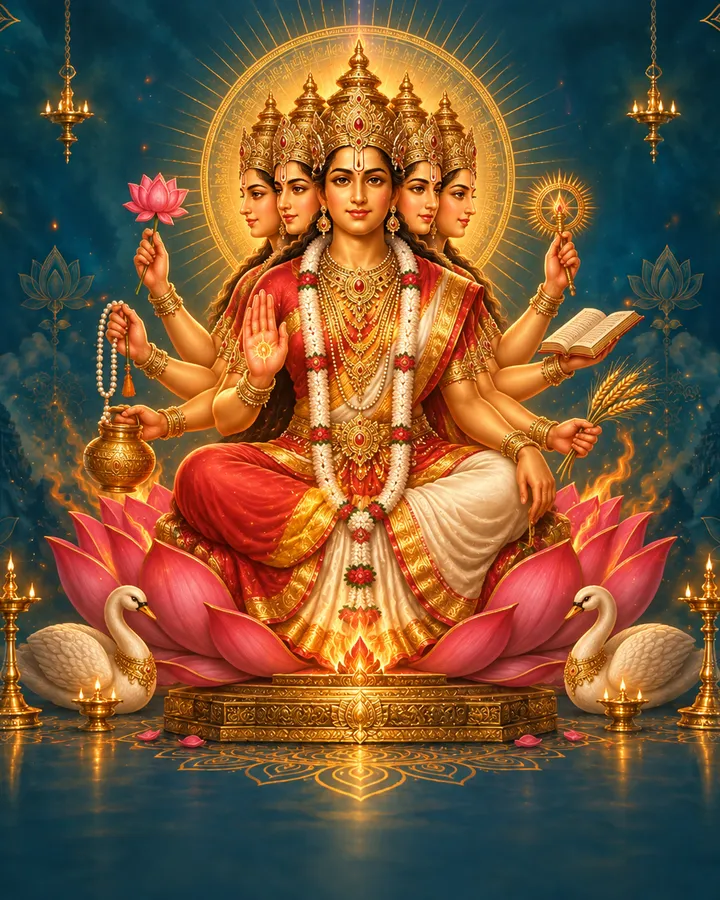
Her traditional iconographic form is unusually elaborate: five heads and ten arms, carrying a mixture of implements associated elsewhere with Shiva, Vishnu, and Brahma, with the count of her heads and limbs numerologically tied to the mantra’s 24 syllables, its 24 associated meters, and its 24 associated deities.
From meter to goddess
Gayatri is, first, the name of a specific poetic meter used through the Rig Veda, and above all for the hymn addressed to the solar deity Savitr known simply as the Gayatri Mantra. The goddess Gayatri is this meter and mantra personified — a genuinely unusual case in Hindu tradition, where the deity’s identity is inseparable from a particular verbal formula rather than from a mythological narrative in the way most gods and goddesses are defined.
The Savitri question
Gayatri is closely, and confusingly, associated with Savitri, and the two names are sometimes used interchangeably. Scholarship on the subject (notably work by Dominik Haas, cited in current reference material) argues that Gayatri and Savitri were originally distinct goddesses — Savitri a solar goddess said to be the daughter of the sun god Savitr, Gayatri the meter and mantra personified — who were merged into a single figure over time, a process that scholarship traces to a specific episode in the Mahabharata involving King Ashwapati’s prayer for a daughter.
The clearest surviving expression of this unresolved relationship is at Pushkar itself, where the local legend holds that Brahma‘s principal wife, Savitri, was late to a yagna he needed a wife present for, so he married a local girl named Gayatri to complete the ritual in her place. When Savitri arrived, she is said to have cursed the situation — accounts differ on the exact terms — while the Padma Purana separately offers a reconciliation in which Savitri accepts Gayatri as a sister. The Matsya Purana takes a different approach again, describing Gayatri, Saraswati, and Savitri as all emerging from one half of Brahma’s body, effectively treating the three names as one entity. This page does not resolve these accounts into a single genealogy, because the textual tradition itself does not.
Pushkar keeps the two goddesses physically separate to this day: Savitri’s temple sits on the town’s highest hill, while the Gayatri temple sits on a lower hill to the east, overlooking the lake.
A separate tradition again, within Shaiva Siddhanta, identifies Gayatri not with Brahma at all but as Manonmani, consort of Sadashiva — a genuinely distinct theological lineage from the more commonly told Pushkar story, reflected in some early Himachal Pradesh bronze images that show her on a bull rather than the swan more usual in later depictions.
Worship today
Gayatri Jayanti, her traditional birthday, falls on Jyeshtha Shukla Ekadashi, the day after Ganga Dussehra, typically in late May or June. Her most active and visible living worship, however, is not built around this single annual date but around the Gayatri Pariwar, a reform movement founded by Pandit Shriram Sharma Acharya and headquartered since 1971 at Shantikunj in Haridwar, where continuous chanting of the Gayatri Mantra and yagna rituals form an ongoing, rather than annual, devotional practice.
In scripture
- Rig Veda — origin of the Gayatri meter and the mantra addressed to Savitr.
- Mahanarayana Upanishad — among the earliest texts to personify Gayatri clearly as a goddess.
- Mahabharata — the Ashwapati narrative central to her merging with Savitri, and the epic’s own declaration that the Vedas issue from her mouth.
Iconography at a glance
Major temples
Gayatri Mata Temple (Pap-Mochani)
Pushkar, Rajasthan, India
Set on a hill on the eastern side of Pushkar Lake, deliberately apart from the temple to Savitri on the town's highest hill — a physical expression of the two goddesses' place in local legend.
Open in Maps ↗Gayatri Teerth Shantikunj
Haridwar, Uttarakhand, India
Headquarters of the All World Gayatri Pariwar, founded by Pandit Shriram Sharma Acharya and the most active living center of organized Gayatri worship today, built around continuous mantra chanting rather than a single annual festival.
Open in Maps ↗Worth knowing
- Gayatri began as the name of a 24-syllable Vedic meter, used above all for the Gayatri Mantra addressed to the sun deity Savitr — the goddess is the personification of that meter and mantra together, an unusually direct link between a deity and a specific text.
- Her traditional form has five heads and ten arms, with the count of her heads, bellies, and arms mapped numerologically to the mantra's 24 syllables, 24 Vedic meters, and 24 associated deities.
- Scholarship on the subject argues that Gayatri and Savitri were originally two separate goddesses, gradually merged into one figure over time, beginning with a specific episode in the Mahabharata.
- At Pushkar, this unresolved relationship is expressed physically: the temple to Savitri sits atop the town's highest hill, while the Gayatri temple sits on a separate, lower hill east of the lake.
- Her most active living worship today is not temple-based in the older sense but centered on the Gayatri Pariwar, a twentieth-century movement founded in 1971 at Shantikunj, Haridwar, built around continuous recitation of her mantra.

