Overview
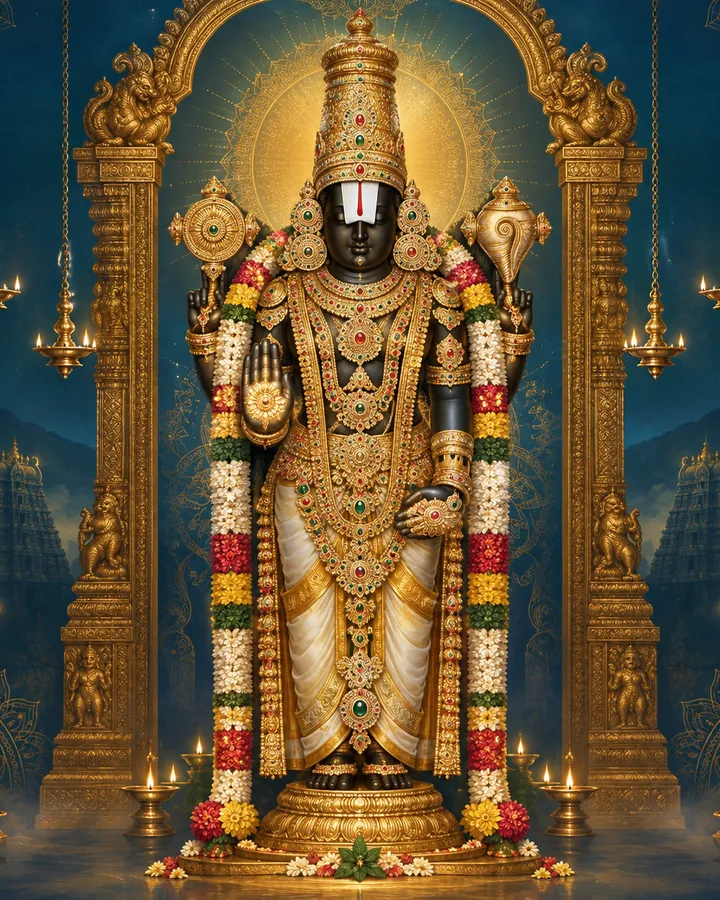
Venkateswara (वेङ्कटेश्वर, Veṅkaṭeśvara), widely known as Balaji or Srinivasa, is a form of Vishnu worshipped principally at the Tirumala Venkateswara Temple in Andhra Pradesh — one of the most-visited religious sites anywhere in the world. Within Sri Vaishnava tradition, he is understood as the accessible, saving form Vishnu takes specifically for the present age, Kali Yuga, a devotional claim this page attributes to the tradition rather than states as fact.
Mythology
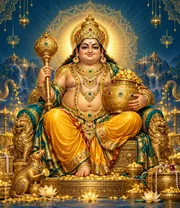
Tradition holds that Lakshmi left Vaikuntha after an act of disrespect toward Vishnu by the sage Bhrigu, and that Vishnu descended to earth as Srinivasa and undertook long penance before seeking the hand of Padmavati, held to be an incarnation of Lakshmi herself, born as daughter of Akasha Raja. Her father set a dowry Srinivasa could not meet alone, so he is said to have borrowed a large sum of gold from Kuber, god of wealth, to complete the marriage — traditionally held at the Kalyana Venkateswara Temple in Narayanavanam. Popular belief holds that the loan carries interest and remains technically outstanding, repayable only by the end of Kali Yuga, and that devotees who contribute to the Tirumala temple’s donation hundi today are, in a sense, still helping repay it — a widely told legend, not a financial claim this page treats as literal fact.
Iconography
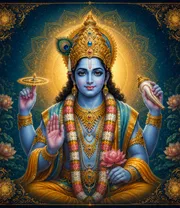
Venkateswara is shown with the Sudarshana Chakra and Nandaka sword typical of Vishnu, marked with Vaishnava tilak, and riding Garuda, Vishnu’s standard vehicle. Some depictions include serpent imagery more commonly associated with Shiva, which a minority of interpretive traditions read as evidence of a syncretic character to his worship — this page presents that reading as one interpretation, not settled doctrine. The temple’s fixed sanctum image, called the Dhruva Beram, is regarded as svayambhu, self-manifested, rather than consecrated through the ritual installation used for most temple images; the deity carried in procession outside the sanctum is a separate image, Malayappa Swami.
The Tirumala Venkateswara Temple
The temple’s earliest recorded endowment dates to 966 CE, under the Pallava queen Samavai; later, better-documented patronage came from the Chola dynasty in the 10th century and the Vijayanagara Empire in the 14th and 15th centuries, with the emperor Krishnadevaraya recorded installing his own statue at the temple in 1517. The present governing body, the Tirumala Tirupati Devasthanams, was established in 1933. Reported annual pilgrim numbers vary meaningfully by year and source but are widely cited in the low-to-mid twenty millions, and the temple is consistently described as one of the wealthiest religious institutions in the world by donation volume, though specific figures (annual hundi collections, trust donations, and overall budget are all different, non-comparable measures) vary considerably depending on which is being cited. Pilgrims commonly shave their heads as an offering, a practice that is also a genuine, reported contributor to the global hair-export industry, and the temple’s hundi remains the primary mechanism through which devotees make donations.
Worship and festivals
Brahmotsavam, the temple’s principal annual festival, is a nine-day celebration, commonly held in September or October, in which the processional deity is carried through the temple’s streets on a different vahana each day. Other significant observances include Vaikuntha Ekadashi and Ratha Saptami, alongside a large number of smaller festival days observed across the year.
In scripture
- Padma Purana, Skanda Purana, Bhavishya Purana, Brahmanda Purana, and Varaha Purana — each contains material relating to Venkateswara.
- Sri Venkatachala Mahatmyam — a text devoted specifically to the sanctity of Venkata Hill and its deity.
Iconography at a glance
Major temple
Tirumala Venkateswara Temple
Tirumala, Tirupati district, Andhra Pradesh, India
One of the eight Vishnu Swayambhu (self-manifested) kshetras and one of the 108 Divya Desams of the Sri Vaishnava tradition; among the most-visited religious sites in the world, with widely reported pilgrim numbers in the low-to-mid twenty millions annually. Its earliest recorded endowment dates to 966 CE, with major later patronage from the Chola and Vijayanagara periods; the present Tirumala Tirupati Devasthanams governing body was established in 1933.
Open in Maps ↗Map loads when scrolled into view.
Worth knowing
- Tradition holds that Venkateswara borrowed a large sum from Kuber to fund his wedding to Padmavati, and that devotees who contribute to the temple's donation hundi today are, per popular belief, still helping repay that debt.
- The temple's main image is regarded within Sri Vaishnava tradition as svayambhu, self-manifested, rather than consecrated through ritual installation like most temple images.
- Pilgrims commonly shave their heads at the temple as an offering; the collected hair is a genuine, reported contributor to the global hair-export industry.
- The temple is widely described as one of the wealthiest religious institutions in the world by donation volume, with cash hundi collections regularly reported in the hundreds of millions of dollars annually, though exact figures vary by year and reporting source.
- Brahmotsavam, the temple's principal annual festival, is a nine-day celebration in which the processional deity is carried through the temple's streets on a different vahana (vehicle) each day.