The text
Tap Recite along to follow verse by verse — use Next, or the arrow keys.
- Stanza 1 (refrain)
जय जय श्री शनिदेव भक्तन हितकारी॥
jaya jaya śrī śanideva bhaktana hitakārī॥
Victory, victory to venerable Lord Shanidev, benefactor of his devotees.
- Stanza 2
सूरज के पुत्र प्रभु छाया महतारी॥जय जय श्री शनिदेव भक्तन हितकारी॥
sūraja ke putra prabhu chāyā mahatārī॥jaya jaya śrī śanideva bhaktana hitakārī॥
Lord, son of Surya, whose mother is Chhaya. Victory, victory to venerable Lord Shanidev, benefactor of his devotees.
- Stanza 3
श्याम अंग वक्र दृष्टि चतुर्भुजा धारी।नीलाम्बर धार नाथ गज की असवारी॥जय जय श्री शनिदेव भक्तन हितकारी॥
śyāma aṅga vakra dṛṣṭi caturbhujā dhārī।nīlāmbara dhāra nātha gaja kī asavārī॥jaya jaya śrī śanideva bhaktana hitakārī॥
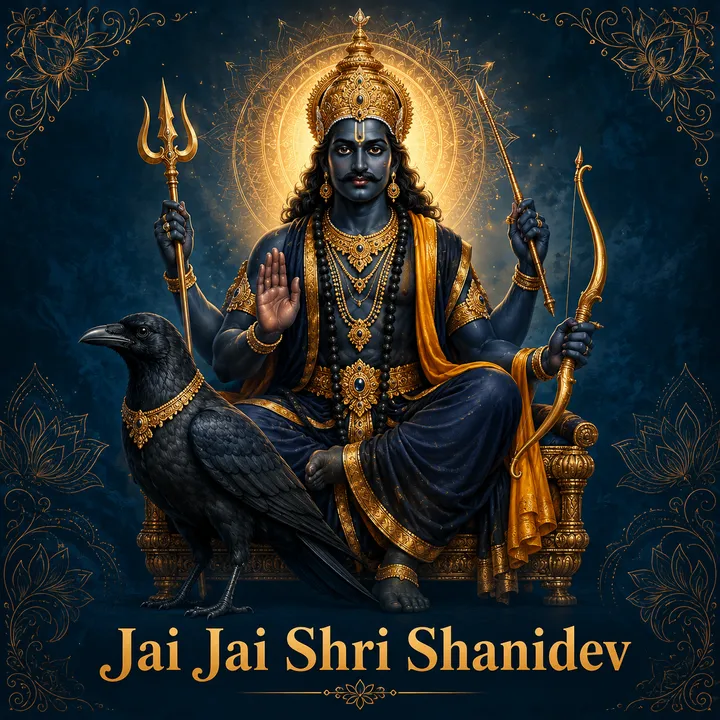
Dark-limbed, with a piercing gaze, bearing four arms; clad in dark-blue garments, the Lord rides upon an elephant. Victory, victory to venerable Lord Shanidev, benefactor of his devotees.
- Stanza 4
क्रीट मुकुट शीश राजित दिपत है लिलारी।मुक्तन की माला गले शोभित बलिहारी॥जय जय श्री शनिदेव भक्तन हितकारी॥
krīṭa mukuṭa śīśa rājita dipata hai lilārī।muktana kī mālā gale śobhita balihārī॥jaya jaya śrī śanideva bhaktana hitakārī॥
A crown shines upon his head, his brow radiant; a garland of pearls graces his neck — we offer ourselves to him. Victory, victory to venerable Lord Shanidev, benefactor of his devotees.
- Stanza 5
मोदक मिष्ठान पान चढ़त हैं सुपारी।लोहा तिल तेल उड़द महिषी अति प्यारी॥जय जय श्री शनिदेव भक्तन हितकारी॥
modaka miṣṭhāna pāna caḍhata haiṁ supārī।lohā tila tela uḍada mahiṣī ati pyārī॥jaya jaya śrī śanideva bhaktana hitakārī॥
Sweets, betel leaf, and areca nut are offered to him; iron, sesame, oil, and black gram are dear to him, and the buffalo is his beloved mount. Victory, victory to venerable Lord Shanidev, benefactor of his devotees.
- Stanza 6
देव दनुज ऋषि मुनि सुमिरत नर नारी।विश्वनाथ धरत ध्यान शरण हैं तुम्हारी॥जय जय श्री शनिदेव भक्तन हितकारी॥
deva danuja ṛṣi muni sumirata nara nārī।viśvanātha dharata dhyāna śaraṇa haiṁ tumhārī॥jaya jaya śrī śanideva bhaktana hitakārī॥
Gods, demons, sages and seers, men and women all remember you in devotion; O Lord of the universe, we meditate upon you and take refuge in you. Victory, victory to venerable Lord Shanidev, benefactor of his devotees.
Overview
Jai Jai Shri Shanidev is a short Hindi aarti in praise of Shani, sung as the concluding devotion in his worship. Its five short stanzas name him as the son of Surya (the Sun) and Chhaya, describe his dark, four-armed form, his crown and pearl garland, and the offerings traditionally made to him — sweets, betel leaf and areca nut, iron, sesame, oil, and black gram — before closing with an appeal for his refuge and protection. Each stanza is followed by the aarti’s own opening line as a refrain, “Jai jai Shri Shanidev bhaktan hitakari,” repeated throughout exactly as it is sung and printed in devotional collections.
Origin and source
Jai Jai Shri Shanidev circulates as an anonymous, traditional Hindi aarti — devotional lyric sites and panchang publishers print it without attributing it to a named composer, unlike some other well-known aartis. Its account of Shani as the son of Surya and Chhaya reflects the widely shared Puranic tradition of his birth. The stanzas listing iron, sesame, oil, and black gram as offerings dear to him mirror the standard items of Saturday Shani puja across North Indian practice.
How it is recited
Jai Jai Shri Shanidev is recited at the close of Shani puja, most often on Saturdays, the day of the week traditionally linked to Shani, and especially on Shani Jayanti. Devotees observing Sade Sati or Shani’s other difficult transits — periods associated with hardship in Vedic astrology — often recite it as part of seeking his goodwill. As with most aartis, it is sung while a lit diya or camphor flame is circled before Shani’s image, with the refrain repeated by everyone present after each stanza.
Frequently asked questions
How many verses does Jai Jai Shri Shanidev have?
Who is Jai Jai Shri Shanidev dedicated to?
When is Jai Jai Shri Shanidev typically recited?
What language is Jai Jai Shri Shanidev composed in?
What tradition is Jai Jai Shri Shanidev associated with?
Is an English translation of Jai Jai Shri Shanidev available?
Is there a Roman transliteration of Jai Jai Shri Shanidev?
Sourcing
Checked against independent sources before publishing — see our sourcing and editorial policy. Spotted an error? Report an issue .