Overview
Shani (शनि, Śani), also called Shanaishchara, “the slow-moving one,” is the deity Hindu tradition identifies with the planet Saturn and one of the Navagraha, the nine celestial bodies of Jyotisha. Of the nine he is the most feared and the most petitioned: the planet whose long, slow orbit — a little under thirty years — stands in for the slow ripening of karma. His worship is concentrated on Saturday, the weekday that carries his name, and at a handful of shrines where the deity is a bare black stone rather than a sculpted image.
Family
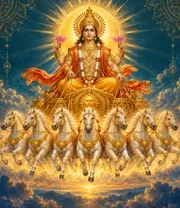
Shani is the son of Surya, the sun, by Chhaya — the shadow-double that Surya’s wife Sanjna (Saranyu) created and left in her place when she could no longer bear her husband’s heat. That parentage makes Yama, the god of death, and Yamuna, the river goddess, his half-siblings by Sanjna, and Savarni Manu and Tapati his full siblings by Chhaya. The Puranic accounts add a note of estrangement: Surya, seeing a dark-complexioned child, doubted that Shani was his, and the coolness between father and son is offered as one explanation for Saturn’s opposition to the Sun in astrology.
Mythology
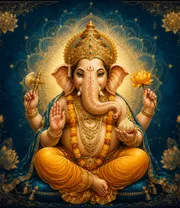
The best-known story of Shani’s power concerns the infant Ganesha. In the Brahmavaivarta Purana’s telling, Shani attends the celebrations for Parvati’s newborn son but keeps his eyes lowered, knowing his gaze brings harm. Parvati insists he look; he does, and the child’s head is severed — one of several accounts the tradition preserves of how Ganesha came to bear an elephant’s head. The story is told to explain the dread of Shani’s drishti, his glance, rather than to blame him: he warned, and was overruled.
A second group of stories concerns kings brought low and restored. King Nala of the Nishadhas, in the Mahabharata’s Nalopakhyana, loses his kingdom and his wife Damayanti under an affliction that later tellings attribute to Shani, and is released at Thirunallar — the temple’s tank, Nala Theertham, takes its name from him. Harishchandra’s long trial and, in medieval narrative, Vikramaditya’s seven and a half years of suffering are told the same way: Shani tests, and those who endure honestly are made whole.
Iconography
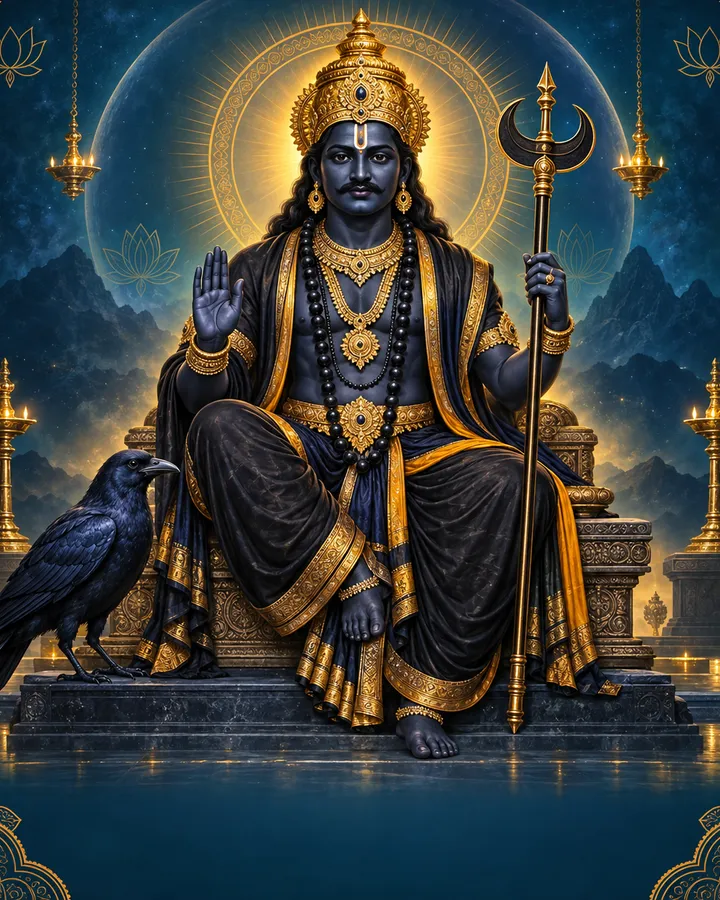
Shani is shown dark-complexioned, clothed in black or deep blue — the colours devotees offer him — and seated or standing on his vahana, most commonly a crow, though a vulture or a buffalo appears in some regional images. He carries a sword, a bow and arrows, or a trident, and is sometimes given a staff. The lameness or slow gait in many descriptions is a deliberate echo of his name: Shanaishchara, the slow mover.
At his most famous shrine there is no image at all. Shani Shingnapur’s deity is a rough black stone slab standing on an open platform under the sky, and devotees pour mustard oil over it directly.
Worship
Saturday is Shani’s day. Devotees visit his shrines, light lamps of mustard oil, and offer black sesame seeds (til), black cloth, iron, or a blue flower; many avoid beginning a journey or a new venture on that day. A Saturday that falls on a new moon — Shani Amavasya — draws the largest gatherings, and Shani Jayanti, his birthday, is kept on the new moon of Jyeshtha.
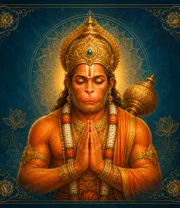
Two devotional habits sit alongside the direct worship of Shani. The first is the Shani Chalisa and the short mantra Om Sham Shanaishcharaya Namah, recited on Saturdays and through the years of Sade Sati. The second is devotion to Hanuman: a widely held belief has it that Shani spares Hanuman’s devotees, so Hanuman temples fill on Saturdays and the Hanuman Chalisa is recited alongside the Shani Chalisa.
In Jyotisha
In Hindu astrology Shani rules Capricorn (Makara) and Aquarius (Kumbha), is exalted in Libra, and takes about two and a half years to cross a sign. His transit over the sign of a person’s natal Moon and its two neighbours — seven and a half years in all — is Sade Sati, the most-discussed of all transits, and a two-and-a-half-year transit in the fourth or eighth sign from the Moon is Dhaiya. This page describes these ideas as the tradition holds them; it does not make astrological claims of its own.
In scripture
- Brahmavaivarta Purana — Shani’s glance and the infant Ganesha.
- Skanda Purana — Navagraha worship and Shani’s temples.
- Navagraha Stotra — the hymn to the nine grahas attributed to Vyasa, whose Shani verse begins nīlāñjana-samābhāsaṃ.
- Shani Mahatmya — the medieval narrative of King Vikramaditya’s seven and a half years under Shani, read on Saturdays.
Parentage
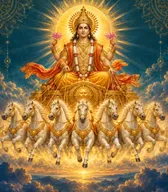 Father Surya Mother Chhaya
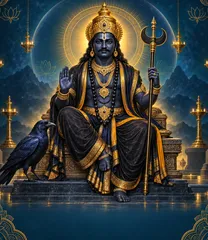 Child Shani
Iconography at a glance
Major temples
Shani Shingnapur
Ahmednagar district, Maharashtra, India
An open-air, self-manifested black stone slab on a platform with no roof — and a village long known for houses built without doors, in the belief that Shani guards it.
Open in Maps ↗Thirunallar Saniswaran Temple
Thirunallar, Karaikal district, Puducherry, India
The Navagraha shrine dedicated to Shani among the nine planetary temples of the Kaveri delta; devotees bathe in the Nala Theertham tank, tied to the story of King Nala's release from Shani's affliction.
Open in Maps ↗Shani Dham
Asola-Fatehpur Beri, New Delhi, India
A modern temple with a tall natural-rock image of Shani, one of the largest in North India; busy on Saturdays and Shani Amavasya.
Open in Maps ↗Map loads when scrolled into view.
Worth knowing
- Shani is the son of Surya by Chhaya, the shadow-form Sanjna left behind when she withdrew from the sun's heat — which makes Yama, god of death, his half-brother.
- Saturday, Shanivar, is named for him; devotees offer black sesame, mustard oil and black cloth, and many avoid beginning new ventures on that day.
- Sade Sati is the seven-and-a-half-year period in which transiting Saturn passes over the sign before, of, and after a person's natal Moon — the most-discussed of all Jyotisha transits.
- The Brahmavaivarta Purana tells how Shani's glance at the infant Ganesha — cast reluctantly, at Parvati's insistence — severed the child's head, one of the accounts of how Ganesha came to have an elephant's head.
- Devotion to Hanuman is widely held to soften Shani's influence; Hanuman temples fill on Saturdays for that reason, and the Hanuman Chalisa is recited alongside the Shani Chalisa.
- He is a judge rather than a villain in the tradition's own reading: Shani rewards honest effort and delays what is unearned, which is why he is called the karma-phala-data, the giver of the fruit of action.