The text
Tap Recite along to follow verse by verse — use Next, or the arrow keys.
- Stanza 1 (refrain)
जय जय पितरजी महाराज, मैं शरण पड़यो हूँ थारी।शरण पड़यो हूँ थारी बाबा, शरण पड़यो हूँ थारी॥
jaya jaya pitarajī mahārāja, maiṁ śaraṇa paḍayo hū̃ thārī।śaraṇa paḍayo hū̃ thārī bābā, śaraṇa paḍayo hū̃ thārī॥
Victory, victory to you, Pitar Maharaj — I have come to take refuge in you. I have taken refuge in you, Baba; I have taken refuge in you.
- Stanza 2
आप ही रक्षक आप ही दाता, आप ही खेवनहारे।मैं मूरख हूँ कछु नहि जाणू, आप ही हो रखवारे॥जय जय पितरजी महाराज।
āpa hī rakṣaka āpa hī dātā, āpa hī khevanahāre।maiṁ mūrakha hū̃ kachu nahi jāṇū, āpa hī ho rakhavāre॥jaya jaya pitarajī mahārāja।
You alone are my protector, you alone my giver, you alone the one who carries me across. I am foolish and understand nothing; you alone are my guardian. Victory, victory to you, Pitar Maharaj.
- Stanza 3
आप खड़े हैं हरदम हर घड़ी, करने मेरी रखवारी।हम सब जन हैं शरण आपकी, है ये अरज गुजारी॥जय जय पितरजी महाराज।
āpa khaḍe haiṁ haradama hara ghaḍī, karane merī rakhavārī।hama saba jana haiṁ śaraṇa āpakī, hai ye araja gujārī॥jaya jaya pitarajī mahārāja।
You stand by me always, at every moment, watching over me; all of us take refuge in you — this is the plea we bring. Victory, victory to you, Pitar Maharaj.
- Stanza 4
देश और परदेश सब जगह, आप ही करो सहाई।काम पड़े पर नाम आपको, लगे बहुत सुखदाई॥जय जय पितरजी महाराज।
deśa aura paradeśa saba jagaha, āpa hī karo sahāī।kāma paḍe para nāma āpako, lage bahuta sukhadāī॥jaya jaya pitarajī mahārāja।
In this land and in every distant land, you alone come to my aid; whenever need arises, your name brings the deepest comfort. Victory, victory to you, Pitar Maharaj.
- Stanza 5
भक्त सभी हैं शरण आपकी, अपने सहित परिवार।रक्षा करो आप ही सबकी, रटूँ मैं बारम्बार॥जय जय पितरजी महाराज।
bhakta sabhī haiṁ śaraṇa āpakī, apane sahita parivāra।rakṣā karo āpa hī sabakī, raṭū̃ maiṁ bārambāra॥jaya jaya pitarajī mahārāja।
All your devotees, together with their families, take refuge in you; protect every one of us — this I repeat again and again. Victory, victory to you, Pitar Maharaj.
Overview
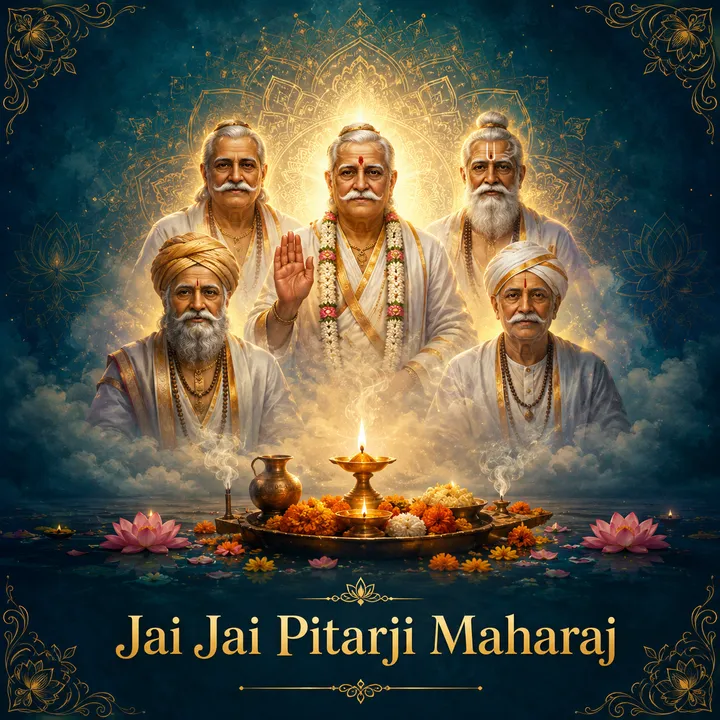
Jai Jai Pitarji Maharaj is a short Hindi aarti of five stanzas addressed to the Pitrs — the departed ancestors of one’s own family, venerated collectively rather than as individual named souls. This is a distinct devotional practice from worship of a deity: the Pitrs are not gods, and the aarti does not ask them for the world-ordering powers a scriptural deity is credited with. Instead it asks for the kind of care a living elder gives a household — protection, guidance, and comfort in a time of need — addressing the ancestors with the same respectful “Maharaj” and “Baba” used for a revered elder. The refrain, repeated after each stanza, is a plain declaration of taking refuge: “I have taken refuge in you.”
Origin and source
No composer is recorded for this aarti in the devotional collections and lyric sites where it circulates, and it is not attributed to any of the named 19th- or 20th-century aarti-writers whose work is documented elsewhere in this collection. It belongs to the wider, largely anonymous body of Hindi shraddha and Pitru Paksha songs that Hindu families sing at home rather than a text with a fixed literary pedigree; as with much of this repertoire, minor wording variants exist between households and regions — some versions of the opening refrain, for instance, close with “Baba” and others with “Deva, rakhiyo laaj hamari” (“Lord, preserve our honor”) — while the four central stanzas of appeal are consistently the same across the sources consulted for this page. Veneration of the Pitrs itself is far older, rooted in the concept of Pitru Rina (the debt owed to one’s ancestors) found in the Dharmashastra and Grihya Sutra literature on shraddha, but this particular aarti is a modern devotional composition built on that older foundation rather than a verse drawn from those texts.
How it is recited
Jai Jai Pitarji Maharaj is sung as part of Pitru Puja — the worship of the Pitrs — most often during Pitru Paksha, the roughly two-week lunar period in the Hindu calendar set aside for honoring departed ancestors, and at shraddha, the rite performed on a family member’s death anniversary. It is typically sung after tarpan (the ritual offering of water) and pinda daan (the offering of rice balls) have been made to the ancestors, with a lit diya circled before a photograph or symbolic representation of the departed as the aarti is recited, in the same manner as an aarti to a deity — the gesture of honor is the same even though what is being honored is one’s own lineage rather than a god.
Frequently asked questions
How many verses does Jai Jai Pitarji Maharaj have?
Who is Jai Jai Pitarji Maharaj dedicated to?
When is Jai Jai Pitarji Maharaj typically recited?
What language is Jai Jai Pitarji Maharaj composed in?
What tradition is Jai Jai Pitarji Maharaj associated with?
Is an English translation of Jai Jai Pitarji Maharaj available?
Is there a Roman transliteration of Jai Jai Pitarji Maharaj?
Sourcing
Checked against independent sources before publishing — see our sourcing and editorial policy. Spotted an error? Report an issue .