Overview
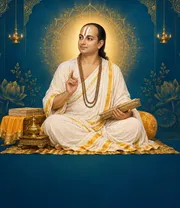
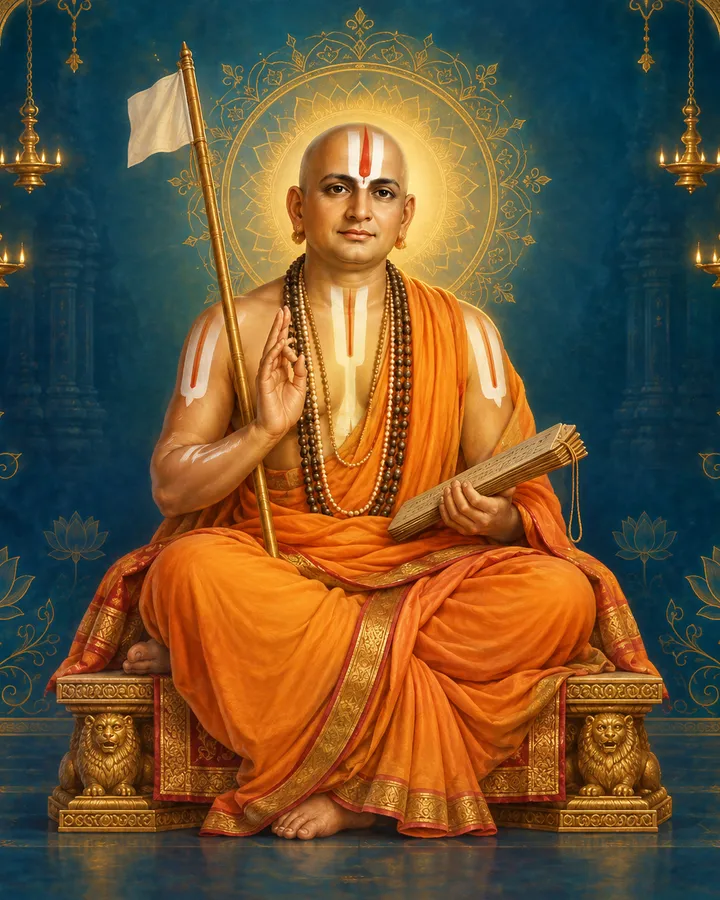
Ramanujacharya (traditionally 1017–1137 CE) was an Indian philosopher and theologian, the central figure behind Vishishtadvaita Vedanta, “qualified non-dualism” — a position that holds Brahman to be a personal God, Vishnu, and the world and individual souls to be genuinely real rather than illusory, standing between Adi Shankaracharya’s Advaita and Madhvacharya’s Dvaita on the question of how the self relates to ultimate reality. His traditional 120-year lifespan is itself disputed by historians, and much of what is told about his life comes from hagiography composed at least a century after his death, which is reason enough to hold most of it loosely rather than as settled fact.
Life
Traditional accounts place his birth at Sriperumbudur, in present-day Tamil Nadu, under the birth name Lakshmana, called Ilaiyalvar, “young Alvar,” in childhood. He first studied under Yadava Prakasha, a teacher aligned with Advaita, but broke with him over philosophical disagreement. He was formally initiated into Sri Vaishnavism through the Pancha Samskara rite by Periya Nambi, also called Mahapurna, a direct disciple of Yamunacharya, the leader of the Sri Vaishnava community at Srirangam at the time — Ramanujacharya himself never personally met Yamunacharya, who died shortly before or around the time the two were to meet. Because the earliest surviving biographies of him postdate his life by more than a century, historians caution that many specific episodes in his traditional biography — including some involving Tirumala and his later years — are best read as devotional tradition, not independently documented fact.
Vishishtadvaita
Ramanujacharya’s philosophical project centered on his commentary on the Brahma Sutras, the Sri Bhashya, in which he set out Vishishtadvaita as a considered alternative to Shankaracharya’s Advaita. Where Advaita holds that the self and Brahman are ultimately one and the same, and the everyday world an illusory appearance, Ramanujacharya held that Brahman is a personal God with real attributes, not an impersonal, attributeless absolute, and that the world and individual souls are real rather than illusory — existing, however, in a relationship of dependent, qualified oneness with Brahman rather than full separateness. This positioned his system as a middle path, later sharpened further in the opposite direction by Madhvacharya’s Dvaita, which holds God and the soul as permanently, unqualifiedly distinct.
Legacy at Srirangam
Ramanujacharya’s clearest, best-attested institutional legacy is his reorganization of ritual structure and worship administration at the Srirangam Ranganathaswamy Temple, one of the most important Sri Vaishnava temples in South India. His teaching gave rise to the Sri Vaishnava Sampradaya, the devotional and philosophical tradition that continues to trace its origin to him, which later divided into the Vadakalai and Tenkalai sub-traditions. Tradition also credits him with widening participation in temple worship, though the specific claims made about this in later hagiography vary in reliability, and this page presents his Srirangam reorganization as the concrete, well-attested core of that legacy rather than extending beyond it.
In his own words
- Sri Bhashya — his major commentary on the Brahma Sutras, the foundational text of Vishishtadvaita.
- Vedartha Sangraha — a synthesis of Vedantic meaning.
- Gita Bhashya — his commentary on the Bhagavad Gita.
- Gadya Trayam — three shorter prose works of devotional surrender.
Worth knowing
- His traditional 120-year lifespan (1017–1137) is widely flagged by historians as implausible or unverifiable; a revised scholarly chronology instead places his life around 1077–1157 — this page does not treat either dating as settled.
- The earliest surviving hagiographies and temple chronicles about his life were composed at least a century after his death, which is why historians describe reconstructing his biography with real confidence as extremely difficult — several specific episodes told about him should be read as devotional tradition rather than documented history.
- He is most credibly and concretely associated with reorganizing ritual structure and worship administration at the Srirangam Ranganathaswamy Temple, his best-attested institutional legacy.
- His Vishishtadvaita, "qualified non-dualism," holds Brahman as a personal God (Vishnu) with real attributes, and the world and individual souls as real rather than illusory — a position between Shankaracharya's Advaita, which holds the self and Brahman ultimately identical, and Madhvacharya's Dvaita, which holds them permanently separate.
- Scholar Wendy Doniger has called him "probably the single most influential thinker of devotional Hinduism."