Overview
Vishwakarma (विश्वकर्मा, Viśvakarmā), whose name means “all-maker,” is the divine architect and engineer of Hindu tradition — credited across the Puranas and epics with building the celestial court, the city of Lanka, the city of Dwarka, and Indra’s thunderbolt weapon, the Vajra. In earlier Vedic literature, he is identified with Tvashtar, an older craftsman deity, and with Prajapati — a layering of identities rather than one continuous figure from the earliest texts onward.
Unlike most major Hindu deities, his most active worship today happens not at pilgrimage temples but at workbenches: on his festival day each September, factories, workshops, and engineering offices across India ritually clean and worship their own tools and machinery in his name.
Iconography
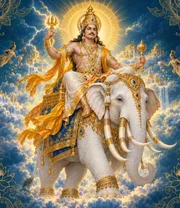
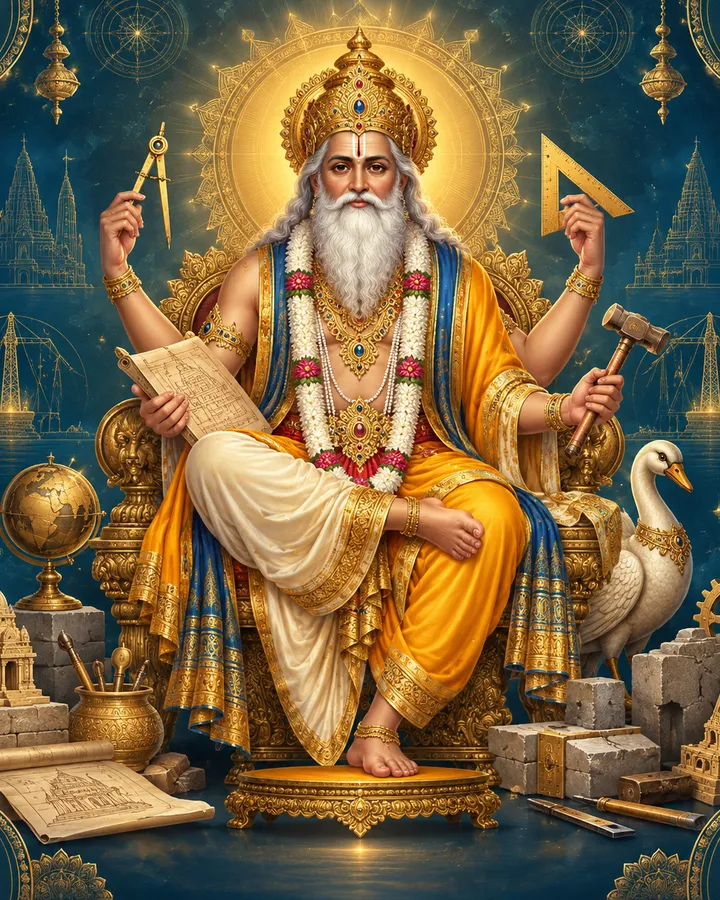
Vishwakarma’s appearance varies notably by region. In western and northwestern India he is typically shown as an aged, wise, white-bearded man with four arms; in eastern India, particularly West Bengal and Odisha, he appears younger and more muscular. Across both traditions, his defining attributes are the tools of a craftsman — a measuring scale, hammer, chisel, kamandalu, and book — rather than weapons or symbols of conquest. His vehicle is described variably as a hamsa, linking him iconographically to Brahma, or an elephant, linking him to Indra and Brihaspati; no single vahana is fixed across all depictions.
Family
Vishwakarma’s parentage differs by text. The Nirukta and Brahmanas name him son of Bhuvana; the Mahabharata and Harivamsha name him son of the Vasu Prabhasa and Yogasiddha; the Vishnu Purana instead names his mother as Varastri, sister of Brihaspati; and some later Puranic sources describe him as a direct son of Brahma. This page does not assert a single lineage. His consort, per the Vamana Purana, is Ghritachi, a celestial apsara.
His best-attested child is his daughter Sanjna, wife of the sun god Surya. Unable to bear the full intensity of her husband’s radiance, Sanjna is said to have left a shadow double of herself, Chhaya, in her place and withdrawn — and Vishwakarma is credited with later reducing Surya’s brilliance on a lathe, making him bearable to look upon. Some versions of this story name Sanjna’s father as Tvashta rather than Vishwakarma specifically, reflecting the same identification between the two figures noted above.
What he is credited with building
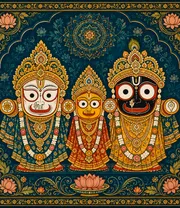
Puranic and epic tradition credits Vishwakarma with an unusually specific list of celebrated constructions: the golden city of Lanka, later ruled by Ravana; the city of Dwarka; the flying palace known as the Pushpaka Vimana; Indra’s thunderbolt weapon, the Vajra; and, according to the Skanda Purana, the original wooden image of Jagannath at Puri. The Ramayana’s vanara architect Nala, credited with designing the bridge to Lanka, is in some tellings identified as his son or incarnation, inheriting his craft.
Worship and Vishwakarma Puja
Vishwakarma Puja, his main festival, falls on Kanya Sankranti, the sun’s astrological entry into Virgo — a date fixed by the solar calendar rather than the lunar calendar most Hindu festivals follow, landing consistently around 16 to 18 September each year. The festival is observed above all by artisans, engineers, and industrial and factory workers, with particular strength in eastern India — West Bengal, Odisha, Bihar, and Jharkhand — where tools, machines, and vehicles are cleaned, decorated, and formally worshipped rather than pilgrims traveling to a temple.
He is also regarded as the mythological progenitor of India’s traditional artisan castes — carpenters, blacksmiths, goldsmiths, coppersmiths, and stonemasons — who trace their occupational lineage to him through the Brahmavaivarta Purana.
In scripture
- Rig Veda (10.81–82) — describes an “all-seeing” creator figure with eyes, faces, arms, and feet on every side, generally read as an early reference to Vishwakarma.
- Vishnu Purana — names him son of the Vasu Prabhasa.
- Mahabharata — describes him as chief architect of the celestial court of Swarga.
- Skanda Purana — credits him with carving the original wooden image of Jagannath at Puri.
Iconography at a glance
Worth knowing
- Vishwakarma's primary living worship happens not at pilgrimage temples but at workplaces — factories, workshops, garages, and engineering offices — where tools and machines are ritually cleaned and worshipped on his festival day each year.
- His festival, Vishwakarma Puja, falls on a fixed date set by the solar calendar (around 16-18 September), unlike most Hindu festivals, which follow the lunar calendar and shift from year to year.
- Puranic tradition credits him with building an unusually specific list of mythological places and objects: the city of Lanka, the city of Dwarka, the flying palace Pushpaka Vimana, Indra's thunderbolt weapon, and, per the Skanda Purana, the original wooden image of Jagannath at Puri.
- In the Rig Veda he is described as "all-seeing," with eyes, faces, arms, and feet said to face every direction at once — an older, more abstract image than his later depiction as a human craftsman.
- He is regarded as the mythological progenitor of India's traditional artisan castes — carpenters, blacksmiths, goldsmiths, coppersmiths, and stonemasons — who trace their occupational descent to him.