Overview
Indra (इन्द्र) is the king of the Devas and ruler of Svarga in Vedic mythology, god of thunder, rain, and war, and the most frequently invoked deity in the Rigveda. Despite this Vedic-era supremacy, his standing changes markedly in later Hindu tradition — a decline this page addresses directly, alongside the myths that define his earlier centrality.
Centrality in the Rigveda
Indra is the sole dedicatee of roughly 250 Rigvedic hymns, more than any other single deity, including Agni, who follows with around 200. His central myth is the slaying of Vritra, a serpent said to have coiled around a mountain and imprisoned the world’s waters. Wielding the vajra, aided by the storm-gods known as the Maruts and fortified by soma, Indra freed the waters by killing Vritra — earning the epithet Vritrahan, “slayer of Vritra,” and establishing the narrative most consistently associated with him across Vedic scholarship.
Iconography
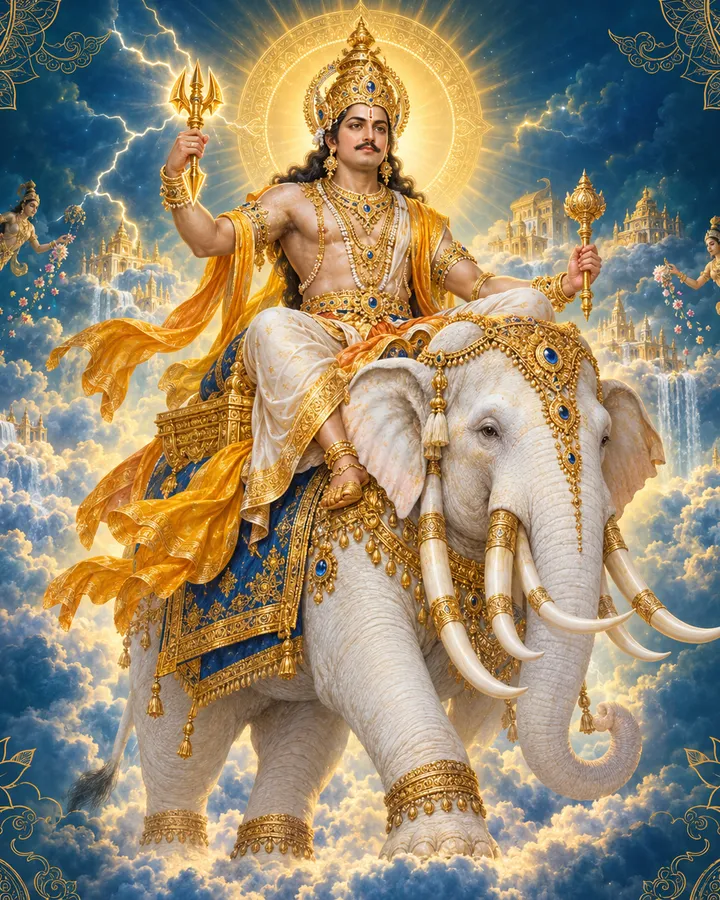
Indra’s signature weapon, the vajra, is traditionally said to have been fashioned by the divine smith Tvashtri from the bones of the sage Dadhichi, who gave his life specifically so the weapon could be made — a vivid, well-attested detail behind his most recognizable attribute. He rides Airavata, a white elephant, and rules from his capital, Amaravati, in Svarga. His epithet Sahasraksha, “thousand-eyed,” comes from a specific later myth rather than describing an original, default form: accounts of the story, and of the curse behind it, vary across texts, and this page does not dwell on their differing details — its lasting trace is simply the epithet itself.
Decline in later tradition
Indra’s supremacy belongs specifically to the Vedic era. By the time of the epics and Puranas, Hindu tradition increasingly centers on the Trimurti, and Indra is consistently subordinated to Vishnu and Shiva in the narratives that follow. He becomes a recurring figure of anxiety rather than unquestioned authority — his throne in Svarga is repeatedly threatened by ascetics, demons, and rival kings across many Puranic stories, among them the account of Vishnu’s Vamana avatar restoring Indra’s throne after the pious king Mahabali had displaced him. This is a well-documented shift, comparable to the declines already described on this site for Brahma and Surya.
Worship today
No major standalone Hindu temple to Indra exists. His clearest dedicated living festival is Indra Jatra, an eight-day celebration in Nepal’s Kathmandu Valley involving chariot processions and masked dances, commemorating a local myth of Indra descending to earth and being briefly held captive while seeking a flower for his mother — a Newar tradition specific to that region rather than a pan-Indian observance.
In scripture
- Rigveda — the primary source of Indra’s centrality, including the Vritra myth and his weapon’s origin.
Iconography at a glance
Worth knowing
- Indra is the most frequently mentioned deity in the Rigveda, sole dedicatee of roughly 250 hymns — more than any other single Vedic deity, including Agni.
- His central myth is the slaying of the serpent Vritra, who had imprisoned the world's waters; using the vajra and aided by the storm-gods, the Maruts, Indra freed the waters and earned the epithet Vritrahan, "slayer of Vritra."
- His vajra is traditionally said to have been forged from the bones of the sage Dadhichi, who gave his life so the weapon could be made.
- By the Puranic and epic period, Indra's supremacy gives way to the rising Trimurti — he is repeatedly portrayed as an anxious ruler whose throne is threatened by ascetics and rival kings, a recurring narrative device across many Puranic stories, including the account of Vishnu's Vamana avatar restoring his throne from Mahabali.
- Indra Jatra, an eight-day festival in Nepal's Kathmandu Valley involving chariot processions and masked dances, is his clearest dedicated living festival, though it is specific to the Newar tradition of that region rather than observed pan-India.