The text
Tap Recite along to follow verse by verse — use Next, or the arrow keys.
- Stanza 1 (refrain)
जय श्री विश्वकर्मा प्रभु, जय श्री विश्वकर्मा।सकल सृष्टि के करता, रक्षक स्तुति धर्मा॥
jaya śrī viśvakarmā prabhu, jaya śrī viśvakarmā।sakala sṛṣṭi ke kartā, rakṣaka stuti dharmā॥
Victory to Lord Vishwakarma, victory to Lord Vishwakarma. You are the maker of all creation, its protector, praised for your righteousness.
- Stanza 2
आदि सृष्टि में विधि को, श्रुति उपदेश दिया।जीव मात्र का जग में, ज्ञान विकास किया॥जय श्री विश्वकर्मा प्रभु, जय श्री विश्वकर्मा।
ādi sṛṣṭi meṁ vidhi ko, śruti upadeśa diyā।jīva mātra kā jaga meṁ, jñāna vikāsa kiyā॥jaya śrī viśvakarmā prabhu, jaya śrī viśvakarmā।
At the dawn of creation, you gave Vidhi (Brahma) the teaching of the Vedas; you spread the light of knowledge to every being in the world. Victory to Lord Vishwakarma, victory to Lord Vishwakarma.
- Stanza 3
ऋषि अंगीरा तप से, शांति नहीं पाई।ध्यान किया जब प्रभु का, सकल सिद्धि आई॥जय श्री विश्वकर्मा प्रभु, जय श्री विश्वकर्मा।
ṛṣi aṅgīrā tapa se, śānti nahīṁ pāī।dhyāna kiyā jaba prabhu kā, sakala siddhi āī॥jaya śrī viśvakarmā prabhu, jaya śrī viśvakarmā।
Sage Angira found no peace through his austerities; but when he meditated on the Lord, every accomplishment came to him. Victory to Lord Vishwakarma, victory to Lord Vishwakarma.
- Stanza 4
रोग ग्रस्त राजा ने, जब आश्रय लीना।संकट मोचन बनकर, दूर दुःखा कीना॥जय श्री विश्वकर्मा प्रभु, जय श्री विश्वकर्मा।
roga grasta rājā ne, jaba āśraya līnā।saṅkaṭa mocana banakara, dūra duḥkhā kīnā॥jaya śrī viśvakarmā prabhu, jaya śrī viśvakarmā।
When an ailing king took refuge in you, you became his reliever from distress and drove his suffering away. Victory to Lord Vishwakarma, victory to Lord Vishwakarma.
- Stanza 5
जब रथकार दंपति, तुम्हारी टेर करी।सुनकर दीन प्रार्थना, विपत सगरी हरी॥जय श्री विश्वकर्मा प्रभु, जय श्री विश्वकर्मा।
jaba rathakāra dampati, tumhārī ṭera karī।sunakara dīna prārthanā, vipata sagarī harī॥jaya śrī viśvakarmā prabhu, jaya śrī viśvakarmā।
When the chariot-maker couple called out to you, you heard their humble prayer and removed all their hardship. Victory to Lord Vishwakarma, victory to Lord Vishwakarma.
- Stanza 6
एकानन चतुरानन, पंचानन राजे।त्रिभुज चतुर्भुज दशभुज, सकल रूप साजे॥जय श्री विश्वकर्मा प्रभु, जय श्री विश्वकर्मा।
ekānana caturānana, pañcānana rāje।tribhuja caturbhuja daśabhuja, sakala rūpa sāje॥jaya śrī viśvakarmā prabhu, jaya śrī viśvakarmā।
With one face, four faces, or five faces, you are enthroned; with three arms, four arms, or ten arms, you grace every form. Victory to Lord Vishwakarma, victory to Lord Vishwakarma.
- Stanza 7
ध्यान धरे तब पद का, सकल सिद्धि आवे।मन द्विविधा मिट जावे, अटल शक्ति पावे॥जय श्री विश्वकर्मा प्रभु, जय श्री विश्वकर्मा।
dhyāna dhare taba pada kā, sakala siddhi āve।mana dvividhā miṭa jāve, aṭala śakti pāve॥jaya śrī viśvakarmā prabhu, jaya śrī viśvakarmā।
Whoever fixes their meditation on your feet gains every accomplishment; the mind's doubt dissolves, and unshakeable strength is gained. Victory to Lord Vishwakarma, victory to Lord Vishwakarma.
- Stanza 8
श्री विश्वकर्मा की आरती, जो कोई गावे।भजत गजानांद स्वामी, सुख संपति पावे॥जय श्री विश्वकर्मा प्रभु, जय श्री विश्वकर्मा।सकल सृष्टि के करता, रक्षक स्तुति धर्मा॥
śrī viśvakarmā kī āratī, jo koī gāve।bhajata gajānānda svāmī, sukha sampati pāve॥jaya śrī viśvakarmā prabhu, jaya śrī viśvakarmā।sakala sṛṣṭi ke kartā, rakṣaka stuti dharmā॥
Whoever sings this aarti of Shri Vishwakarma — says Gajanand Swami — receives happiness and prosperity. Victory to Lord Vishwakarma, victory to Lord Vishwakarma: you are the maker of all creation, its protector, praised for your righteousness.
Overview
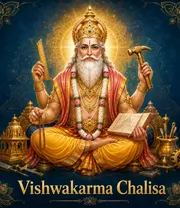
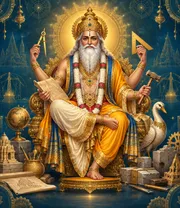
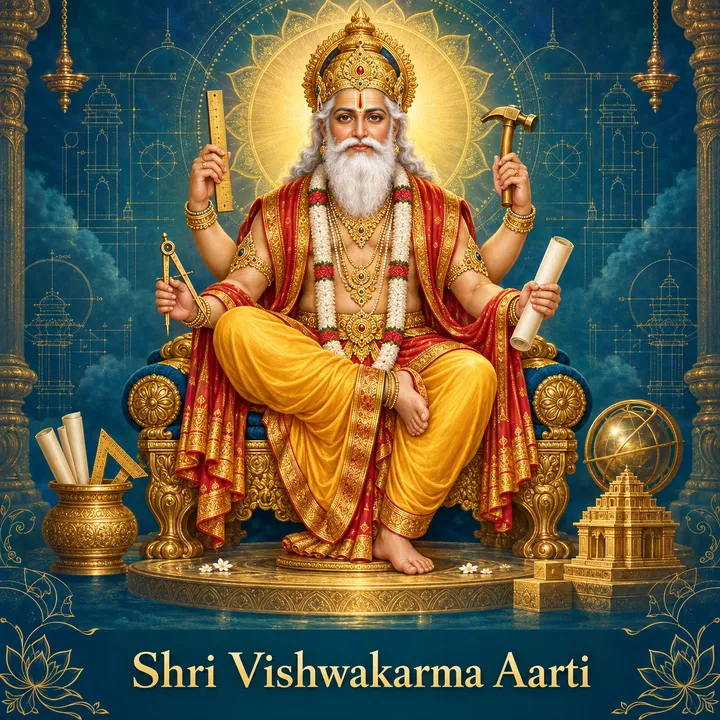
Shri Vishwakarma Aarti is a Hindi aarti of eight stanzas addressed to Vishwakarma, revered in Hindu tradition as the divine architect and craftsman — the deity of building, machinery, and skilled work. Puranic tradition credits Vishwakarma with constructing Lanka for Kubera (later occupied by Ravana) and Dwaraka for Krishna, and popular devotional tradition further credits him with Indraprastha, the Pandavas’ capital, and with divine weapons carried by other deities. Because of this association with craft and construction, Vishwakarma is worshipped above all by artisans, engineers, architects, and industrial workers, and his aarti is sung at the close of the puja performed over tools, machines, and workshops.
Origin and source
Like many Hindi aartis, Shri Vishwakarma Aarti circulates without a documented author or date of composition; its final stanza names “Gajanand Swami” in its closing line, a common convention (bhanita) in this genre where the composer signs off within the verse itself, but no further biographical detail about this figure is reliably attested in accessible sources. The stanzas draw on Puranic episodes — Vishwakarma instructing Brahma at the start of creation, sage Angira’s austerities, an ailing king’s relief, and a chariot-maker couple’s prayer — alongside a description of his iconography as appearing with one, four, or five faces and three, four, or ten arms.
How it is recited
Shri Vishwakarma Aarti is sung on Vishwakarma Puja, observed by many communities in North and East India in mid-September, coinciding with Kanya Sankranti (the date varies slightly by region and calendar). On this day, workshops, factories, and offices clean and worship their tools, machines, and equipment, and craftspeople, mechanics, and engineers gather to seek Vishwakarma’s blessing for their work. As with most aartis, it is sung while a lit lamp is circled before the deity’s image, with the refrain “Jai Shri Vishwakarma Prabhu, jai Shri Vishwakarma” repeated after each stanza.
Frequently asked questions
How many verses does Shri Vishwakarma Aarti have?
Who is Shri Vishwakarma Aarti dedicated to?
When is Shri Vishwakarma Aarti typically recited?
What language is Shri Vishwakarma Aarti composed in?
What tradition is Shri Vishwakarma Aarti associated with?
Is an English translation of Shri Vishwakarma Aarti available?
Is there a Roman transliteration of Shri Vishwakarma Aarti?
Sourcing
Checked against independent sources before publishing — see our sourcing and editorial policy. Spotted an error? Report an issue .