Overview
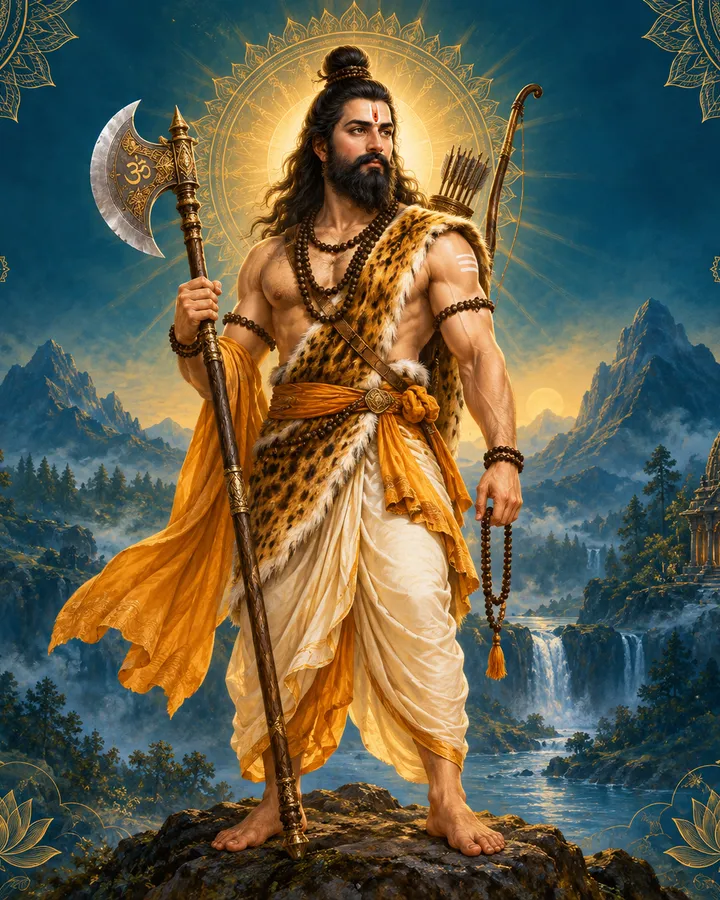
Parashurama (परशुराम, Paraśurāma), “Rama with an axe,” is the sixth of the ten Dashavatara of Vishnu, appearing between Vamana and Rama. He is a distinctive figure among the avatars: a sage born into a Brahmin family who takes up the life of a warrior, carrying the axe, or parashu, from which his name comes, traditionally said to have been given to him by Shiva.
Family
His father is the sage Jamadagni, of the Bhrigu lineage, and his mother is Renuka. Sources name several elder brothers, though the exact list of names varies across texts. Some Puranic sources give his consort as Dharani, said to be an incarnation of Lakshmi, though this pairing receives far less emphasis in most tellings than his identity as a celibate ascetic-warrior.
Mythology
Parashurama’s best-known story begins when King Kartavirya Arjuna forcibly seized Jamadagni’s wish-granting cow and, when the sage resisted, killed him. Parashurama avenged his father’s death by killing Kartavirya Arjuna — and, in the fuller telling, went on to wage a lengthy series of campaigns against the Kshatriya warrior class in response to continued provocations that followed, sparing only lineages descended from Manu and Ikshvaku. It is among the more forceful narratives in Hindu tradition, and this page notes it plainly rather than dwelling on it.
In the Mahabharata, Parashurama appears in a different register, as guru to Bhishma, Drona, and Karna, training each in warfare and the use of divine weapons; his own inconclusive 23-day duel with Bhishma, over Bhishma’s refusal to marry Amba, ends in a draw. In the Ramayana, he confronts the young Rama after Rama breaks Shiva’s bow to win Sita, offering his own bow — Vishnu’s own — as a further test. When Rama strings it with ease, Parashurama recognizes him as a fellow, and in this era senior, incarnation of Vishnu, yields his own divine energy, and retires — a confrontation that resolves in recognition rather than conflict.
A regional origin-legend: the Konkan coast
A separate and later tradition, recorded in the Keralolpathi, a Malayalam chronicle compiled in the 17th century, credits Parashurama with reclaiming the coastal land from Gokarna to Kanyakumari from the sea by casting his axe, the sea god receding to reveal the land later fertilized with the help of the serpent king Vasuki. This page presents this specifically as a regional chronicle tradition, centuries later than the classical Sanskrit Puranas, rather than claiming it equal antiquity.
Worship and festivals
Parashurama Jayanti, commemorating his birth, falls on Akshaya Tritiya — the same date as one of the most widely observed auspicious days in the Hindu calendar more broadly, a coincidence of dates worth noting in its own right. At the Shri Kshetra Parashuram Temple in Chiplun, on the Konkan coast of Maharashtra, he is regarded as the region’s presiding deity; the temple’s architecture is a documented blend of Hindu and Islamic elements, reflecting centuries of layered historical patronage.
He is counted among the Chiranjivis, a small group of figures in Hindu tradition said to remain immortal and present in the world; tradition holds that he remains in meditative retreat at Mahendra Mountain, and is destined to serve as martial teacher to Kalki, the tenth and final avatar, at the end of the current age.
In scripture
- Mahabharata — the Kartavirya Arjuna narrative, and his role as guru to Bhishma, Drona, and Karna.
- Ramayana — his confrontation with, and recognition of, Rama.
Parentage
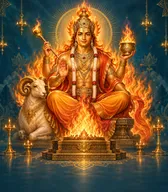 Father Agni Jamadagni Mother Renuka
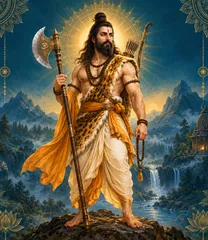 Child Parashurama
Iconography at a glance
Major temples
Shri Kshetra Parashuram Temple
Chiplun, Ratnagiri district, Maharashtra, India
A major Konkan-region pilgrimage site, regarded as Parashurama's presiding shrine for the region; temple tradition dates an original structure to the 6th century, though this rests on tradition rather than independently corroborated dating. Enshrines Parashurama flanked by images representing Brahma, Vishnu, and Shiva, with a separate shrine to Renuka behind the main temple.
Open in Maps ↗Parshuram Kund
Lohit district, Arunachal Pradesh, India
A pilgrimage site associated with Parashurama, visited especially during Makar Sankranti.
Open in Maps ↗Worth knowing
- Parashurama is the sixth of the ten Dashavatara, between Vamana and Rama, and one of the few avatars traditionally described as still present on earth, said to coexist across both the Rama and Krishna eras.
- He is one of the Chiranjivis, the immortals of Hindu tradition, said to remain in retreat and destined to serve as martial guru to Kalki, the tenth and final avatar, at the end of the current age.
- In the Ramayana, his confrontation with Rama ends not in violence but in recognition — he yields on seeing Rama string his own bow, acknowledging Rama as a fellow incarnation of Vishnu.
- Parashurama Jayanti coincides with Akshaya Tritiya, one of the most widely observed auspicious days in the Hindu calendar.
- The tradition that Parashurama reclaimed the Konkan and Kerala coastline from the sea comes from the Keralolpathi, a 17th-century Malayalam chronicle — a regional origin-legend, distinct in era and genre from the classical Sanskrit Puranas.