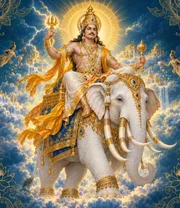
Overview
Agni (अग्नि) is the Vedic god of fire, one of the most central deities of the Rigveda — its opening hymn is addressed to him — and the traditional messenger between the human and divine realms, carrying oblations offered in yajna, fire sacrifice, up to the gods. Despite this Vedic-era centrality, he has no major standalone temple today; his living worship continues almost entirely through ritual rather than pilgrimage, a distinction this page treats directly.
Centrality in the Rigveda
Roughly 200 of the Rigveda’s approximately 1,028 hymns are dedicated to Agni, placing him second only to Indra in dedicated hymn-count among all Rigvedic deities, and nearly every book of the Rigveda opens with a hymn to him. As messenger between worlds, he is understood to carry the oblations of the sacrificial fire to the gods, and in turn to summon the gods down to the sacrifice — the basis of his role as Hotr, the divine priest, named in the Rigveda’s very first hymn.
Iconography
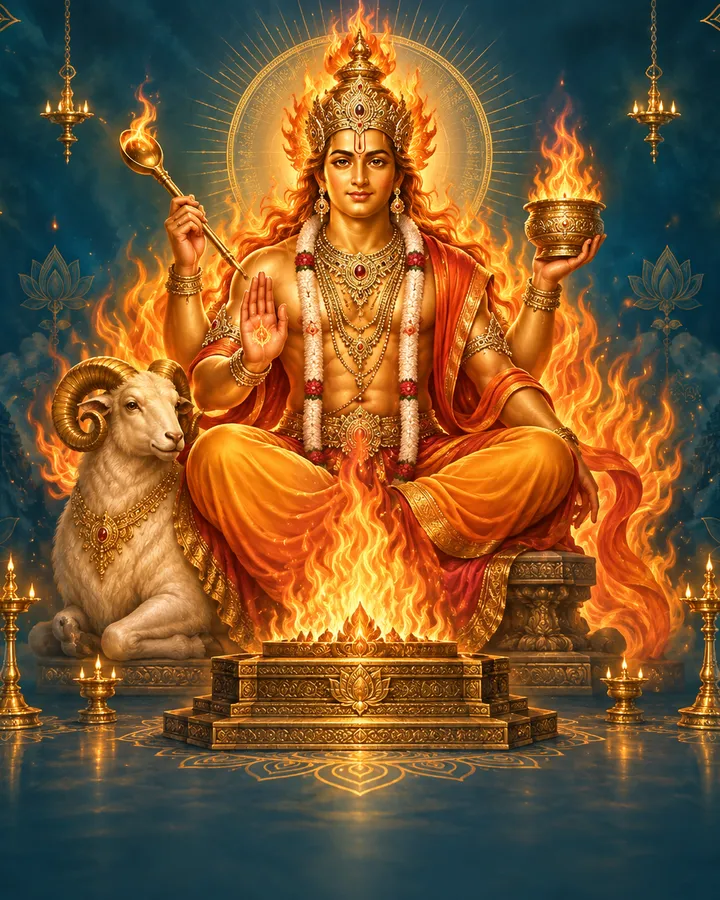
Agni is shown deep red in color, often with two faces, read as representing his dual role as both domestic hearth-fire and sacrificial fire. Some texts describe him with seven individually named tongues of flame. His vehicle is most often a ram, sometimes a chariot drawn by goats, and he carries a fan for kindling fire, a sacrificial ladle, an axe, and a flaming torch.
Family
Agni’s parentage is genuinely inconsistent across Puranic sources — variously named a son of Dyaus (Sky) and Prithvi (Earth), one of the Adityas born to Kashyapa and Aditi, or descended from Brahma through the sage Angiras. Reference works on Puranic genealogy note directly that his lineage is difficult to trace with any single settled account, and this page presents that inconsistency rather than choosing one version. His consort, Svaha, is consistently attested across sources.
A threefold form
Vedic texts, including the Atharva Veda and Shatapatha Brahmana, describe Agni as existing simultaneously in three forms: as fire on earth, as lightning in the atmosphere, and as the sun in the sky — one essence taking three visible shapes, a distinctive theological claim among Vedic deities.
Decline and living ritual role
Agni’s centrality declined sharply after the Vedic period; scholars describe his identity as having been internalized over time to represent transformative energy generally, rather than remaining a widely worshipped, independently enshrined deity — a shift comparable to the declines documented elsewhere on this site for Brahma and Surya. Yet he remains functionally present in Hindu ritual life in a way distinct from temple worship: he is invoked in nearly every homa, havan, and yajna performed today, is the ritual witness at Hindu weddings during the Saptapadi, the seven steps taken around the sacred fire, and is central to Agnihotra, the practice of regular domestic fire offerings. No major standalone temple is dedicated to him as presiding deity — his living worship is carried through this ongoing ritual function rather than through pilgrimage.
In scripture
- Rigveda — its opening hymn, and roughly 200 hymns overall, addressed to Agni.
- Atharva Veda and Shatapatha Brahmana — sources for his threefold form.
Iconography at a glance
Worth knowing
- The Rigveda's very first hymn is addressed to Agni, and roughly 200 of its approximately 1,028 hymns are dedicated to him — second only to Indra in dedicated hymn-count among all Rigvedic deities.
- He is described as existing simultaneously in three forms: as fire on earth, as lightning in the atmosphere, and as the sun in the sky — a threefold identity set out in the Atharva Veda and Shatapatha Brahmana.
- Puranic accounts of his parentage are genuinely inconsistent — he is variously named a son of Dyaus and Prithvi, one of the Adityas born to Kashyapa and Aditi, or descended from Brahma through Angiras — and no single genealogy is treated as settled across texts.
- His importance declined sharply in the post-Vedic era relative to his Rigvedic centrality, a shift scholars describe as his identity being internalized to represent transformative energy more broadly rather than a single worshipped figure.
- No major standalone Hindu temple is dedicated to him as presiding deity — his living worship today is carried almost entirely through ritual rather than pilgrimage.