Overview
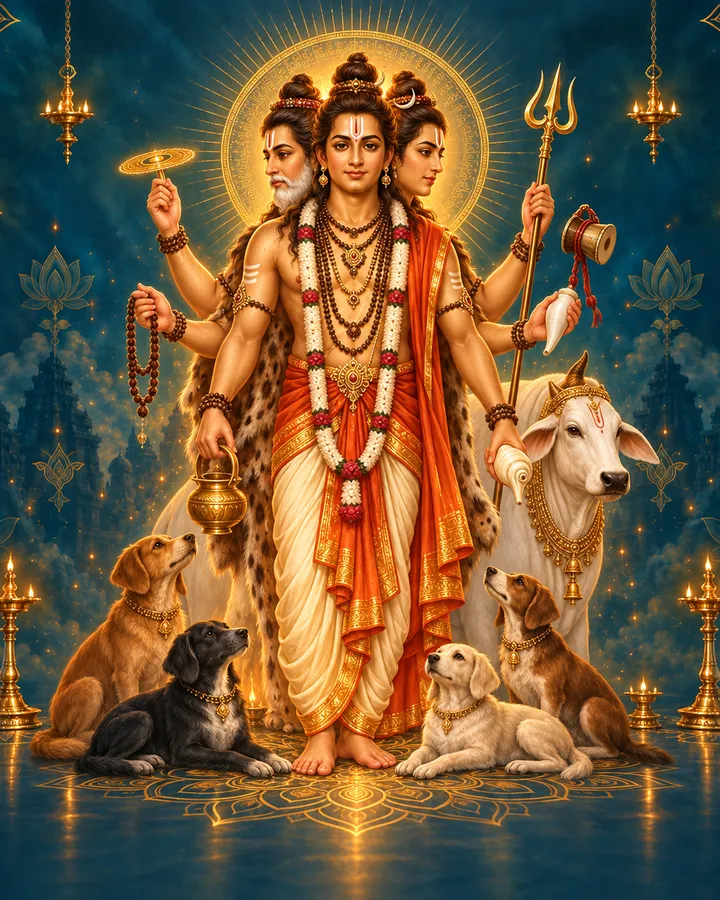
Dattatreya (दत्तात्रेय, Dattātreya) is worshipped as a single deity combining Brahma, Vishnu, and Shiva, most commonly shown with three heads and six arms. He is regarded as an adi-guru, a primordial teacher, and the central figure of the Datta Sampradaya, a devotional lineage strongest in Maharashtra, Karnataka, and the Andhra/Telangana region, though his worship and iconography also appear more broadly across Vaishnava, Shaiva, and Smarta tradition.
Family and birth
His father is the Vedic rishi Atri, a contributor to the Rigveda, and his mother is Anasuya, renowned in Puranic tradition for her chastity and austerity. The standard Puranic birth narrative holds that Brahma, Vishnu, and Shiva together tested Anasuya’s virtue and, satisfied by it, were born to her as a single combined child. His exact birthplace is not agreed upon across tradition — some accounts place it at Mahur in present-day Maharashtra, others in the western Deccan or near Kashmir, with no single version treated here as authoritative.
Iconography
Dattatreya’s now-dominant modern form has three heads, representing Brahma, Vishnu, and Shiva together, and six arms carrying items associated with each — a japamala and kamandalu for Brahma, a shankha and chakra for Vishnu, a trishula and damaru for Shiva, though the exact pairing of items to heads varies somewhat by source. He is typically shown accompanied by four dogs, commonly read as symbolizing the four Vedas, and a cow, often identified with Kamadhenu and read as a symbol of the earth’s sustenance. Older and medieval temple images — at Mahur, Pandharpur, Badami, Ajmer, and Varanasi among them — more often show a single-headed, two- or four-armed form; the three-headed convention seen most widely today developed later.
The twenty-four gurus
A well-known teaching story describes Dattatreya naming twenty-four teachers drawn from the natural world, each of whom taught him something about liberation simply by being observed — among them the earth (patience), a pigeon (the danger of attachment, drawn from watching a pigeon lose its family to a hunter), a python (learning to accept whatever comes without seeking it out), and a bee (gathering wisdom from many sources, as a bee gathers nectar from many flowers). The exact list of twenty-four varies somewhat across the texts that tell it, and no single version is definitive — the story’s function, illustrating that a true teacher can be found anywhere for one who is willing to observe closely, is more consistent than its exact roster.
The Datta Sampradaya
Within the Datta Sampradaya, the Guru Charitra, composed by Saraswati Gangadhar, holds a status devotees often compare to the Bhagavad Gita’s place in wider Vaishnavism. Its roughly 52 chapters recount the lives of Shripad Shri Vallabha and Narasimha Saraswati, two figures the tradition regards as avatars of Dattatreya himself, rather than being a text composed by Dattatreya. The Avadhuta Gita, a separate work traditionally attributed to Dattatreya directly, sets out teaching on the nature of the self in the voice of a fully liberated avadhuta; its surviving manuscripts are usually dated to around the 9th or 10th century, though the oral tradition behind it may well be older, so no precise date is asserted here. Some traditions, including parts of the Nath sampradaya, also regard Dattatreya as an adi-guru of their own lineage — a connection some scholars treat as a later addition rather than part of the tradition’s original formation.
Worship and temples
Datta Jayanti, his birthday, is observed on Margashirsha Purnima, the full moon of the Margashirsha month (roughly November or December), with particular strength in Maharashtra, Karnataka, Andhra Pradesh, Telangana, and Gujarat. Dattatreya’s worship spans these regions rather than belonging to one linguistic or cultural tradition. His most visited sites include the Dattatreya Temple at the summit of Girnar Hill in Gujarat, reached by a roughly 10,000-step pilgrimage route, and Sri Kshetra Ganagapur in Karnataka, where the Datta Sampradaya holds that Narasimha Saraswati — regarded within the tradition as his second avatar — spent his final years.
In scripture
- Avadhuta Gita — traditionally attributed to Dattatreya, teaching on the nature of the liberated self.
- Guru Charitra — the central text of the Datta Sampradaya, recounting the lives of two figures the tradition holds to be his avatars.
- Mentioned in the Bhagavata Purana and Markandeya Purana, among other Puranic sources.
Parentage
 Child Dattatreya
Iconography at a glance
Major temples
Dattatreya Temple, Girnar Hill
Girnar Hill, Junagadh district, Gujarat, India
At the summit of a roughly 10,000-step pilgrimage route, passed on the way up by Jain temples and the Ambaji Temple; a major pilgrim destination especially during Maha Shivaratri.
Open in Maps ↗Sri Kshetra Ganagapur
Afzalpur taluka, Kalaburagi district, Karnataka, India
At the confluence of the Bhima and Amaraja rivers; the Datta Sampradaya holds that Narasimha Saraswati, regarded within the tradition as Dattatreya's second avatar, spent his final years here, and the site's Nirgun Math preserves his charan paduka (footprint shrine).
Open in Maps ↗Worth knowing
- Dattatreya is worshipped as a single deity combining Brahma, Vishnu, and Shiva, most often shown with three heads and six arms — a distinctly composite iconography with no equivalent among the other deities on this site.
- He is regarded as an adi-guru, a primordial teacher, and the archetype of the avadhuta — a fully liberated wandering ascetic beyond ordinary social and ritual convention.
- A widely repeated teaching story describes him naming 24 gurus drawn from the natural world — among them the earth, a pigeon, a python, and a bee — each teaching him a spiritual lesson simply by being observed; the exact list of 24 varies somewhat by text.
- The Datta Sampradaya, a devotional lineage strongest in Maharashtra, Karnataka, and Andhra Pradesh/Telangana, holds the Guru Charitra in a status comparable to how broader Vaishnavism regards the Bhagavad Gita.
- Some traditions, including parts of the Nath sampradaya, name him as an adi-guru of their own lineage — a linkage some scholars regard as a later addition to the tradition rather than an original one, so this page does not treat it as settled.