Overview
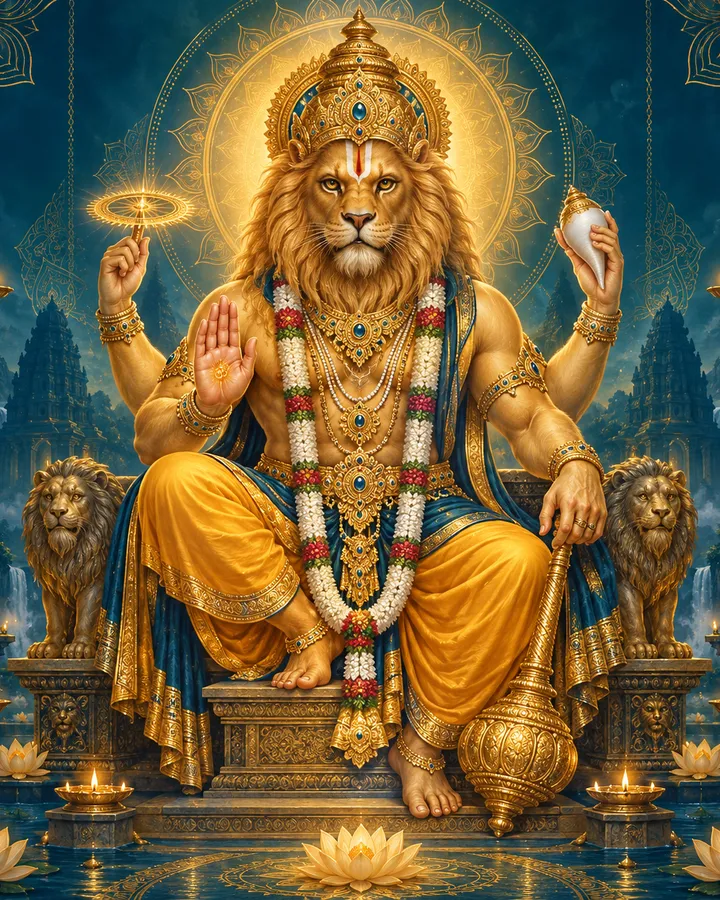
Narasimha (नरसिंह, Narasiṃha), “man-lion,” is the fourth of the ten Dashavatara of Vishnu, appearing between Varaha and Vamana. He is shown with a lion’s head and claws fused onto a human torso, and his central myth — the killing of the demon-king Hiranyakashipu to save his devotee son Prahlada — is one of the best-known stories in the Vaishnava tradition.
Mythology
Hiranyakashipu had won a boon from Brahma making him effectively unkillable: not by human or animal, not indoors or outdoors, not by day or night, not on earth or in the sky, and not by any weapon. His own son, Prahlada, remained devoted to Vishnu despite his father’s fierce opposition to that devotion. When Hiranyakashipu struck a palace pillar, demanding Prahlada show him Vishnu’s presence within it, Narasimha burst forth from the pillar itself.
Narasimha then killed Hiranyakashipu while honoring every condition of the boon to the letter: at twilight, neither day nor night; on the threshold of a doorway, neither indoors nor outdoors; across his own lap, neither on the earth nor in the sky; and by disemboweling him with bare claws, not a conventional weapon. The story is widely told, within Hindu tradition, as an example of a boon’s letter being honored while its intent is entirely defeated.
Iconography
Narasimha’s most common iconographic form shows him either emerging from a split pillar or in the act of killing Hiranyakashipu across his lap. At Ahobilam, nine distinct forms are separately enshrined as the Nava Narasimha, ranging from fierce forms such as Ugra and Jwala Narasimha to the serene Yogananda Narasimha — an unusual degree of iconographic multiplicity for a single avatar site. At Simhachalam, he is worshipped in a composite form fused with Varaha, the third avatar, and is kept covered in sandalwood paste year-round, his true form revealed to devotees only once a year, on Akshaya Tritiya.
Worship and festivals
Narasimha Jayanti, observed on Vaishakha Shukla Chaturdashi, the fourteenth day of the bright fortnight of Vaishakha, typically April or May, commemorates his manifestation to save Prahlada and is marked with puja, fasting, temple ritual, and recitation of the Prahlada narrative.
In scripture
- Bhagavata Purana — the most detailed and widely cited telling of the Hiranyakashipu-Prahlada myth.
- Vishnu Purana — an earlier account of the same narrative.
- Narasimha Tapaniya Upanishad — a minor Upanishad devoted specifically to Narasimha.
- Sangam-era Tamil literature, including the Paripatal (roughly 300 BCE to 300 CE), contains early references to Narasimha worship, indicating the antiquity of his cult in South India, corroborated by surviving sculpture from as early as the 2nd to 4th centuries CE.
Iconography at a glance
Major temples
Ahobilam
Kurnool district, Andhra Pradesh, India
One of the 108 Divya Desams; site of the Nava Narasimha, nine distinct enshrined forms of the deity set among the Eastern Ghats, celebrated in hymns by the Vaishnava saint Thirumangai Azhwar.
Open in Maps ↗Varaha Lakshmi Narasimha Temple
Simhachalam, Visakhapatnam, Andhra Pradesh, India
Built by Eastern Ganga king Narasingha Deva I in the 13th century and consecrated by his son in 1268 CE. The deity is worshipped in a composite form fused with Varaha, kept covered year-round in sandalwood paste and revealed in true form only on Akshaya Tritiya.
Open in Maps ↗Worth knowing
- Narasimha is the fourth of the ten Dashavatara, appearing between Varaha and Vamana.
- Hiranyakashipu's boon made him unkillable by human or animal, indoors or outdoors, by day or night, on earth or in the sky, and by any weapon — Narasimha honored every condition to the letter while defeating its intent, killing him at twilight, on a threshold, on his own lap, with bare claws.
- Archaeological evidence places organized Narasimha worship as early as the 2nd to 4th centuries CE, among the older attested avatar cults with surviving physical sculpture.
- Ahobilam hosts nine distinct enshrined forms of Narasimha, an unusual scale of multiplicity among Vishnu avatar worship sites.
- At Simhachalam, Narasimha is worshipped fused with Varaha, the third avatar, and the temple keeps the deity's true form hidden under sandalwood paste all but one day a year, Akshaya Tritiya.