Overview
Bagalamukhi (बगलामुखी, Bagalāmukhī) is the eighth of the ten Mahavidyas, the “Great Wisdom Goddesses” of Shakta tantric tradition headed by Kali. Her worship is tantric and esoteric in character — traditionally approached through initiation, mantra-japa, and guidance from a ritual specialist — a real and important distinction from the mainstream devotional-Puranic worship pattern of goddesses such as Lakshmi or Durga, and one this page states directly rather than smoothing over.
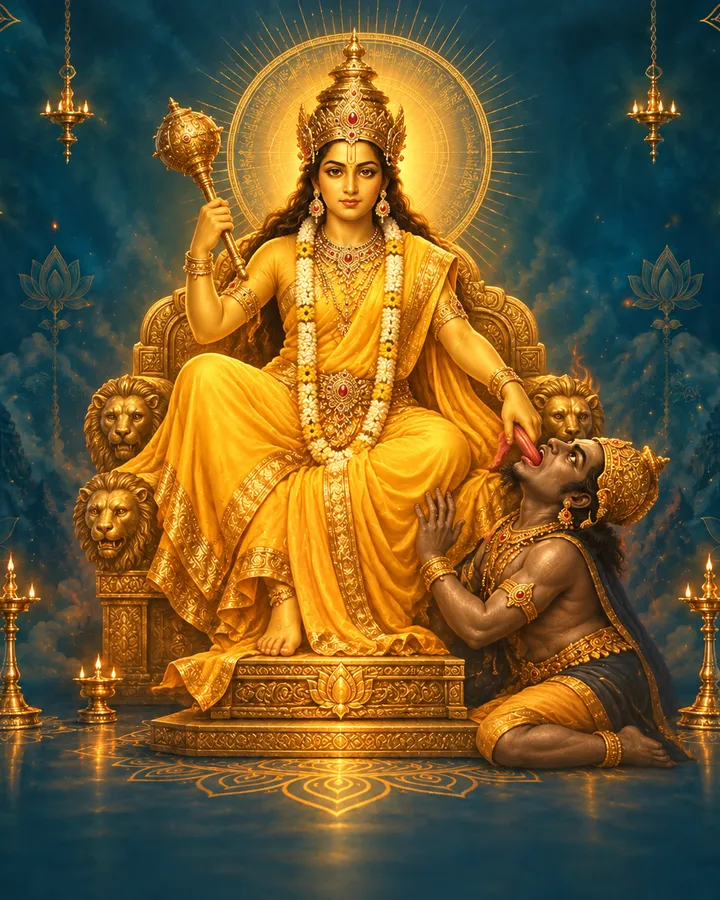
Her most consistent identifying feature across every source is color: yellow, in her clothing, her offerings, and the turmeric-bead rosaries used in her worship, giving her the alternate name Pitambari, “she who wears yellow.”
Origin and iconography
Bagalamukhi’s own myth describes her manifesting from Haridra Sarovar, the “Turmeric Lake,” in response to Vishnu’s prayer to Parvati during a cosmic storm, in order to restore order — an origin-legend rather than a birth in the family-tree sense used for Puranic deities, and this page does not assign her a family beyond that legend, since mainstream sources treat the Mahavidyas as a group of emanations of the one Devi rather than as goddesses with individually attested parents, consorts, or children.
Her defining iconographic image shows her seated, pulling a demon’s tongue with one hand while striking him with a club (gada) in the other — a direct visual representation of stambhana, her core mythic role: the power to paralyze, stun, or silence an opponent’s speech or action. This two-armed form is her more common depiction; multi-armed tantric forms also appear in specialist iconographic texts such as the Tantrasara. Her vehicle is not consistently identified across sources, and this page treats it as an open detail rather than asserting one.
Worship
Bagalamukhi’s worship is centered less on a public festival calendar than on ritual practice: mantra-japa using her seed mantra, Hlīṃ, often performed as part of the broader Dasha Mahavidya Anushthana, a structured tantric worship sequence covering all ten Mahavidyas together. Yellow-themed puja, using yellow flowers, turmeric, and golden ornaments, is her most consistent ritual marker.
Shree Pitambara Peeth in Datia, Madhya Pradesh, is the most prominent institution associated with her, functioning as a major center of tantric-Shakta pilgrimage and practice built around a lineage of gurus rather than a single shrine. The Bagalamukhi Temple at Bankhandi, in Kangra district, Himachal Pradesh, is a further prominent site in the Himalayan region, with a local tradition connecting it to the era of Rama — a devotional legend, not a historically verified claim, and presented here as such.
In scripture
- Rudrayamala Tantra — source of the Bagalamukhi Stotra and Kavacham, her primary hymns.
- Kubjika Tantra — offers an etymological account of her name.
- Tantrasara — sets out detailed iconographic prescriptions for her worship.
Iconography at a glance
Major temples
Shree Pitambara Peeth
Datia, Madhya Pradesh, India
The most prominent Bagalamukhi institution, associated with a lineage of gurus and functioning as a major center of tantric-Shakta pilgrimage and practice.
Open in Maps ↗Bagalamukhi Temple, Bankhandi
Kangra district, Himachal Pradesh, India
A prominent Himalayan-region temple; local tradition links the site to the era of Rama, though this is a devotional legend rather than a historically verified claim.
Open in Maps ↗Worth knowing
- Bagalamukhi is formally the eighth of the ten Mahavidyas — the group of tantric goddesses of Shakta tradition, headed by Kali — a placement consistent across sources.
- Her textual foundation is tantric — the Rudrayamala Tantra, Kubjika Tantra, and Tantrasara — rather than the mainstream Puranic corpus that grounds most widely worshipped Hindu goddesses; her worship has historically been approached through initiation and specific mantra practice rather than generalized public puja.
- Yellow is her single most consistent cross-source iconographic and ritual marker, down to the turmeric-bead rosaries used in her worship.
- Her defining mythic role is stambhana, paralysis or immobilization of an enemy's speech or action, reflected literally in her core iconographic image of pulling a demon's tongue.
- Shree Pitambara Peeth in Datia, Madhya Pradesh, functions as a major tantric-Shakta pilgrimage and institutional center associated with her worship, not merely a shrine.