Overview
Lalita Tripurasundari (ललिता त्रिपुरसुन्दरी, Lalitā Tripurasundarī) is the third of the ten Mahavidyas, the group of tantric goddesses headed by Kali — the same standard list on which Bagalamukhi is counted eighth. Within her own tradition, Srividya, a major branch of Shakta tantra, she holds a further, separate distinction: devotees there regard her as foremost among the Mahavidyas in devotional standing, a status claim distinct from her fixed third position in the shared numbered list. “Lalita” and “Tripura Sundari” name one and the same goddess, not two different figures, and she is also called Shodashi, “the sixteen-year-old,” after her eternally youthful form.
A note on names, since it matters for this site specifically: Lalita Tripurasundari is worshipped at Kanchipuram, Tamil Nadu, under the name Kamakshi — a name easy to confuse with Kamakhya, the different goddess of Nilachal Hill in Assam covered elsewhere on this site. The two names sound alike but belong to distinct goddesses, distinct temples, and distinct regional traditions; this page is about the Kanchipuram identity only.
Iconography and the Sri Chakra
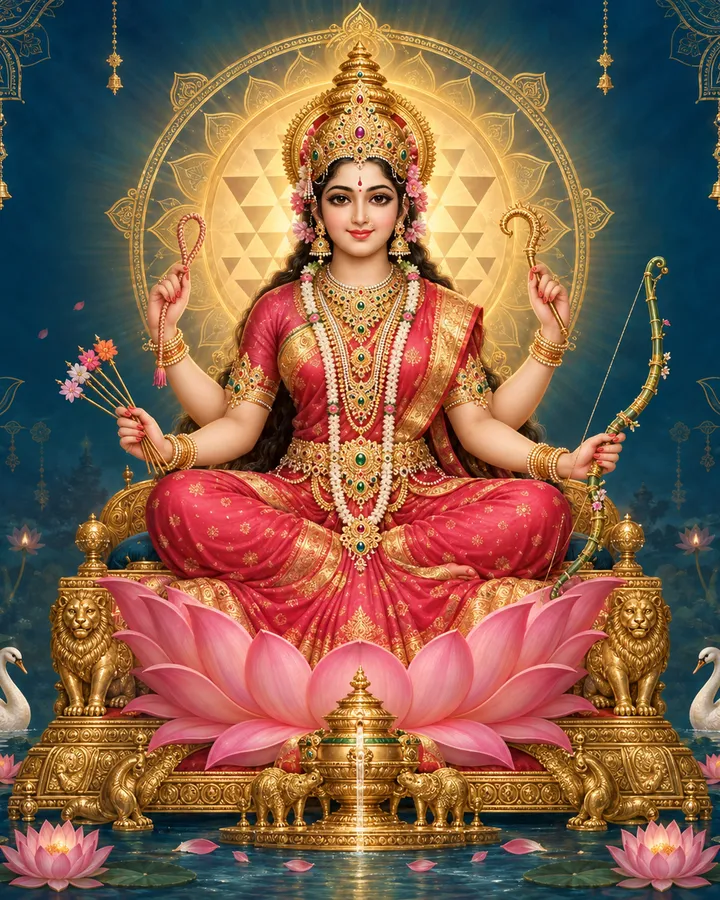
She is depicted as an eternally sixteen-year-old girl, seated on a lotus that itself rests on the supine body of Sadashiva, a recurring visual motif in Srividya iconography placing Shakti above Shiva. Her attributes — a noose, an elephant goad, a bow of sugarcane, and arrows of flowers — represent mind and emotion rather than instruments of war. Srividya tradition holds that she is worshipped in three parallel forms: a gross, anthropomorphic image; a subtle form, as the Srividya mantra; and a supreme form, the Sri Chakra (or Sri Yantra) — nine interlocking triangles, four pointing upward for Shiva and five downward for Shakti, treated as her most abstract and esoteric presence and central to Srividya ritual practice.
Worship
Srividya worship is chiefly an initiatory tradition, transmitted through a guru lineage and centered on mantra recitation and yantra-based ritual rather than temple pilgrimage as such — a real, distinguishing fact about how she is worshipped rather than a gap in her devotional record. Lalita Jayanti, observed in the Hindu month of Magha, marks her occasion of manifestation.
The clearest temple expression of her worship is the Kamakshi Amman Temple at Kanchipuram, Tamil Nadu, where tradition holds that Adi Shankaracharya personally installed a Sri Chakra and reoriented the temple’s worship from a fierce (ugra) form toward the peaceful (shanta) form associated with her — the origin of the site’s status as seat of the Kamakoti Peetham. A separate major site, the Tripura Sundari Temple at Matabari in Tripura, founded in 1501 CE and counted among the 51 Shakti Peethas, draws on a related but distinct regional pilgrimage tradition rather than Srividya’s initiatory practice.
In scripture
- Lalita Sahasranama — her thousand names, framed as part of the Brahmanda Purana, distinctive among such texts for repeating none of them. Only a single meditation verse within it is sometimes credited to Adi Shankaracharya, not the work as a whole.
- Saundarya Lahari — a devotional poem describing her form, traditionally credited to Adi Shankaracharya, though scholars genuinely dispute the attribution; some date the text later than his traditional lifetime, and its tantric content sits uneasily beside his Advaita non-dualism. This page states the attribution as traditional, not settled.
- Tripura Rahasya — a philosophical text exploring her significance within a non-dualist framework.
Iconography at a glance
Major temples
Kamakshi Amman Temple
Kanchipuram, Tamil Nadu, India
Tradition holds that Adi Shankaracharya personally installed a Sri Chakra here and reoriented the temple's worship from a fierce (ugra) form to the peaceful (shanta) form associated with Lalita Tripurasundari, making this the seat of the Kamakoti Peetham.
Open in Maps ↗Tripura Sundari Temple, Matabari
Udaipur, Tripura, India
Founded in 1501 CE by Maharaja Dhanya Manikya and counted among the 51 Shakti Peethas; a major pilgrimage site, though its worship tradition is distinct from the initiatory Srividya practice described on this page.
Open in Maps ↗Worth knowing
- Lalita and Tripura Sundari are the same goddess, referred to interchangeably along with the name Shodashi — not two separate deities.
- She is the third of the ten Mahavidyas in the standard list (Kali, Tara, Tripura Sundari, Bhuvaneshvari, Bhairavi, Chhinnamasta, Dhumavati, Bagalamukhi, Matangi, Kamala), while within her own Srividya tradition she is separately described as foremost among them in devotional standing — two distinct claims, not a contradiction.
- Her most esoteric form of worship is not an image at all but the Sri Chakra, a geometric diagram of nine interlocking triangles read as a map of her own presence.
- The Saundarya Lahari, a devotional poem describing her form, is traditionally credited to Adi Shankaracharya, but scholars genuinely dispute this attribution — some date the text after his traditional lifetime, and its tantric content sits uneasily beside his Advaita philosophy.
- Srividya worship is chiefly an initiatory, guru-lineage tradition centered on mantra and yantra rather than a temple-pilgrimage practice, which is why she has no single central temple comparable to some other major goddesses.