Overview
Annapurna (अन्नपूर्णा, Annapūrṇā), “she who is full of food,” is worshipped as the food-giving form of Parvati, principally at Varanasi (Kashi), where she is closely tied to the worship of her consort Shiva. Her name is built from anna, food or grain, and pūrṇa, full or complete.
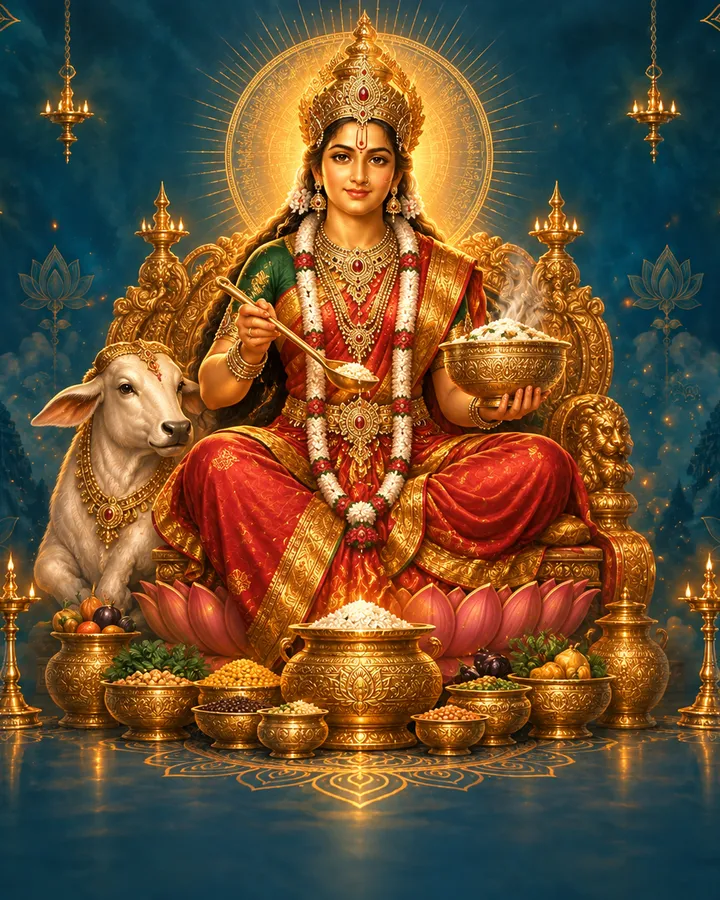
She is depicted with a jeweled golden ladle in one hand and a bowl of food in the other — an unusually stable pairing of attributes across regional depictions, compared to how much iconography for other goddesses varies by region.
Family
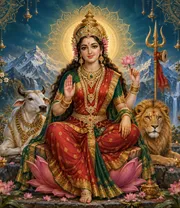
Because Annapurna is understood as a specific aspect of Parvati rather than an independently originated goddess, her family follows Parvati’s own: her father is Himavan, personification of the Himalayas, her mother Mena, and her consort Shiva. Sources consistently describe her this way rather than assigning her a separate genealogy.
Mythology
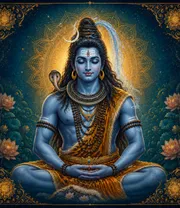
The central legend behind her worship, traced chiefly to the Linga Purana, tells of a moment when Shiva dismissed the material world, food included, as illusion (maya). Parvati, offended, vanished from the world entirely — and without her presence, a global famine followed. Only at Kashi did food remain available, because Parvati herself returned there in the form of Annapurna to feed the world directly from her own kitchen. Even Shiva, tradition holds, eventually came to her, begging bowl in hand, to receive food from her hands — a story often read as illustrating that even the ascetic, world-renouncing side of Shiva depends on the material sustenance the Goddess provides.
Worship and festivals
Annapurna Jayanti, observed on the full moon of the lunar month Margashirsha, typically in November or December, is the clearest, most consistently dated occasion associated with her. Some traditions separately connect her to Akshaya Tritiya as an auspicious day in her honor — a different date from Annapurna Jayanti, reflecting two traditions rather than one settled account, and this page does not merge them.
At the Annapurna Devi Mandir in Varanasi, daily food and prasad distribution at noon is a live, ongoing practice, expanded further during Navaratri — arguably the clearest continuous expression of her defining role as a food-giving goddess. Despite her broad popularity in household devotion and in widely recited texts such as the Annapurna Stotra, traditionally attributed to Adi Shankaracharya, dedicated standalone Annapurna temples remain comparatively few — her worship is carried more often through Parvati and Shiva devotion in the home than through an independent temple network.
In scripture
- Linga Purana — source of the core famine and food-withholding legend.
- Skanda Purana — describes the sage Vyasa receiving food from Annapurna at Varanasi.
- Annapurna Upanishad — a minor Upanishad devoted to her, framed as a teaching given to the sage Ribhu.
Parentage
 Child Annapurna
Iconography at a glance
Major temples
Annapurna Devi Mandir
Varanasi, Uttar Pradesh, India
The primary and most famous Annapurna temple, adjacent to the Kashi Vishwanath Temple; its current structure is commonly dated to a 1729 renovation under Maratha Peshwa Bajirao I. Daily food and prasad distribution at noon continues there today, expanded during Navaratri.
Open in Maps ↗Annapoorneshwari Temple
Horanadu, Chikkamagaluru district, Karnataka, India
A well-known South Indian Annapurna temple where feeding devotees is part of ongoing temple practice.
Open in Maps ↗Worth knowing
- Annapurna is understood, both textually and in popular devotion, as a specific food-giving form of Parvati rather than an independently originated goddess.
- The central legend behind her worship — that Shiva once dismissed the material world as illusion, causing Parvati to vanish and the world to starve, until she returned as Annapurna at Kashi to feed everyone, including Shiva himself — is traced chiefly to the Linga Purana.
- Her defining iconographic pairing, a ladle in one hand and a food vessel in the other, is unusually stable across regional depictions compared to many other goddesses.
- Despite broad popular devotion, dedicated standalone Annapurna temples are relatively few in number — most worship happens through her as an aspect of Parvati and Shiva household devotion rather than through an independent temple network.
- The Annapurna Devi Mandir in Varanasi, beside the Kashi Vishwanath Temple, is the clearest single flagship site associated with her worship.