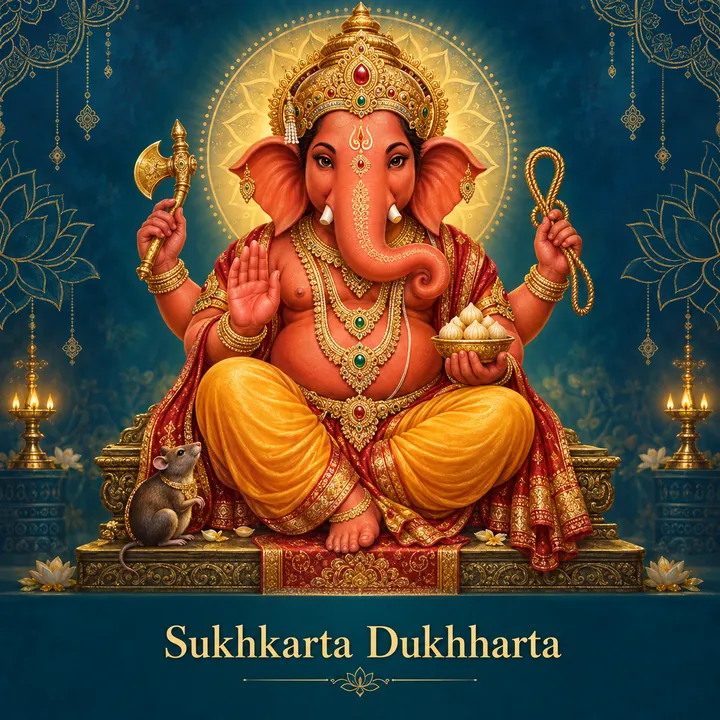
The text
Tap Recite along to follow verse by verse — use Next, or the arrow keys.
- Stanza
- Stanza 1
सुखकर्ता दुखहर्ता वार्ता विघ्नाची।नुरवी पुरवी प्रेम कृपा जयाची।सर्वांगी सुंदर उटी शेंदुराची।कंठी झळके माळ मुक्ताफळांची॥
sukhakartā dukhahartā vārtā vighnācī।nuravī puravī prema kṛpā jayācī।sarvāṅgī sundara uṭī śendurācī।kaṇṭhī jhaḷake māḷa muktāphaḷāñcī॥
Giver of joy, remover of sorrow, banisher of every obstacle — no devotee's love goes unanswered by your grace. Your whole form is beautiful, anointed with vermillion, and a garland of pearls gleams at your throat.
- Refrain
- Refrain (Dhrupad)
जय देव जय देव जय मंगलमूर्ती।दर्शनमात्रे मनकामना पुरती॥
jaya deva jaya deva jaya maṅgalamūrtī।darśanamātre manakāmanā puratī॥
Glory, glory, glory to the auspicious one — the mere sight of you fulfills every wish of the heart.
- The 2 stanzas
- Stanza 2
रत्नखचित फरा तुज गौरीकुमरा।चंदनाची उटी कुंकुमकेशरा।हिरेजडित मुकुट शोभतो बरा।रुणझुणती नूपुरे चरणी घागरिया॥
ratnakhacita pharā tuja gaurīkumarā।candanācī uṭī kuṅkumakeśarā।hirejaḍita mukuṭa śobhato barā।ruṇajhuṇatī nūpure caraṇī ghāgariyā॥
O son of Gauri, a jewel-studded ornament shines on your brow; your forehead is anointed with sandal paste, vermillion, and saffron. A diamond-studded crown graces you well, and anklets, hung with tiny bells, jingle softly at your feet.
- Stanza 3
लंबोदर पीतांबर फणिवरबंधना।सरळ सोंड वक्रतुंड त्रिनयना।दास रामाचा वाट पाहे सदना।संकटी पावावे निर्वाणी रक्षावे सुरवरवंदना॥
lambodara pītāmbara phaṇivarabandhanā।saraḷa soṇḍa vakratuṇḍa trinayanā।dāsa rāmācā vāṭa pāhe sadanā।saṅkaṭī pāvāve nirvāṇī rakṣāve suravaravandanā॥
Large-bellied one, clad in yellow silk, a great serpent bound as your belt; straight of trunk yet curved of face, three-eyed one — this servant of Rama awaits you at his door. Come to my aid in times of trouble, and protect me at the last, O one to whom even the gods bow.
Overview
Sukhkarta Dukhharta (“giver of joy, remover of sorrow”) is a Marathi aarti to Ganesha, sung at the close of worship in households and temples across Maharashtra. Its three stanzas are each followed by the same refrain, or dhrupad — “Jai Dev Jai Dev Jai Mangalmurti” — so a full recitation runs to four sung parts even though the composition itself is built from three verses. It is commonly the first aarti sung at the end of a puja, and during Ganesh Chaturthi it is sung daily, often alongside other Ganesh aartis such as Jai Ganesh Jai Ganesh Deva and Shendur Lal Chadhayo.
Origin and source
The aarti is traditionally attributed to Samarth Ramdas, the seventeenth-century Marathi saint and guru of Chhatrapati Shivaji, best known for the Dasbodh. It is said to have been composed after Ramdas had darshan of the Mayureshwar idol at Morgaon, one of Maharashtra’s Ashtavinayak (eight self-manifested Ganesha) shrines, and it is traditionally sung in the Jogiya raga. Like other Marathi aartis of its era, it is composed in the vernacular rather than Sanskrit, which is part of why it reads as direct, personal devotion rather than formal scripture. The third stanza carries the poet’s own signature in its closing line — “dasa ramacha vata pahe sadana,” “this servant of Rama awaits you at his door” — a wordplay on Ramdas’s own name that is a common convention in Marathi bhakti poetry.
How it is recited
Sukhkarta Dukhharta is sung with the refrain repeated after every stanza, typically to a harmonium or simple clapped rhythm, with an aarti thali (plate bearing a lit lamp) circled before the deity’s image as the song is sung. It is recited daily in many Maharashtrian households as part of the closing of puja, and takes on particular prominence during Ganesh Chaturthi, when it is often the aarti that opens or closes each day’s worship of the visiting idol. It is frequently followed by Ghalin Lotangan, the closing prayer traditionally sung to end a Marathi aarti sequence.
Frequently asked questions
How many verses does Sukhkarta Dukhharta have?
Who is Sukhkarta Dukhharta dedicated to?
When is Sukhkarta Dukhharta typically recited?
What language is Sukhkarta Dukhharta composed in?
What tradition is Sukhkarta Dukhharta associated with?
Is an English translation of Sukhkarta Dukhharta available?
Is there a Roman transliteration of Sukhkarta Dukhharta?
Sourcing
Checked against independent sources before publishing — see our sourcing and editorial policy. Spotted an error? Report an issue .