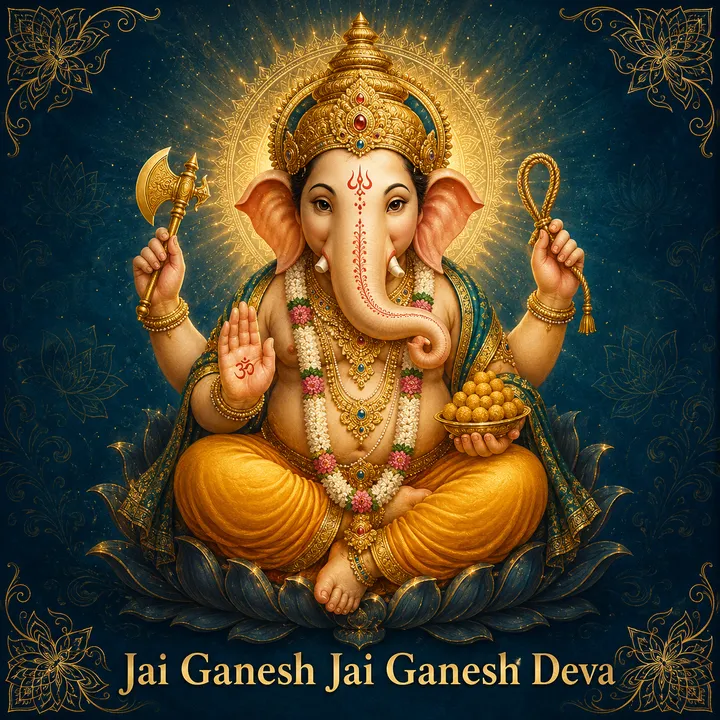
The text
Tap Recite along to follow verse by verse — use Next, or the arrow keys.
- Stanza 1
जय गणेश जय गणेश, जय गणेश देवा।माता जाकी पार्वती, पिता महादेवा॥
jaya gaṇeśa jaya gaṇeśa, jaya gaṇeśa devā।mātā jākī pārvatī, pitā mahādevā॥
Victory to Ganesha, victory to Ganesha, victory to Lord Ganesha — whose mother is Parvati and whose father is Mahadeva.
- Stanza 2
एक दंत दयावंत, चार भुजा धारी।माथे सिंदूर सोहे, मूसे की सवारी॥जय गणेश जय गणेश, जय गणेश देवा।माता जाकी पार्वती, पिता महादेवा॥
eka danta dayāvanta, cāra bhujā dhārī।māthe sindūra sohe, mūse kī savārī॥jaya gaṇeśa jaya gaṇeśa, jaya gaṇeśa devā।mātā jākī pārvatī, pitā mahādevā॥
One-tusked and full of compassion, bearing four arms; vermilion shines on his forehead, and his mount is the mouse. (Refrain) Victory to Ganesha, victory to Ganesha, victory to Lord Ganesha — whose mother is Parvati and whose father is Mahadeva.
- Stanza 3
पान चढ़े फूल चढ़े, और चढ़े मेवा।लड्डुअन का भोग लगे, संत करें सेवा॥जय गणेश जय गणेश, जय गणेश देवा।माता जाकी पार्वती, पिता महादेवा॥
pāna caḍhe phūla caḍhe, aura caḍhe mevā।laḍḍuana kā bhoga lage, santa karẽ sevā॥jaya gaṇeśa jaya gaṇeśa, jaya gaṇeśa devā।mātā jākī pārvatī, pitā mahādevā॥
Betel leaves are offered, flowers are offered, and dried fruits besides; an offering of laddus is made, and the saints perform his service. (Refrain) Victory to Ganesha, victory to Ganesha, victory to Lord Ganesha — whose mother is Parvati and whose father is Mahadeva.
- Stanza 4
अंधन को आंख देत, कोढ़िन को काया।बांझन को पुत्र देत, निर्धन को माया॥जय गणेश जय गणेश, जय गणेश देवा।माता जाकी पार्वती, पिता महादेवा॥
andhana ko ā̃kha deta, koḍhina ko kāyā।bā̃jhana ko putra deta, nirdhana ko māyā॥jaya gaṇeśa jaya gaṇeśa, jaya gaṇeśa devā।mātā jākī pārvatī, pitā mahādevā॥
He gives sight to the blind, and a sound body to the leper; he gives a son to the childless, and wealth to the poor. (Refrain) Victory to Ganesha, victory to Ganesha, victory to Lord Ganesha — whose mother is Parvati and whose father is Mahadeva.
- Stanza 5
'सूर' श्याम शरण आए, सफल कीजे सेवा।माता जाकी पार्वती, पिता महादेवा॥
'sūra' śyāma śaraṇa āe, saphala kīje sevā।mātā jākī pārvatī, pitā mahādevā॥
'Sur' has come seeking your refuge — make this service fruitful — for your mother is Parvati and your father is Mahadeva.
- Stanza 6
दीनन की लाज रखो, शंभु सुतकारी।कामना को पूर्ण करो, जाऊं बलिहारी॥जय गणेश जय गणेश, जय गणेश देवा।माता जाकी पार्वती, पिता महादेवा॥
dīnana kī lāja rakho, śambhu sutakārī।kāmanā ko pūrṇa karo, jāū̃ balihārī॥jaya gaṇeśa jaya gaṇeśa, jaya gaṇeśa devā।mātā jākī pārvatī, pitā mahādevā॥
Preserve the honor of the humble, O son of Shambhu; fulfill our wishes — I offer myself to you. (Refrain) Victory to Ganesha, victory to Ganesha, victory to Lord Ganesha — whose mother is Parvati and whose father is Mahadeva.
Overview
Jai Ganesh Jai Ganesh Deva is a six-stanza Hindi aarti to Ganesha, and a widely sung devotional song in Hindu practice. Its opening line — “Jai Ganesh, jai Ganesh, jai Ganesh Deva” — is recognizable across regions and languages, and the aarti is sung as the customary opening invocation of nearly any puja, honoring Ganesha’s role as the remover of obstacles who is worshipped first before other deities.
Origin and source
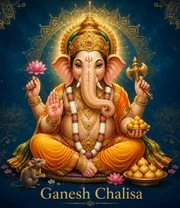
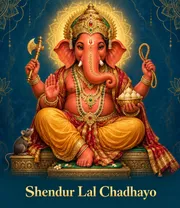
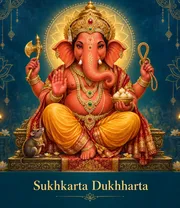
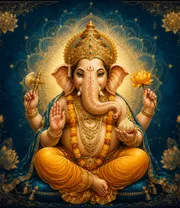
The aarti is a traditional composition in Hindi rather than classical Sanskrit, and its authorship is not attached to a single named poet the way many other devotional works are — it circulates as an anonymous, communally transmitted text, printed in aarti collections across North India. The opening stanza establishes Ganesha’s parentage, as the son of Parvati and Mahadeva (Shiva); the middle stanzas describe his form — the single tusk, four arms, vermilion mark, and mouse mount — and the offerings made to him, before turning to his character as a giver of blessings to those in every kind of need. The closing stanza is a direct appeal for his protection and grace.
How it is recited
This aarti is most often sung at the start of a puja, before the recitation of other prayers, since Ganesha is traditionally invoked first as Vighnaharta, the remover of obstacles, so that the rest of the worship may proceed without hindrance. It is sung nightly in many homes during the ten days of Ganesh Chaturthi, frequently paired with the Marathi aarti “Sukhkarta Dukhharta,” and is closed, as with most aartis, by circling a lit lamp before the deity’s image while the refrain is repeated.
Frequently asked questions
How many verses does Jai Ganesh Jai Ganesh Deva have?
Who is Jai Ganesh Jai Ganesh Deva dedicated to?
When is Jai Ganesh Jai Ganesh Deva typically recited?
What language is Jai Ganesh Jai Ganesh Deva composed in?
What tradition is Jai Ganesh Jai Ganesh Deva associated with?
Is an English translation of Jai Ganesh Jai Ganesh Deva available?
Is there a Roman transliteration of Jai Ganesh Jai Ganesh Deva?
Sourcing
Checked against independent sources before publishing — see our sourcing and editorial policy. Spotted an error? Report an issue .