The text
Tap Recite along to follow verse by verse — use Next, or the arrow keys.
- Refrain
- Refrain
ॐ जय जगदानन्दी, मैया जय आनंद कन्दी।ब्रह्मा हरिहर शंकर रेवा, शिव हरि शंकर रुद्री पालन्ती॥
oṃ jaya jagadānandī, maiyā jaya ānanda kandī।brahmā harihara śaṅkara revā, śiva hari śaṅkara rudrī pālantī॥
Om, victory to the one who delights the world; Mother, victory to the root of bliss. Brahma, Harihar, Shankar, Reva; Shiva, Hari, Shankar; Rudri, who sustains.
- The 6 stanzas
- Stanza 1
देवी नारद शारद तुम वरदायक, अभिनव पदचण्डी।सुर नर मुनि जन सेवत, सुर नर मुनि शारद पदवन्ती॥
devī nārada śārada tuma varadāyaka, abhinava padacaṇḍī।sura nara muni jana sevata, sura nara muni śārada padavantī॥
Goddess, you are the giver of boons to Narada and Sharada, the ever-new padacaṇḍī; gods, men and sages serve you — gods, men, sages and Sharada revere your feet.
- Stanza 2
देवी धूमक वाहन राजत, वीणा वादयन्ती।झूमकत झूमकत झूमकत, झननन झननन रमती राजन्ती॥
devī dhūmaka vāhana rājata, vīṇā vādayantī।jhūmakata jhūmakata jhūmakata, jhananana jhananana ramatī rājantī॥
Goddess, you shine mounted on your dhūmaka vāhana, playing the veena; swaying, swaying, swaying — jhananana, jhananana — you move and reign in delight.
- Stanza 3
देवी बाजत ताल मृदंगा, सुरमण्डल रमती।तोड़ीतान तोड़ीतान तोड़ीतान, तुरड़ड़ तुरड़ड़ तुरड़ड़ रमती सुरवन्ती॥
devī bājata tāla mṛdaṅgā, suramaṇḍala ramatī।toḍītāna toḍītāna toḍītāna, turaḍaḍ turaḍaḍ turaḍaḍ ramatī suravantī॥
Goddess, the cymbals and the mridanga sound; you move amid the circle of notes. Toḍītāna, toḍītāna, toḍītāna; turaḍaḍ, turaḍaḍ, turaḍaḍ — you move, attended by the notes.
- Stanza 4
देवी सकल भुवन पर आप विराजत, निशदिन आनन्दी।गावत गंगा शंकर, सेवत रेवाशंकर तुम भव मेटन्ती॥
devī sakala bhuvana para āpa virājata, niśadina ānandī।gāvata gaṅgā śaṅkara, sevata revāśaṅkara tuma bhava meṭantī॥
Goddess, you are enthroned above every world, joyful night and day. Ganga and Shankar sing of you, Revashankar serves you; you wipe away worldly existence.
- Stanza 5
मैया जी को कंचन थाल विराजत, अगर कपूर बाती।अमरकंठ में विराजत, घाटन घाट कोटी रतन जोती॥
maiyā jī ko kañcana thāla virājata, agara kapūra bātī।amarakaṇṭha meṃ virājata, ghāṭana ghāṭa koṭī ratana jotī॥
A golden platter is set before Mother, with aloewood, camphor and a wick. At Amarkanth (Amarkantak) she is enthroned; at ghat after ghat, millions of jewel-lights.
- Stanza 6 (closing)
मैया जी की आरती निशदिन पढ़ि गावें, हो रेवा जुग जुग नर गावें।भजत शिवानंद स्वामी, जपत हरि मन वांछित फल पावें॥
maiyā jī kī āratī niśadina paḍhi gāveṃ, ho revā juga juga nara gāveṃ।bhajata śivānanda svāmī, japata hari mana vāñchita phala pāveṃ॥
Mother's aarti is read and sung night and day — O Reva, may men sing it age after age. Shivanand Swami sings it; chanting Hari, he obtains the fruit his heart desires.
Overview
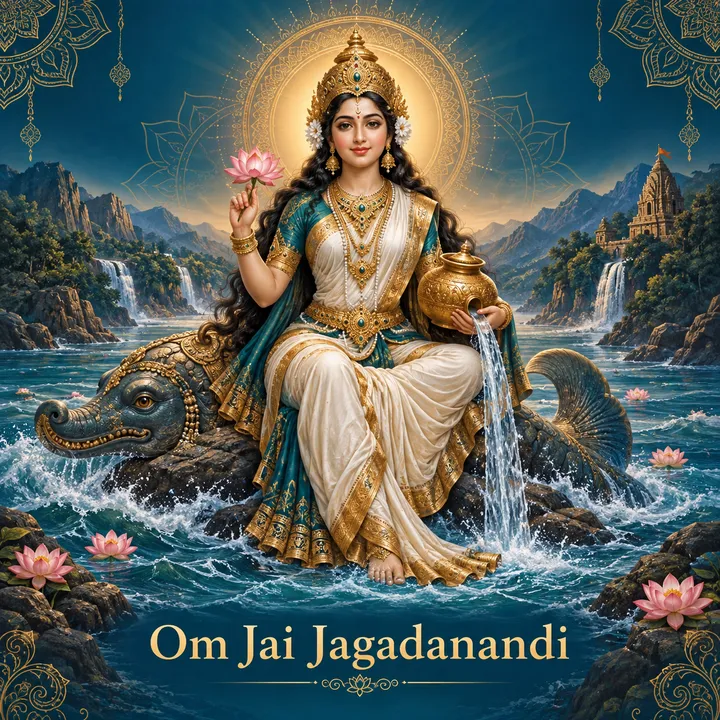
Om Jai Jagadanandi is a six-stanza Hindi aarti to the river goddess Narmada, opening with a refrain of the same name — “Victory to the one who delights the world, Mother, victory to the root of bliss.” It is a separate composition from the Narmada Chalisa: where the Chalisa is a forty-verse text that recounts Narmada’s birth, iconography, and the merit of her worship at length, this aarti is the shorter piece meant to accompany the literal act of aarti — offering a lit lamp before her image or at her ghats — and its verses stay close to that moment, describing music sounding in her honor (veena, mridanga, cymbals) and closing with the golden plate of camphor and incense lifted before her. Stanza 2 also names a mount for the goddess, dhūmaka vāhana, an epithet not further explained in the sources consulted for this page — a different image from the crocodile (makara) that opens the Chalisa’s own description of her.
Origin and source
No composer is named in the secondary sources consulted for this page, and the aarti’s authorship could not be confirmed; it is treated here as a traditional composition. Its closing stanza does contain a textual self-reference — “bhajata Shivānanda Svāmī,” naming Shivanand Swami as the one who sings it — a convention common in Hindi bhakti compositions, where the final verse folds in a name tied to the reciting or composing tradition. No further biographical detail about this figure could be verified from the sources consulted, so none is asserted here beyond what the line itself says.
The text’s few geographic references — Amarkantak, named as the place where the goddess is worshipped with lamps at the ghats, and “koṭi ratana jotī” (millions of jewel-lights) describing the lamps along her banks — align with the Chalisa’s own account of Amarkantak as Narmada’s source, but the two texts do not otherwise overlap: this aarti’s content is the ritual moment of worship itself rather than her mythology.
The English meanings printed with the verses were made for this page from the Devanagari above. No published bhāvārth — a verse-by-verse Hindi gloss — of this aarti was found in the two published versions consulted, so the rendering is this page’s own rather than a translation of someone else’s commentary. Those two are also the reason no Devanagari here was touched: compared clause by clause, neither matches this page through a whole stanza. One keeps the same stanza order and differs at thirteen clauses, between spelling (झूमकत / झुमकत, शारद / सारद) and wording (रुद्री / रुद्रौ, भव मेटन्ती / भट मेटन्ती); the other is a recognizably different printing, dropping the देवी that opens four stanzas here and closing on जपत हरिहर स्वामी where this page has जपत हरि. This aarti circulates in variant wordings, and this page prints one of them. A few things in the English are deliberately left as they stand: dhūmaka vāhana in Stanza 2, noted above; the compound padacaṇḍī in Stanza 1, where pada can mean a foot, a word or a station; and toḍītāna and turaḍaḍ in Stanza 3, which are sung melody and drum syllables rather than words. Where sura could be read either as a musical note or as a god — the aarti uses it in both senses, naming “sura nara muni” in Stanza 1 — the two music stanzas read it as “note”.
How it is recited
Om Jai Jagadanandi is sung, like most Hindi aartis, at the close of worship — at home, at Narmada’s temples, and along her ghats, where a lit lamp is circled before her image or before the river itself while the aarti is recited. It is especially associated with Narmada Jayanti, her annual birth festival observed on Saptami of the bright fortnight of Magh, and it is also recited by pilgrims undertaking the Narmada Parikrama, the circumambulation of the river along both of her banks from her source at Amarkantak.
Frequently asked questions
How many verses does Om Jai Jagadanandi have?
Who is Om Jai Jagadanandi dedicated to?
When is Om Jai Jagadanandi typically recited?
What language is Om Jai Jagadanandi composed in?
What tradition is Om Jai Jagadanandi associated with?
Is an English translation of Om Jai Jagadanandi available?
Is there a Roman transliteration of Om Jai Jagadanandi?
Sourcing
Checked against independent sources before publishing — see our sourcing and editorial policy. Spotted an error? Report an issue .