The text
Tap Recite along to follow verse by verse — use Next, or the arrow keys.
- Stanza 1 (refrain)
ॐ जय चित्रगुप्त हरे, स्वामी जय चित्रगुप्त हरे।भक्त जनों के इच्छित, फल को पूर्ण करे॥ॐ जय चित्रगुप्त हरे॥
oṃ jaya citragupta hare, svāmī jaya citragupta hare।bhakta janõ ke icchita, phala ko pūrṇa kare॥oṃ jaya citragupta hare॥
Om, victory to you, Chitragupta, remover of sorrow — victory to you, Lord. You fulfill the cherished wish of your devotees.
- Stanza 2
विघ्न विनाशक मंगलकर्ता, सन्तन सुखदायी।भक्तन के प्रतिपालक, त्रिभुवन यश छायी॥ॐ जय चित्रगुप्त हरे॥
vighna vināśaka maṅgalakartā, santana sukhadāyī।bhaktana ke pratipālaka, tribhuvana yaśa chāyī॥oṃ jaya citragupta hare॥
Destroyer of obstacles, doer of auspicious things, giver of happiness to your children; sustainer of your devotees, your fame spreads across the three worlds.
- Stanza 3
रूप चतुर्भुज, श्यामल मूरति, पीताम्बर राजै।मातु इरावती, दक्षिणा, वाम अङ्ग साजै॥ॐ जय चित्रगुप्त हरे॥
rūpa caturbhuja, śyāmala mūrati, pītāmbara rājai।mātu irāvatī, dakṣiṇā, vāma aṅga sājai॥oṃ jaya citragupta hare॥
Four-armed in form, dark of complexion, resplendent in yellow robes; your mother Iravati graces your right side, adorning your left as well.
- Stanza 4
कष्ट निवारण, दुष्ट संहारण, प्रभु अन्तर्यामी।सृष्टि संहारण, जन दुःख हारण, प्रकट हुये स्वामी॥ॐ जय चित्रगुप्त हरे॥
kaṣṭa nivāraṇa, duṣṭa saṃhāraṇa, prabhu antaryāmī।sṛṣṭi saṃhāraṇa, jana duḥkha hāraṇa, prakaṭa huye svāmī॥oṃ jaya citragupta hare॥
Reliever of hardship, destroyer of the wicked, Lord who dwells within every heart; you who can withdraw creation itself and take away your devotees' sorrow — you appeared, O Lord.
- Stanza 5
कलम, दवात, शङ्ख, पत्रिका, कर में अति सोहै।वैजयन्ती वनमाला, त्रिभुवन मन मोहै॥ॐ जय चित्रगुप्त हरे॥
kalama, davāta, śaṅkha, patrikā, kara mẽ ati sohai।vaijayantī vanamālā, tribhuvana mana mohai॥oṃ jaya citragupta hare॥
A pen, an inkpot, a conch, and a register shine so well in your hand; your garland of vaijayanti flowers enchants the mind of all three worlds.
- Stanza 6
सिंहासन का कार्य सम्भाला, ब्रह्मा हर्षाये।तैंतीस कोटि देवता, चरणन में धाये॥ॐ जय चित्रगुप्त हरे॥
siṃhāsana kā kārya sambhālā, brahmā harṣāye।taintīsa koṭi devatā, caraṇana mẽ dhāye॥oṃ jaya citragupta hare॥
You took up the charge of the throne, and Brahma rejoiced; thirty-three crore gods came running to your feet.
- Stanza 7
नृपति सौदास, भीष्म पितामह, याद तुम्हें कीन्हा।वेगि विलम्ब न लायो, इच्छित फल दीन्हा॥ॐ जय चित्रगुप्त हरे॥
nṛpati saudāsa, bhīṣma pitāmaha, yāda tumhẽ kīnhā।vegi vilamba na lāyo, icchita phala dīnhā॥oṃ jaya citragupta hare॥
King Saudas, and Bhishma the grandsire, remembered you; without any delay, you granted them their heart's desire.
- Stanza 8
दारा, सुत, भगिनी, सब अपने स्वास्थ के कर्ता।जाऊँ कहाँ शरण में किसकी, तुम तज मैं भर्ता॥ॐ जय चित्रगुप्त हरे॥
dārā, suta, bhaginī, saba apane svāstha ke kartā।jāũ kahā̃ śaraṇa mẽ kisakī, tuma taja mai bhartā॥oṃ jaya citragupta hare॥
Wife, children, and sister — all, in the end, look after their own interest; besides you, whose shelter shall I seek? You alone are my protector.
- Stanza 9
बन्धु, पिता तुम स्वामी, शरण गहूँ किसकी।तुम बिन और न दूजा, आस करूँ जिसकी॥ॐ जय चित्रगुप्त हरे॥
bandhu, pitā tuma svāmī, śaraṇa gahū̃ kisakī।tuma bina aura na dūjā, āsa karū̃ jisakī॥oṃ jaya citragupta hare॥
You are my brother, my father, my Lord — whose refuge else shall I hold? Besides you there is no other in whom I could place my hope.
- Stanza 10
जो जन चित्रगुप्त जी की आरती, प्रेम सहित गावैं।चौरासी से निश्चित छूटैं, इच्छित फल पावैं॥ॐ जय चित्रगुप्त हरे॥
jo jana citragupta jī kī āratī, prema sahita gāvaĩ।caurāsī se niścita chūṭaĩ, icchita phala pāvaĩ॥oṃ jaya citragupta hare॥
Whoever sings this aarti to Chitragupta ji with love is certainly freed from the eighty-four-lakh cycle of birth, and obtains the fruit they desire.
- Stanza 11
न्यायाधीश बैकुण्ठ निवासी, पाप पुण्य लिखते।हम हैं शरण तिहारी, आस न दूजी करते॥ॐ जय चित्रगुप्त हरे॥
nyāyādhīśa baikuṇṭha nivāsī, pāpa puṇya likhate।hama haĩ śaraṇa tihārī, āsa na dūjī karate॥oṃ jaya citragupta hare॥
Judge, dweller in Vaikuntha, who records both sin and merit — we are in your refuge, and hold no other hope.
Overview
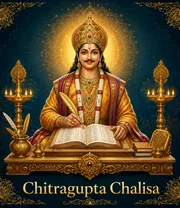
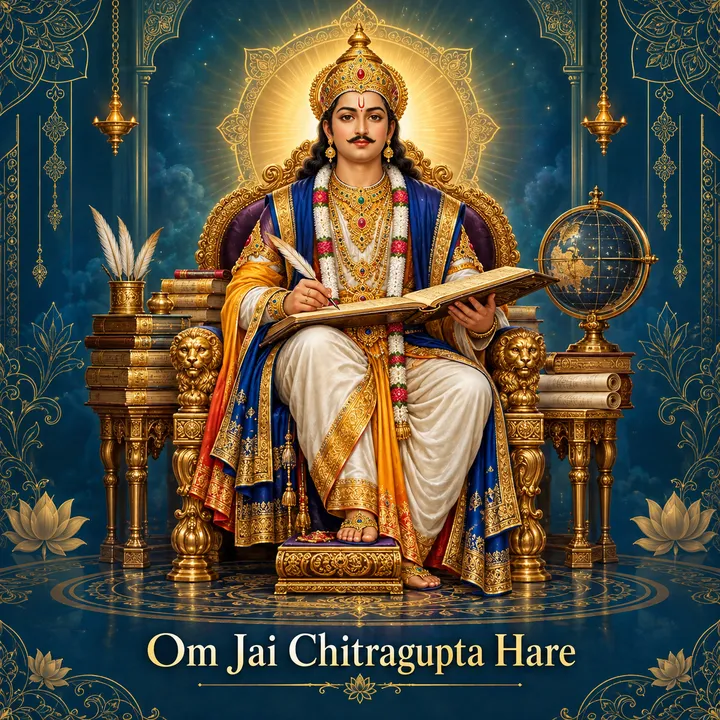
Om Jai Chitragupta Hare is an eleven-stanza Hindi aarti to Chitragupta, the divine scribe of Hindu tradition who keeps the written record of every soul’s deeds — the account that Yama, lord of death, consults to weigh a soul’s sins and merits after it leaves the body. The verses describe him as four-armed and dark-complexioned, holding a pen, an inkpot, a conch, and a register (the “patrika,” his ledger of accounts), with the third stanza naming “mother Iravati” at his side — Kayastha genealogical tradition names Iravati as one of Chitragupta’s two consorts, considered ancestral mothers of the community’s sub-castes, rather than his literal mother. Chitragupta is worshipped across sectarian lines rather than within one specific tradition, and is especially significant to the Kayastha community, many of whom trace their lineage to him and regard him as their progenitor deity.
Origin and source
This page’s text matches a recension found identically worded across several lyrics sites, including drikpanchang.com — a long-running Hindu calendar and ritual reference site whose own archived copy of this page is confirmed unchanged back to 2015. A second, differently worded recension also circulates online (for instance at bhaktibharat.com, whose earliest archived copy dates to 2019), differing from the text used here at two points: the sixth stanza and the closing stanza.
Where this page’s sixth stanza has Chitragupta “taking up the charge of the throne” (siṃhāsana kā kārya sambhālā), with thirty-three crore gods running to his feet, the second recension instead has him “taking up the charge of the world’s justice” (viśva nyāya kā kārya sambhālā), with an unspecified “crore upon crore” of gods at his feet — a different claim about what office Chitragupta assumed. And where this page’s closing stanza reads simply “we are in your refuge” (hama haĩ śaraṇa tihārī), the second recension’s closing line instead reads “‘Nanak’ is in your refuge” (‘nānaka’ śaraṇa tihāre), inserting a name into the verse in the closing-signature convention common to Hindi bhajans. No source consulted identifies who this Nanak was, and nothing ties the name to Guru Nanak; it most plausibly names an otherwise unrecorded author or singer within that second lineage. This is a live, undated variant reading, not a settled or dismissed one — the evidence available does not date either recension’s origin, only its earliest documented appearance online.
This page follows the first recension mainly because it is the version carried by the more reference-grade, longer-documented source. As a secondary, weaker data point, an independently produced recording of the aarti uploaded to YouTube on 2012-05-06 (channel DigiTatva) sings audio that YouTube’s automatic Hindi captions render as “सिंहासन का कार्य संभाला” and “हम है शरण” at the two disputed points — consistent with this page’s recension rather than the “Nanak” one. That consistency is offered here only as a minor corroborating note, not as deciding evidence: automatic captions are machine transcription generated by a model trained on the same broader corpus of Hindi text and audio that also carries this recension’s much wider mirroring online, so a match may reflect the model’s own prior rather than an independent ear on the recording. The video’s upload date is confirmed genuine (2012-05-06, verified from YouTube’s own metadata) even though its title, description, and tags have since been rewritten for search, but the caption track itself carries no independent date and cannot be assumed to predate anything. The underlying disagreement between the two recensions is not fully resolved by any source found; the reading followed here is a judgment call between two attested lineages, not a settled question. A handful of smaller differences between the two recensions elsewhere (for instance “निवारण/संहारण” against “निवारक/संहारक” in the fourth stanza, or “नृपति सौदास” against “नृप सुदास अरू” in the seventh) are minor word-form variants that don’t change a stanza’s meaning, and both recensions agree on the remaining stanzas verbatim.
The aarti runs to eleven stanzas in total, not the six once estimated for this page before its source text was fully verified.
How it is recited
This aarti is sung as part of Chitragupta Puja, also called Kalam-Dawat Puja (“pen-and-inkpot worship”), observed by Kayastha families on Yama Dwitiya — the second day after Diwali, also known as Bhai Dooj. On this day, many Kayasthas set aside writing itself and instead worship their pens, inkstands, and account books alongside an image of Chitragupta, singing this aarti with a lit lamp circled before it. Its tenth stanza’s promise — that singing it with devotion frees the singer from the cycle of eighty-four lakh births — is a standard aarti phalashruti, the closing assurance of fruit for a devotee who recites the hymn.
Frequently asked questions
How many verses does Om Jai Chitragupta Hare have?
Who is Om Jai Chitragupta Hare dedicated to?
When is Om Jai Chitragupta Hare typically recited?
What language is Om Jai Chitragupta Hare composed in?
What tradition is Om Jai Chitragupta Hare associated with?
Is an English translation of Om Jai Chitragupta Hare available?
Is there a Roman transliteration of Om Jai Chitragupta Hare?
Sourcing
Checked against independent sources before publishing — see our sourcing and editorial policy. Spotted an error? Report an issue .