The text
Tap Recite along to follow verse by verse — use Next, or the arrow keys.
- Stanza 1 (refrain)
आरती श्री वृषभानुसुता की, मंजुल मूर्ति मोहन ममता की॥
āratī śrī vṛṣabhānusutā kī, mañjula mūrti mohana mamatā kī॥
Arati to the daughter of Vrishabhanu, the enchanting image of Mohan's tender love.
- Stanza 2
त्रिविध तापयुत संसृति नाशिनि, विमल विवेकविराग विकासिनि।पावन प्रभु पद प्रीति प्रकाशिनि, सुन्दरतम छवि सुन्दरता की॥आरती श्री वृषभानुसुता की, मंजुल मूर्ति मोहन ममता की॥
trividha tāpayuta saṃsṛti nāśini, vimala vivekavirāga vikāsini।pāvana prabhu pada prīti prakāśini, sundaratama chavi sundaratā kī॥āratī śrī vṛṣabhānusutā kī, mañjula mūrti mohana mamatā kī॥
She who destroys worldly existence and its three-fold affliction, who awakens pure discernment and detachment; who illumines devoted love for the Lord's holy feet — the most beautiful of all beautiful forms. Arati to the daughter of Vrishabhanu, the enchanting image of Mohan's tender love.
- Stanza 3
मुनि मन मोहन मोहन मोहनि, मधुर मनोहर मूरति सोहनि।अविरलप्रेम अमिय रस दोहनि, प्रिय अति सदा सखी ललिता की॥आरती श्री वृषभानुसुता की, मंजुल मूर्ति मोहन ममता की॥
muni mana mohana mohana mohani, madhura manohara mūrati sohani।aviralaprema amiya rasa dohani, priya ati sadā sakhī lalitā kī॥āratī śrī vṛṣabhānusutā kī, mañjula mūrti mohana mamatā kī॥
She who enchants even the minds of sages, herself the enchantress of Mohan, whose sweet and captivating form delights; whose unbroken love pours forth a nectar-like sweetness — ever the dearest companion of her sakhi Lalita. Arati to the daughter of Vrishabhanu, the enchanting image of Mohan's tender love.
- Stanza 4
संतत सेव्य सत मुनि जनकी, आकर अमित दिव्यगुन गनकी।आकर्षिणी कृष्ण तन मनकी, अति अमूल्य सम्पति समता की॥आरती श्री वृषभानुसुता की, मंजुल मूर्ति मोहन ममता की॥
santata sevya sata muni janakī, ākara amita divyaguna ganakī।ākarṣiṇī kṛṣṇa tana manakī, ati amūlya sampati samatā kī॥āratī śrī vṛṣabhānusutā kī, mañjula mūrti mohana mamatā kī॥
She who is ever worthy of the service of true sages, a treasury of countless divine virtues; who draws to herself Krishna's very body and mind — a possession of matchless, priceless worth. Arati to the daughter of Vrishabhanu, the enchanting image of Mohan's tender love.
- Stanza 5
कृष्णात्मिका, कृष्ण सहचारिणि, चिन्मयवृन्दा विपिन विहारिणि।जगजननि जग दुखनिवारिणि, आदि अनादिशक्ति विभुता की॥आरती श्री वृषभानुसुता की, मंजुल मूर्ति मोहन ममता की॥
kṛṣṇātmikā, kṛṣṇa sahacāriṇi, cinmayavṛndā vipina vihāriṇi।jagajanani jaga dukhanivāriṇi, ādi anādi śakti vibhutā kī॥āratī śrī vṛṣabhānusutā kī, mañjula mūrti mohana mamatā kī॥
She whose very self is one with Krishna, his constant companion, at play in the transcendent groves of Vrindavan; mother of the world, remover of the world's sorrow — the glory of a power with neither beginning nor end. Arati to the daughter of Vrishabhanu, the enchanting image of Mohan's tender love.
Overview
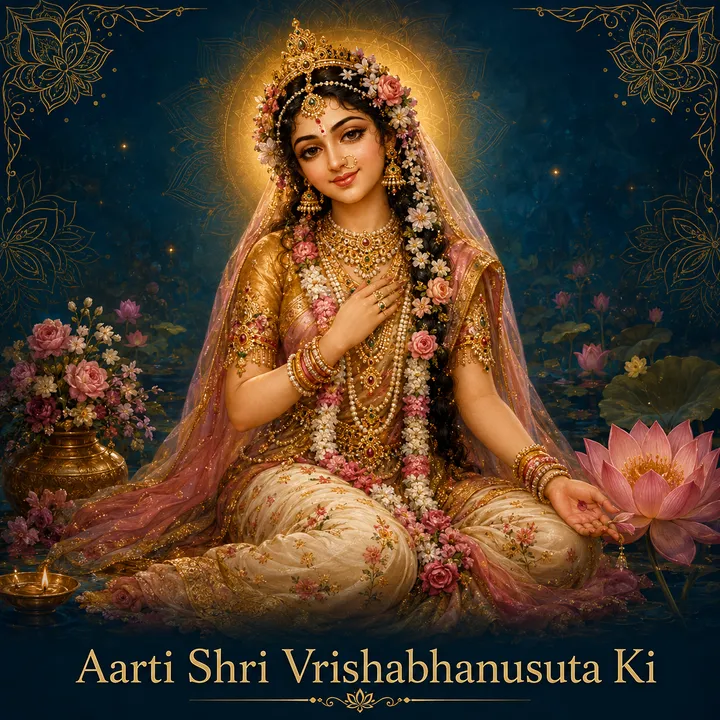
“Vrishabhanusuta” (वृषभानुसुता) is an epithet built from two parts: Vrishabhanu, the name of the Braj chieftain whom tradition holds to be Radha’s father, and suta, “daughter.” Vrishabhanusuta is thus simply “the daughter of Vrishabhanu” — one of a family of epithets for Radha built the same way, alongside the Radha Chalisa’s own “vṛṣabhānujā” and “vṛṣabhānu dulārī” (also “daughter of Vrishabhanu” and “beloved of Vrishabhanu”). Aarti Shri Vrishabhanusuta Ki takes this epithet as its opening address and repeats it as a refrain throughout.
Compared to longer Radha-Krishna devotional works like the forty-verse Radha Chalisa, this aarti is compact: a single refrain couplet — “आरती श्री वृषभानुसुता की, मंजुल मूर्ति मोहन ममता की” (“Arati to the daughter of Vrishabhanu, the enchanting image of Mohan’s tender love”) — followed by four short stanzas, each closed by the refrain repeating. Its language leans more Sanskritized than the everyday register of Braj Bhasha, favoring compound epithets — vivekavirāga vikāsini (“awakener of discernment and detachment”), jagajanani (“mother of the world”) — over narrative description. The stanzas move from Radha’s beauty and purifying grace, to her power to enchant even sages and her closeness with her companion Lalita, to her matchless worth in Krishna’s eyes, and finally to the Gaudiya Vaishnava reading of her identity as inseparable from Krishna’s own — “kṛṣṇātmikā, kṛṣṇa sahacāriṇi,” “one with Krishna, his constant companion” — closing on her standing as jagajanani, mother of the world.
Origin and source
This aarti’s authorship is not documented with confidence in the sources consulted for this page. Unlike Jai Ambe Gauri, which is traditionally credited to the 19th-century poet Pandit Shraddha Ram Phillauri, Aarti Shri Vrishabhanusuta Ki carries no attribution to a named composer across the devotional collections and aarti-sangraha pages where it circulates; it is treated here as an anonymous, traditional composition of the Braj Vaishnava devotional current rather than assigned to a specific author. Its vocabulary and concerns sit within the same Gaudiya Vaishnava frame as the Radha Chalisa — Radha as jagajanani, mother of the world, and as inseparable in essence from Krishna (“kṛṣṇātmikā”) — without repeating that text’s language directly.
This page’s text was checked against several sources circulating online. A cluster of pages — including BhaktiBharat.com, HinduismFAQ.com, and Bhaktilok.in — matches word for word, down to shared idiosyncratic formatting, which points to a common upstream source rather than separate witnesses. Two further pages, Drikpanchang.com and JourneyOfTemple.com, differ from that cluster and from each other in minor, independent ways — Drikpanchang renders two words with fuller Sanskrit orthography (“jagajjanani” with a doubled consonant and “duḥkhanivāriṇi” with a visarga, against the other sources’ “jagajanani” and “dukhanivāriṇi”) and lays out the refrain repetitions differently on the page — yet agree on every substantive word of all four stanzas and the refrain. That agreement across sources with visibly independent formatting and spelling choices, on a short text with no internal variation in content, is the basis for this page’s verbatim text; where sources diverged only in orthography, this page follows the more common spelling.
How it is recited
Aarti Shri Vrishabhanusuta Ki is sung as one of several aartis addressed to Radha, typically while a lit lamp or camphor flame is circled before her image, with the refrain taken up by everyone present after each stanza. It carries particular weight on Radhashtami, the festival marking Radha’s appearance, and in the devotional life of Barsana — the village tradition holds to be her childhood home — and the wider Braj region around Vrindavan, where it is offered alongside other Radha-Krishna devotional texts such as the Radha Chalisa as part of daily or festival worship.
Frequently asked questions
How many verses does Aarti Shri Vrishabhanusuta Ki have?
Who is Aarti Shri Vrishabhanusuta Ki dedicated to?
When is Aarti Shri Vrishabhanusuta Ki typically recited?
What language is Aarti Shri Vrishabhanusuta Ki composed in?
What tradition is Aarti Shri Vrishabhanusuta Ki associated with?
Is an English translation of Aarti Shri Vrishabhanusuta Ki available?
Is there a Roman transliteration of Aarti Shri Vrishabhanusuta Ki?
Sourcing
Checked against independent sources before publishing — see our sourcing and editorial policy. Spotted an error? Report an issue .