

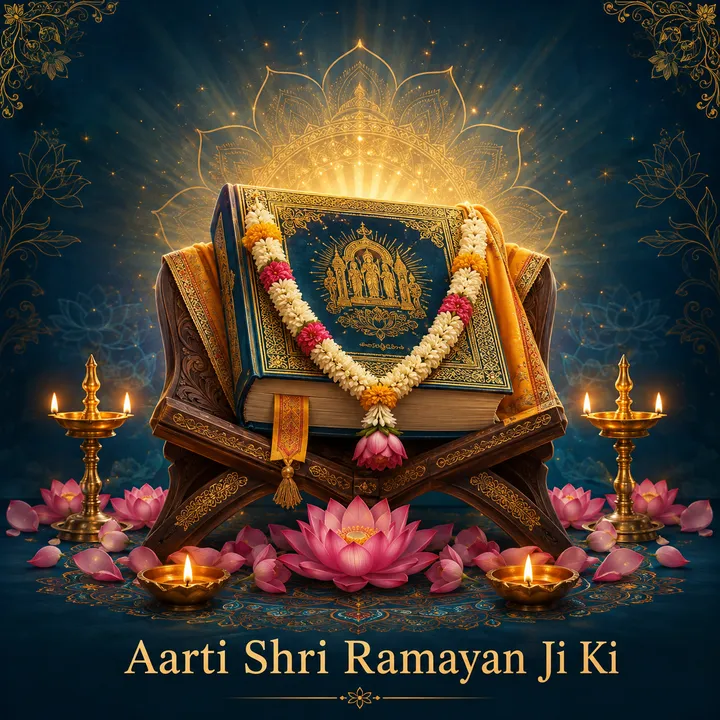
The text
Tap Recite along to follow verse by verse — use Next, or the arrow keys.
- Stanza 1 (refrain)
आरती श्री रामायण जी की।कीरति कलित ललित सिय पी की॥
āratī śrī rāmāyaṇa jī kī।kīrati kalita lalita siya pī kī॥
Aarti to the venerable Ramayan, whose lovely, radiant fame belongs to Siya-pi — Sita's beloved, Ram.
- Stanza 2
गावत ब्रहमादिक मुनि नारद।बाल्मीकि बिग्यान बिसारद॥शुक सनकादिक शेष अरु शारद।बरनि पवनसुत कीरति नीकी॥आरती श्री रामायण जी की।कीरति कलित ललित सिय पी की॥
gāvata brahamādika muni nārada।bālmīki bigyāna bisārada॥śuka sanakādika śeṣa aru śārada।barani pavanasuta kīrati nīkī॥āratī śrī rāmāyaṇa jī kī।kīrati kalita lalita siya pī kī॥
Sages headed by Brahma, and Narada, sing its praise, as does Valmiki, learned and skilled in wisdom; Shuka, the sage Sanaka and his brothers, Shesha, and Sharada all describe the fine fame of Hanuman, the son of the wind. Aarti to the venerable Ramayan, whose lovely, radiant fame belongs to Siya-pi.
- Stanza 3
गावत बेद पुरान अष्टदस।छओं शास्त्र सब ग्रंथन को रस॥मुनि जन धन संतान को सरबस।सार अंश सम्मत सब ही की॥आरती श्री रामायण जी की।कीरति कलित ललित सिय पी की॥
gāvata beda purāna aṣṭadasa।chhaoṃ śāstra saba granthana ko rasa॥muni jana dhana santāna ko sarabasa।sāra aṃśa sammata saba hī kī॥āratī śrī rāmāyaṇa jī kī।kīrati kalita lalita siya pī kī॥
The Vedas and the eighteen Puranas sing its praise, for it is the essence of all six shastras and every scripture; it is the whole wealth of sages, their followers, and their descendants — its essential portion is agreed upon by every text alike. Aarti to the venerable Ramayan, whose lovely, radiant fame belongs to Siya-pi.
- Stanza 4
गावत संतत शंभु भवानी।अरु घटसंभव मुनि बिग्यानी॥ब्यास आदि कबिबर्ज बखानी।कागभुशुंडि गरुड़ के ही की॥आरती श्री रामायण जी की।कीरति कलित ललित सिय पी की॥
gāvata santata śaṃbhu bhavānī।aru ghaṭasaṃbhava muni bigyānī॥byāsa ādi kabibarja bakhānī।kāgabhuśuṃḍi garuḍa ke hī kī॥āratī śrī rāmāyaṇa jī kī।kīrati kalita lalita siya pī kī॥
Shambhu and Bhavani sing it constantly, as does the wise sage born of a pitcher; Vyasa and the foremost poets have described it — it belongs equally to Kagbhushundi the crow-sage and to Garuda. Aarti to the venerable Ramayan, whose lovely, radiant fame belongs to Siya-pi.
- Stanza 5
कलिमल हरनि बिषय रस फीकी।सुभग सिंगार मुक्ति जुबती की॥दलनि रोग भव मूरि अमी की।तात मातु सब बिधि तुलसी की॥आरती श्री रामायण जी की।कीरति कलित ललित सिय पी की॥
kalimala harani biṣaya rasa phīkī।subhaga siṃgāra mukti jubatī kī॥dalani roga bhava mūri amī kī।tāta mātu saba bidhi tulasī kī॥āratī śrī rāmāyaṇa jī kī।kīrati kalita lalita siya pī kī॥
It removes the impurities of the Kali age and leaves the taste of worldly pleasures bland by comparison; it is the fair adornment of the maiden Liberation. It is the nectar-root remedy that destroys the disease of worldly existence — in every way, it is father and mother to Tulsi. Aarti to the venerable Ramayan, whose lovely, radiant fame belongs to Siya-pi.
Overview
Aarti Shri Ramayan Ji Ki is a five-stanza Awadhi aarti offered not to Ram directly, but to the Ramayan — the Ramcharitmanas — as a scripture in its own right. Where a personal-deity aarti describes a god’s form, weapons, and deeds, this one describes who reveres the text and what the text is: Brahma, Narada, Valmiki, Shuka, and Sharada are named as singing its praise; the Vedas, the eighteen Puranas, and the six shastras are said to find their essence in it; and its closing stanza credits it with removing the taint of the Kali age and being “father and mother” to Tulsi. Ram appears only by implication, as “Siya-pi” (Sita’s beloved) whose fame the text carries — the devotional center of gravity here is the book itself.
Origin and source
The aarti is closely tied to the Ramcharitmanas tradition of Goswami Tulsidas. Its fourth stanza names Kagbhushundi and Garuda — the crow-sage and the divine eagle whose dialogue frames the Uttar Kand of the Ramcharitmanas — and its final line calls the text “tata matu” (father and mother) specifically to Tulsi, anchoring the aarti to Tulsidas’s own retelling rather than to the Valmiki Ramayana in general.
How it is recited
This aarti is traditionally sung at the conclusion of a Ramcharitmanas path (a reading of the text, whether a single sitting or a multi-day Akhand Path), as a way of honoring the scripture just recited before the lamp is set down. It is also sung on Ram Navami and at other gatherings centered on the Ramcharitmanas, distinct from the aartis sung to Ram, Sita, or Hanuman as personal deities during the same occasions.
Frequently asked questions
How many verses does Aarti Shri Ramayan Ji Ki have?
Who is Aarti Shri Ramayan Ji Ki dedicated to?
When is Aarti Shri Ramayan Ji Ki typically recited?
What language is Aarti Shri Ramayan Ji Ki composed in?
What tradition is Aarti Shri Ramayan Ji Ki associated with?
Is an English translation of Aarti Shri Ramayan Ji Ki available?
Is there a Roman transliteration of Aarti Shri Ramayan Ji Ki?
Sourcing
Checked against independent sources before publishing — see our sourcing and editorial policy. Spotted an error? Report an issue .

