The text
Tap Recite along to follow verse by verse — use Next, or the arrow keys.
- Verse 1
आरती युगलकिशोर की कीजै।तन मन धन न्योछावर कीजै॥
āratī yugalakiśora kī kījai।tana mana dhana nyochāvara kījai॥
Let the aarti of Yugal Kishor, the youthful divine pair, be performed; let body, mind, and wealth be offered up to them.
- Verse 2
गौरश्याम मुख निरखन लीजै।हरि का रूप नयन भरि पीजै॥
gauraśyāma mukha nirakhana lījai।hari kā rūpa nayana bhari pījai॥
Let the fair and the dark faces be beheld; let the eyes drink their fill of Hari's form.
- Verse 3
रवि शशि कोटि बदन की शोभा।ताहि निरखि मेरो मन लोभा॥
ravi śaśi koṭi badana kī śobhā।tāhi nirakhi mero mana lobhā॥
Their countenance shines like millions of suns and moons together; beholding it, my mind is drawn to them.
- Verse 4
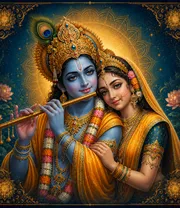
ओढ़े नील पीत पट सारी।कुंजबिहारी गिरिवरधारी॥
oṛhe nīla pīta paṭa sārī।kuñjabihārī girivaradhārī॥
Robed entirely in garments of blue and yellow — Kunj Bihari, the one who lifted the mountain.
- Verse 5
फूलन सेज फूल की माला।रत्न सिंहासन बैठे नंदलाला॥
phūlana seja phūla kī mālā।ratna siṃhāsana baiṭhe nandalālā॥
A bed of flowers, a garland of flowers; Nandalala is seated on a jeweled throne.
- Verse 6
कंचन थार कपूर की बाती।हरि आए निर्मल भई छाती॥
kañcana thāra kapūra kī bātī।hari āe nirmala bhaī chātī॥
A golden plate holds the camphor flame; as Hari arrives, the heart grows pure.
- Verse 7
श्री पुरुषोत्तम गिरिवरधारी।आरती करें सकल नर नारी॥
śrī puruṣottama girivaradhārī।āratī karẽ sakala nara nārī॥
Shri Purushottam, who lifted the mountain — all men and women perform his aarti.
- Verse 8 (bhanita)
नंदनंदन बृजभान किशोरी।परमानंद स्वामी अविचल जोरी॥
nandanandana brajabhāna kiśorī।paramānanda svāmī avicala jorī॥
The son of Nanda and the daughter of Brijbhan — Paramanand Swami calls them an eternal, unwavering pair.
Overview
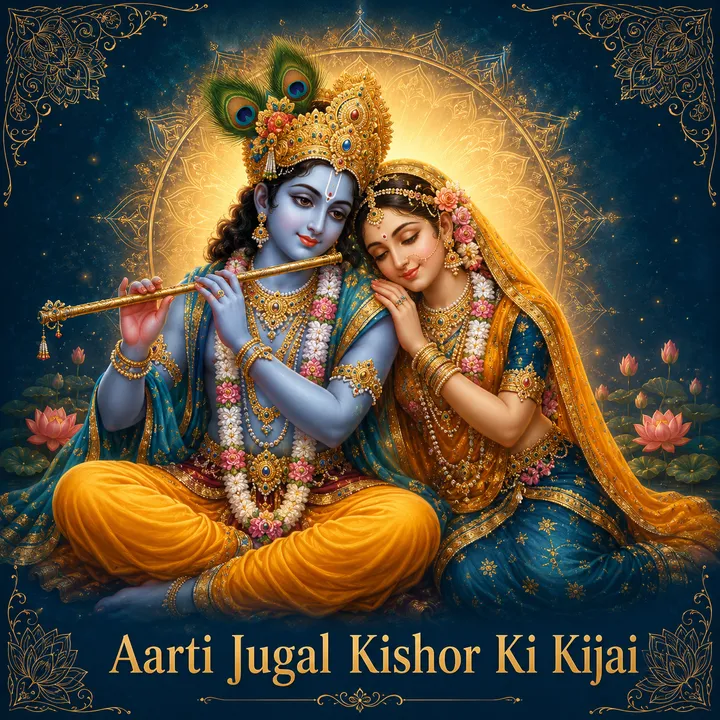
Jugal Kishor (जुगल किशोर, “the youthful pair”) is an epithet not for Krishna alone but for Radha and Krishna worshipped together as a single, inseparable pair — the same naming convention covered on the Radha-Krishna page. This aarti’s own verses confirm the paired reading directly: it addresses “गौरश्याम मुख” — the fair face and the dark face together (gaura for Radha’s fairness, śyāma for Krishna’s dark hue) — and its closing verse names “नंदनंदन बृजभान किशोरी,” Nanda’s son and Brijbhan’s (Vrishabhanu’s) daughter, as “अविचल जोरी,” an eternal, unwavering pair. Several individual verses do use Krishna-specific epithets on their own — Kunj Bihari, Girivardhari (the lifter of Govardhan), Nandalala, Purushottam — which is typical of aartis to the paired deity: Krishna’s own forms and deeds are described within a song that is, as a whole, addressed to the two of them together.
Origin and source
The aarti’s closing line carries a bhanita, a poet’s signature verse: “परमानंद स्वामी अविचल जोरी” names Paramanand (Das), one of the Ashtachhap, the eight poets associated with the Pushtimarg tradition founded by Vallabhacharya. A four-couplet pad opening “तन मन धन न्यौछावर कीजे” and closing on the same “नंद नंदन वृषभान किसोरी” signature is preserved in the edited critical volume Ashtachhap ke Kavi: Parmanand Das (ed. Hargulal, Publications Division, Ministry of Information and Broadcasting, Government of India, 2008, p. 57), which attributes it to Paramanand Das. The eight-couplet form given here — with its additional verses describing camphor and golden plate, the flower-strewn seat, and the pair’s blue-and-yellow garments — is the fuller aarti as it is widely sung today; these additional couplets are not present in that critical edition and appear to be later devotional accretions to the original pad, as is common for aartis that grew out of a shorter poem through generations of temple and household singing.
How it is recited
This aarti is sung before the murtis of Radha and Krishna installed together as a pair, in the Vrindavan style of worship described on the Radha-Krishna deity page — most visibly at temples that install the two as a matched pair rather than as a deity with an attending consort. As with most aartis, it is sung while a lit diya or camphor flame is circled before the image, the devotee’s own gaze moving between the two forms named in its verses.
Frequently asked questions
How many verses does Aarti Jugal Kishor Ki Kijai have?
Who is Aarti Jugal Kishor Ki Kijai dedicated to?
When is Aarti Jugal Kishor Ki Kijai typically recited?
What language is Aarti Jugal Kishor Ki Kijai composed in?
What tradition is Aarti Jugal Kishor Ki Kijai associated with?
Is an English translation of Aarti Jugal Kishor Ki Kijai available?
Is there a Roman transliteration of Aarti Jugal Kishor Ki Kijai?
Sourcing
Checked against independent sources before publishing — see our sourcing and editorial policy. Spotted an error? Report an issue .